International Journal of
Reproductive Biomedicine
Thu, Apr 2, 2026
[Archive]
Volume 24, Issue 2 (February 2026)
IJRM 2026, 24(2): 0-0 |
Back to browse issues page

Ethics code: IR.SSU.AEC.1401.027


Download citation:
BibTeX | RIS | EndNote | Medlars | ProCite | Reference Manager | RefWorks
Send citation to:


BibTeX | RIS | EndNote | Medlars | ProCite | Reference Manager | RefWorks
Send citation to:
Azizi Khareshki M, Hoseini Sharifabad M, Fesahat F, Talebi A, Hassanpour Dehnavi A. Therapeutic effects of Foeniculum vulgare and Achillea millefolium on ovarian function in a mouse model of polycystic ovary syndrome: An experimental study. IJRM 2026; 24 (2)
URL: http://ijrm.ir/article-1-3562-en.html
URL: http://ijrm.ir/article-1-3562-en.html
Mohadeseh Azizi Khareshki1 

 , Mohamad Hoseini Sharifabad1 , Farzaneh Fesahat2 , Alireza Talebi3 , Azam Hassanpour Dehnavi *4
, Mohamad Hoseini Sharifabad1 , Farzaneh Fesahat2 , Alireza Talebi3 , Azam Hassanpour Dehnavi *4
1- Department of Anatomical Sciences, School of Medicine, Shahid Sadoughi University of Medical Sciences, Yazd, Iran.
2- Reproductive Immunology Research Center, Shahid Sadoughi University of Medical Sciences, Yazd, Iran.
3- Research and Clinical Center for Infertility, Shahid Sadoughi University of Medical Sciences, Yazd, Iran.
4- Department of Anatomical Sciences, School of Medicine, Shahid Sadoughi University of Medical Sciences, Yazd, Iran. & Reproductive Immunology Research Center, Shahid Sadoughi University of Medical Sciences, Yazd, Iran. ,a.hassanpour@stu.ssu.ac.ir
2- Reproductive Immunology Research Center, Shahid Sadoughi University of Medical Sciences, Yazd, Iran.
3- Research and Clinical Center for Infertility, Shahid Sadoughi University of Medical Sciences, Yazd, Iran.
4- Department of Anatomical Sciences, School of Medicine, Shahid Sadoughi University of Medical Sciences, Yazd, Iran. & Reproductive Immunology Research Center, Shahid Sadoughi University of Medical Sciences, Yazd, Iran. ,
Abstract: (47 Views)
Background: Polycystic ovary syndrome (PCOS) is a common disorder in women of reproductive age, characterized by hormonal imbalances, ovarian dysfunction, and impaired folliculogenesis.
Objective: This study investigated the therapeutic effects of Foeniculum vulgare (fennel) and Achillea millefolium (yarrow) on ovarian histomorphology, gene expression, and hormonal levels in a mouse model of PCOS.
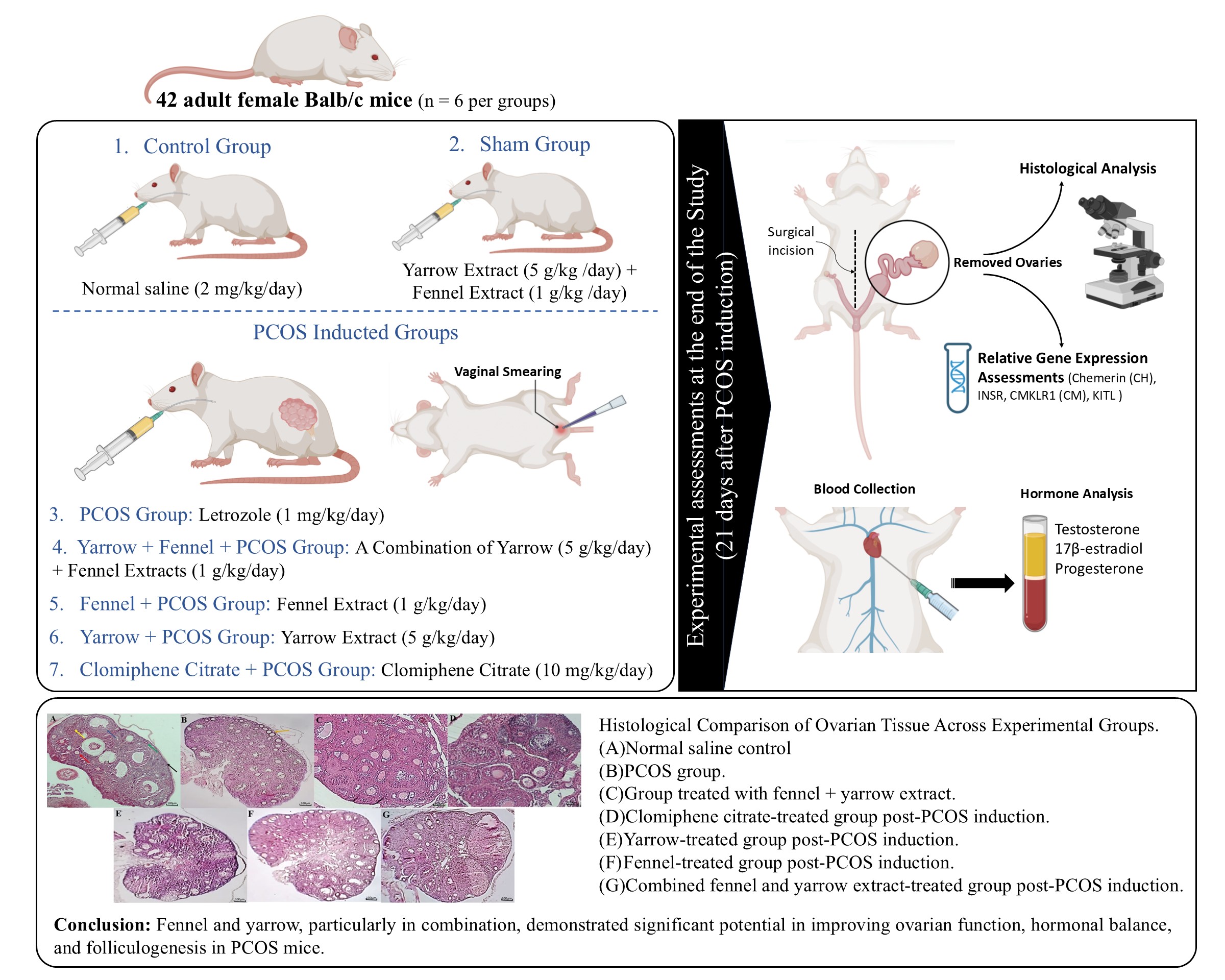
Materials and Methods: In this experimental study, 42 virgin adult female Balb/c mice (6-8 wk, 25 ± 5 gr) were randomly divided into 7 groups: control, fennel-yarrow, PCOS group, PCOS groups treated with fennel, PCOS groups treated with yarrow, fennel-yarrow combination, and clomiphene citrate. PCOS was induced using letrozole (1 mg/kg/day). Hormonal levels were analyzed using enzyme-linked immunosorbent assay. Histological analysis assessed follicular development, and molecular analysis evaluated the expression of insulin receptor, KIT ligand, chemerin, and chemokine-like receptor 1 genes.
Results: The PCOS group exhibited significantly lower estrogen (p = 0.001), progesterone (p = 0.001), and follicle counts (primary: p = 0.001, antral: p = 0.001) compared to controls. Testosterone levels were found to be elevated in the PCOS group (p = 0.001). Treatment with fennel-yarrow significantly increased estrogen (p = 0.001), progesterone (p = 0.002), and follicular counts while reducing testosterone levels (p = 0.001). Clomiphene citrate produced similar improvements in hormone levels and ovarian morphology. Gene expression analysis showed no significant changes in insulin receptor, KIT ligand, chemerin, and chemokine-like receptor 1 across groups.
Conclusion: Fennel and yarrow, particularly in combination, demonstrated significant potential in improving ovarian function, hormonal balance, and folliculogenesis in PCOS mice. These findings suggest fennel and yarrow as promising complementary therapies for PCOS management.
Objective: This study investigated the therapeutic effects of Foeniculum vulgare (fennel) and Achillea millefolium (yarrow) on ovarian histomorphology, gene expression, and hormonal levels in a mouse model of PCOS.
Materials and Methods: In this experimental study, 42 virgin adult female Balb/c mice (6-8 wk, 25 ± 5 gr) were randomly divided into 7 groups: control, fennel-yarrow, PCOS group, PCOS groups treated with fennel, PCOS groups treated with yarrow, fennel-yarrow combination, and clomiphene citrate. PCOS was induced using letrozole (1 mg/kg/day). Hormonal levels were analyzed using enzyme-linked immunosorbent assay. Histological analysis assessed follicular development, and molecular analysis evaluated the expression of insulin receptor, KIT ligand, chemerin, and chemokine-like receptor 1 genes.
Results: The PCOS group exhibited significantly lower estrogen (p = 0.001), progesterone (p = 0.001), and follicle counts (primary: p = 0.001, antral: p = 0.001) compared to controls. Testosterone levels were found to be elevated in the PCOS group (p = 0.001). Treatment with fennel-yarrow significantly increased estrogen (p = 0.001), progesterone (p = 0.002), and follicular counts while reducing testosterone levels (p = 0.001). Clomiphene citrate produced similar improvements in hormone levels and ovarian morphology. Gene expression analysis showed no significant changes in insulin receptor, KIT ligand, chemerin, and chemokine-like receptor 1 across groups.
Conclusion: Fennel and yarrow, particularly in combination, demonstrated significant potential in improving ovarian function, hormonal balance, and folliculogenesis in PCOS mice. These findings suggest fennel and yarrow as promising complementary therapies for PCOS management.
Type of Study: Original Article |
Subject:
Reproductive Pattology
Send email to the article author
| Rights and permissions | |
 |
This work is licensed under a Creative Commons Attribution-NonCommercial 4.0 International License. |