International Journal of
Reproductive Biomedicine
Tue, Sep 29, 2026
[Archive]
Volume 24, Issue 5 (May 2026)
IJRM 2026, 24(5): 383-390 |
Back to browse issues page




Download citation:
BibTeX | RIS | EndNote | Medlars | ProCite | Reference Manager | RefWorks
Send citation to:


BibTeX | RIS | EndNote | Medlars | ProCite | Reference Manager | RefWorks
Send citation to:
Vahidi Mehrjardi S, Vahidi S, Izadi M. Attitudes toward abortion in the three Abrahamic religions of Judaism, Christianity, and Islam: A narrative review. IJRM 2026; 24 (5) :383-390
URL: http://ijrm.ir/article-1-3582-en.html
URL: http://ijrm.ir/article-1-3582-en.html


1- Department of Philosophy, Meybod University, Meybod, Iran.
2- Andrology Research Center, Yazd Reproductive Sciences Institute, Shahid Sadoughi University of Medical Sciences, Yazd, Iran.
3- Andrology Research Center, Yazd Reproductive Sciences Institute, Shahid Sadoughi University of Medical Sciences, Yazd, Iran. & Research and Clinical Center for Infertility, Yazd Reproductive Sciences Institute, Shahid Sadoughi University of Medical Sciences, Yazd, Iran. ,mizadi890112@gmail.com; M.izadi@ssu.ac.ir
2- Andrology Research Center, Yazd Reproductive Sciences Institute, Shahid Sadoughi University of Medical Sciences, Yazd, Iran.
3- Andrology Research Center, Yazd Reproductive Sciences Institute, Shahid Sadoughi University of Medical Sciences, Yazd, Iran. & Research and Clinical Center for Infertility, Yazd Reproductive Sciences Institute, Shahid Sadoughi University of Medical Sciences, Yazd, Iran. ,
Full-Text [PDF 389 kb]
(483 Downloads)
| Abstract (HTML) (578 Views)
Full-Text: (112 Views)
1. Introduction
Terminating a pregnancy before the unborn child is capable of surviving outside the uterus is known as an abortion. The exact age at which a fetus is considered viable is a topic of disagreement. When determining the baseline between an abortion and an early delivery, many obstetricians use either 21 wk or 400-500 gr birth weight. Various religions have a similar definition for abortion, so that the removal of an embryo in each step is recognized as a crime. However, in some cases, abortion has been permitted by the religious Theologians. The scholars address the issue by defining abortion as the removal of all (complete) or any part (incomplete) of the placenta or membranes, with or without an abortus, prior to the 20th wk (before 134 days) of pregnancy. Abortion that takes place before the 12th wk of pregnancy (84 days) is referred to as an early abortion; abortion that occurs after the 12th wk but before the commencement of the 20th wk of gestation (85-134 days) is known as a late abortion (1). Abortion is one of the most important issues in the law and divine legislative system. Special attention has been given to legal and religious systems since ancient times because religious systems are worth a lot to the human spirit and life. Therefore, embryos and abortions also have a special place in these systems (2). Studies have shown that even in nations with relatively liberal abortion laws, post abortion distress can be induced or reinforced by social gatekeepers (3). This issue has long existed in the Abrahamic religions and has been considered an illegitimate and unethical act in many cases. Abrahamic religions were in charge of the ethical guidance of the community before the 18th century; however, with the advent of modernity and changing social, cultural, and economic conditions, the function of religions were dimmed, and ethical schools undertook this very important task. Nevertheless, the role of religion is still undeniable in societies.
This narrative review aims to elucidate and compare the theological and ethical perspectives on abortion within Judaism, Christianity, and Islam, focusing on their principles, permissible conditions, and practical implications. The primary research question is, how do the Abrahamic religions reconcile the sanctity of fetal life with maternal health and other exceptional circumstances in their rulings on abortion? Sub-questions include: 1) what theological principles (rodef in Judaism, double effect in Christianity, and Darura in Islam) guide abortion decisions in each religion? 2) under what specific conditions is abortion permitted, and how do these conditions differ across the 3 faiths? 3) how do these religious perspectives inform modern bioethical and legal practices? This study aims to help discussions in bioethics, reproductive health, and religious studies by providing insights into how these faiths agree and differ in dealing with complicated ethical issues.
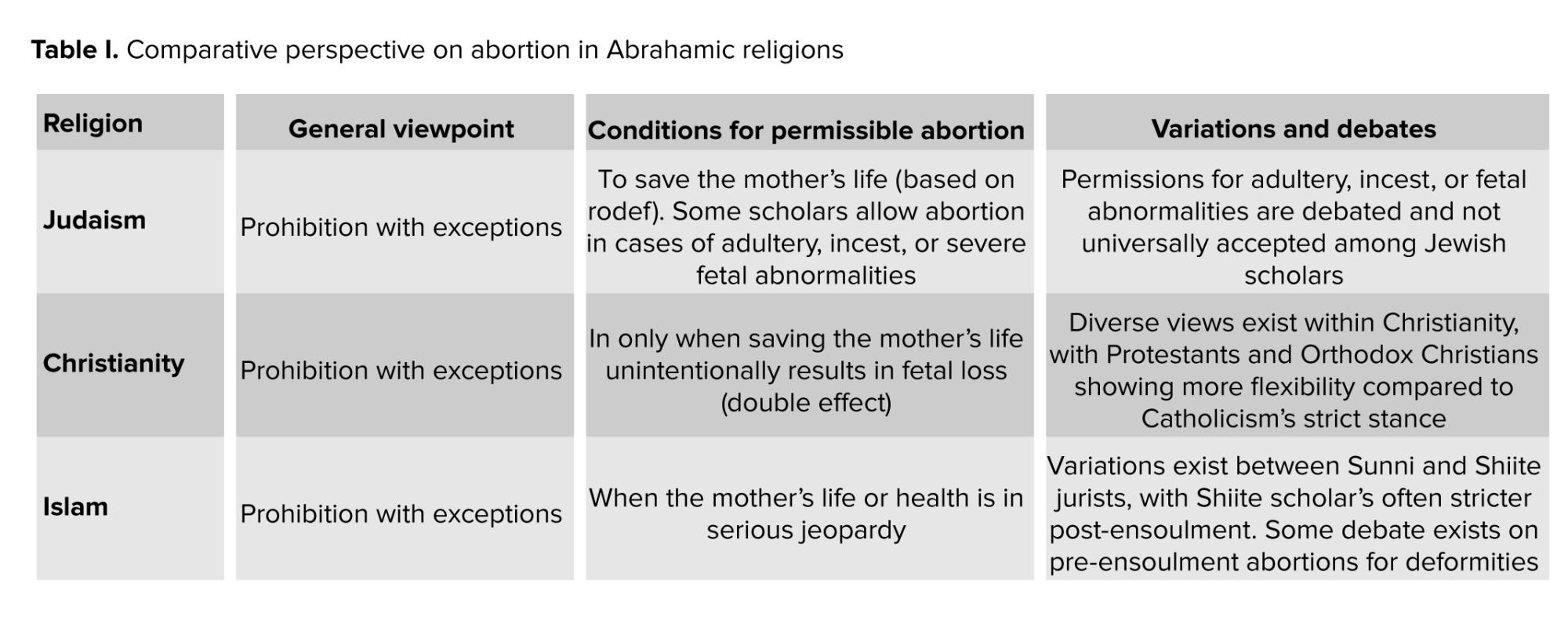
Abortion can occur spontaneously (miscarriage) or be induced, with various factors influencing its occurrence (4). Induced abortion may be performed for medical, legal, or personal reasons, while restricted by some social and religious rules (5). There are 2 types of religious restrictions on abortion. Some abortions are limited to reasons for abortion, while others are limited to the timing of the pregnancy (1) (Table I).
2. Abortion viewpoints
2.1. Judaism
In the Torah and Talmud, the main sources of Jewish religion, do not mention intentional abortion or prohibit it without prescribed retaliatory punishment. Permissible abortion in the legal discussions of this book is considered in some cases. Difficulty during childbirth, life threat, and if the fetus is still in the uterus, the mother's life must be saved by abortion; nevertheless, if the cranial structure or a significant portion of the fetus has been extricated from the uterine cavity, the termination of the pregnancy is no longer permissible. This is due to the existence of 2 distinct viable entities, thereby rendering it untenable to assert that the mother’s life holds greater intrinsic value than that of the neonate. Some Jewish sources state that abortion is permissible if it is necessary for the mother's treatment, and this ruling even includes cases where the fetus itself is not the direct source of the mother's illness and does not threaten the mother's death. Pregnancy through adultery is also permission for abortion, but if an unmarried girl becomes pregnant in this way, it is not permissible to abort her fetus (6). The time of pregnancy, ages of embryo or fetus, and the matter of the soul entering are not considered for permission of abortion in Jewish religion (7).
In accordance with the concept of rodef, abortion can be done to preserve the mother's life. At the same time, certain scholars also permit it for pregnancies caused by adultery or possible birth defects (7). Also, according to the Talmud, if the life of a woman is in danger during childbirth, we should save her life by aborting her fetus (6). In addition, if a large part of the embryo or its head is getting out, then the mother can abort it to save her own life (8). Some Talmud laws indicate that abortion is only allowed when the mother's condition is directly related to the pregnancy (9). Although opposed to this opinion, abortion is allowed to relieve the mother's discomfort and illness for any reason (10).
There are different opinions among Jewish scholars about abortion due to pregnancy resulting from adultery. They allow abortion caused by incest or adulterous intercourse (10). In addition, if a woman becomes pregnant through adultery and they want to execute her, abortion is permitted, unless the delivery has begun. A detailed description of this is contained in some treatise of Talmud (11).
To distinguish between different types of necessity for abortion, Jewish bioethicists developed 4 categories of illnesses. The first is "discomfort", which includes mild rashes and coughs. The irritating coughs and headaches that are severe but not severe enough to necessitate bed rest fall under the next category, "minor illness". The third group consists of patients who "are severely but not fatally ill" and/or whose "limbs but not lives are in danger". Illnesses that require preventative care or that keep patients hospitalized fall under this category. The fourth category is "a potentially fatal condition". Each of these groups has different restrictions on when and what types of conventional prohibitions are permissible (12). This is because a mother falls into the fourth category if her pregnancy is causing a "fatal" illness, in which case everything must be done to save her life, including breaking a Torah command. The person in charge of the woman's health is guilty of murder if this is not done, as it is a far more serious offense than abortion, which is not murder in Jewish law (13). Abortion among Iranian Jews is criticized after 40 days since embryo formation in Iran, but only with the danger to the mother's life and the approval of a doctor who believes in the principles of the Jewish religion, does abortion occur, and even the child's disability does not allow abortion (1).
2.2. Christianity
Terminating a pregnancy before the unborn child is capable of surviving outside the uterus is known as an abortion. The exact age at which a fetus is considered viable is a topic of disagreement. When determining the baseline between an abortion and an early delivery, many obstetricians use either 21 wk or 400-500 gr birth weight. Various religions have a similar definition for abortion, so that the removal of an embryo in each step is recognized as a crime. However, in some cases, abortion has been permitted by the religious Theologians. The scholars address the issue by defining abortion as the removal of all (complete) or any part (incomplete) of the placenta or membranes, with or without an abortus, prior to the 20th wk (before 134 days) of pregnancy. Abortion that takes place before the 12th wk of pregnancy (84 days) is referred to as an early abortion; abortion that occurs after the 12th wk but before the commencement of the 20th wk of gestation (85-134 days) is known as a late abortion (1). Abortion is one of the most important issues in the law and divine legislative system. Special attention has been given to legal and religious systems since ancient times because religious systems are worth a lot to the human spirit and life. Therefore, embryos and abortions also have a special place in these systems (2). Studies have shown that even in nations with relatively liberal abortion laws, post abortion distress can be induced or reinforced by social gatekeepers (3). This issue has long existed in the Abrahamic religions and has been considered an illegitimate and unethical act in many cases. Abrahamic religions were in charge of the ethical guidance of the community before the 18th century; however, with the advent of modernity and changing social, cultural, and economic conditions, the function of religions were dimmed, and ethical schools undertook this very important task. Nevertheless, the role of religion is still undeniable in societies.
This narrative review aims to elucidate and compare the theological and ethical perspectives on abortion within Judaism, Christianity, and Islam, focusing on their principles, permissible conditions, and practical implications. The primary research question is, how do the Abrahamic religions reconcile the sanctity of fetal life with maternal health and other exceptional circumstances in their rulings on abortion? Sub-questions include: 1) what theological principles (rodef in Judaism, double effect in Christianity, and Darura in Islam) guide abortion decisions in each religion? 2) under what specific conditions is abortion permitted, and how do these conditions differ across the 3 faiths? 3) how do these religious perspectives inform modern bioethical and legal practices? This study aims to help discussions in bioethics, reproductive health, and religious studies by providing insights into how these faiths agree and differ in dealing with complicated ethical issues.
Abortion can occur spontaneously (miscarriage) or be induced, with various factors influencing its occurrence (4). Induced abortion may be performed for medical, legal, or personal reasons, while restricted by some social and religious rules (5). There are 2 types of religious restrictions on abortion. Some abortions are limited to reasons for abortion, while others are limited to the timing of the pregnancy (1) (Table I).
2. Abortion viewpoints
2.1. Judaism
In the Torah and Talmud, the main sources of Jewish religion, do not mention intentional abortion or prohibit it without prescribed retaliatory punishment. Permissible abortion in the legal discussions of this book is considered in some cases. Difficulty during childbirth, life threat, and if the fetus is still in the uterus, the mother's life must be saved by abortion; nevertheless, if the cranial structure or a significant portion of the fetus has been extricated from the uterine cavity, the termination of the pregnancy is no longer permissible. This is due to the existence of 2 distinct viable entities, thereby rendering it untenable to assert that the mother’s life holds greater intrinsic value than that of the neonate. Some Jewish sources state that abortion is permissible if it is necessary for the mother's treatment, and this ruling even includes cases where the fetus itself is not the direct source of the mother's illness and does not threaten the mother's death. Pregnancy through adultery is also permission for abortion, but if an unmarried girl becomes pregnant in this way, it is not permissible to abort her fetus (6). The time of pregnancy, ages of embryo or fetus, and the matter of the soul entering are not considered for permission of abortion in Jewish religion (7).
In accordance with the concept of rodef, abortion can be done to preserve the mother's life. At the same time, certain scholars also permit it for pregnancies caused by adultery or possible birth defects (7). Also, according to the Talmud, if the life of a woman is in danger during childbirth, we should save her life by aborting her fetus (6). In addition, if a large part of the embryo or its head is getting out, then the mother can abort it to save her own life (8). Some Talmud laws indicate that abortion is only allowed when the mother's condition is directly related to the pregnancy (9). Although opposed to this opinion, abortion is allowed to relieve the mother's discomfort and illness for any reason (10).
There are different opinions among Jewish scholars about abortion due to pregnancy resulting from adultery. They allow abortion caused by incest or adulterous intercourse (10). In addition, if a woman becomes pregnant through adultery and they want to execute her, abortion is permitted, unless the delivery has begun. A detailed description of this is contained in some treatise of Talmud (11).
To distinguish between different types of necessity for abortion, Jewish bioethicists developed 4 categories of illnesses. The first is "discomfort", which includes mild rashes and coughs. The irritating coughs and headaches that are severe but not severe enough to necessitate bed rest fall under the next category, "minor illness". The third group consists of patients who "are severely but not fatally ill" and/or whose "limbs but not lives are in danger". Illnesses that require preventative care or that keep patients hospitalized fall under this category. The fourth category is "a potentially fatal condition". Each of these groups has different restrictions on when and what types of conventional prohibitions are permissible (12). This is because a mother falls into the fourth category if her pregnancy is causing a "fatal" illness, in which case everything must be done to save her life, including breaking a Torah command. The person in charge of the woman's health is guilty of murder if this is not done, as it is a far more serious offense than abortion, which is not murder in Jewish law (13). Abortion among Iranian Jews is criticized after 40 days since embryo formation in Iran, but only with the danger to the mother's life and the approval of a doctor who believes in the principles of the Jewish religion, does abortion occur, and even the child's disability does not allow abortion (1).
2.2. Christianity
The Christian law interprets issues related to law and religion from an ethical perspective. Based on the ethical approach, there has never been a consistent position on abortion among Christian denominations, and opinions have changed over time (14-16). Although abortion was condemned in early Christian texts such as the Didache, some scholars contended that it might be acceptable prior to ensoulment. In the 19th century, the Catholic Church officially rejected this notion, outlawing all abortions and punishing offenders with excommunication. Nonetheless, life-saving operations that might unintentionally result in fetal death are permitted by the "double effect" principle. Because they see the fetus as a potential human being, many Protestants and Orthodox Christians may defend abortion under specific conditions. When the mother's life is in danger, some feminist theologians advocate for the right to an abortion (16). The 20th century noticed a rise in the abortion debate, with progressive Christians supporting reproductive justice and conservative Christians opposing it on the basis of their interpretations of biblical prohibitions against murder (16, 17).
There has never been a consistent agreement among Christian scholars regarding abortion. Although abortion was discriminated against in early Christian doctrine, the Bible and influential biblical scholars such as Augustine and Aquinas said very little about it. Some Christian philosophers oppose abortion on philosophical grounds, arguing that a human being of entirely moral worth exists from conception (18). Due to historical, social, and political influences, the abortion debate is still complicated in Christian thought (16).
2.3. Islam
There has never been a consistent agreement among Christian scholars regarding abortion. Although abortion was discriminated against in early Christian doctrine, the Bible and influential biblical scholars such as Augustine and Aquinas said very little about it. Some Christian philosophers oppose abortion on philosophical grounds, arguing that a human being of entirely moral worth exists from conception (18). Due to historical, social, and political influences, the abortion debate is still complicated in Christian thought (16).
2.3. Islam
Islamic perspectives generally prohibit abortion (Quran [17: 31-32]), with an exception that does not include in the Quran, means in certain situations where the mother's life or health is in serious jeopardy. Some jurisprudential sources allow abortion prior to ensoulment (19), which is anticipated to occur 40 or 120 days after conception, especially in cases where the fetus has serious defects (20). Maqasid Shariah, the principle of preserving life, is of utmost importance and permits abortion when it satisfies the Darura (necessity) criteria (13). Iran's therapeutic abortion behavior demonstrates how Islamic jurisprudence is adaptable in handling new problems. In order to support moral decision-making and the creation of policies, there is a need for more education on reproductive health in Islamic contexts, as well as the integration of religious law with medical practice (21). Therefore, abortion has a special place in Islamic jurisprudence, and Islamic scholars and religious jurists have discussed it with special elegance. The embryo has 2 kinds in Islamic jurisprudence: an embryo that has a human spirit and an embryo lacking in spirit. Many religious experts believe that a fetus does not exist without a soul because sperm and egg cells are alive before fertilization, so the fetus is alive from the very beginning of its formation, even before the mother feels the fetus move in the womb (22). The primary argument of the present study is that the intended purpose of the Islamic jurists and scholars is not absolute, but human life, which is the blowing (divine breathing) of the spirit to the body, and blowing (Nafkh) means the life that permeates or transmigrates to the body. “After I created him and formed him as a human being and breathed into him a spirit from my presence, then you all bow down before him”. Therefore, the spirit is a special thing for man, which distinguishes him from other beings.
The abortion prohibition can be deduced after investigating the sum of Hadiths and verses of the Holy Quran. By examining these valuable resources, we find that the human life in the fetus appears after 4 months, which means an embryo has a spirit in its 5th month of embryonic life (23). The views of Islam on abortion are extracted from the Quran, hadiths, narrations of the Imams and the Prophet of Islam, and the fatwas of religious scholars are stated here. In general, abortion is prohibited in sources related to the Prophet and Imams. Even in situations where the fetus is formed through adultery, it is emphasized that the fetus must be born, and then the mother is punished. With the advancement of science and the diagnosis of fetal disorders and diseases, jurists allowed abortion in any situation (before and after the soul is breathed in) if the continuation of the pregnancy would cause the death of the mother or a serious threat to the fetus and mother.
Abortion is generally prohibited by Shiite scholars, particularly after ensoulment, which happens at about 4 months of pregnancy. Nonetheless, there are exceptions made in cases where the mother's life is in jeopardy or she is dealing with unbearable challenges (1). Some academics are re-evaluating the ban in cases of severe fetal deformities in light of recent developments. A law permitting therapeutic abortions before 16 wk of gestation under certain conditions was passed in Iran in 2003. Defective fetuses are the main selection criteria for Shiite sources, which allow fetal reduction prior to ensoulment in emergencies involving multifetal pregnancies (24). Shiite scholars generally agree that abortion is prohibited unless there are strong medical reasons to protect the mother's life or health. However, some Islamic scholars permit it while others forbid it (14). Abortion is permitted from a Shiite scholarly perspective in cases such as when the fetus dies in utero or poses a threat to the mother's life. Controversy arises regarding fetuses with human life, with notable Shiite jurisprudent Sahib Javahir opposing abortion. Sunni scholars largely align with this view. In cases where the embryo lacks human life and endangers the mother's health or results in severe hardships post-birth, abortion is allowed. Abortions may also be permissible in situations of non-viable tissue or fetuses resulting from adultery without the woman's consent (12).
3. Conclusion
One ethical subject with important religious consequences is abortion and examining how each religion handles the question of omitting one life to save another offers a helpful example of their bioethical discussion. The idea of a rodef is used in Jewish halacha to permit abortion if the doctor determines that the mother's life is at risk due to the fetus. Catholic moral theology places the sanctity of life more than anything else, abortion is only permitted under the theory of "double effect" in cases where it is an unintended outcome of a procedure that is required to preserve the mother's life. Since maintaining life is one of the 5 maqāṣid, or higher goals of the law, according to Islamic sharia, abortion can be performed to save the mother's life even after 120 days of pregnancy by applying the concept of necessity, which permits the forbidden. Therefore, in the present investigation of abortion, in each religion, it is understood when a life can be taken to save another life, and also that each religious group has provided moral and legal solutions to handle these types of situations.
3.1. Limitations and future directions
The present study has certain limitations that should be acknowledged. The study primarily relies on secondary sources, with limited access to some texts, which may restrict the depth of analysis. Additionally, the absence of statistical or empirical data analysis, inherent to the narrative review methodology, limits the ability to quantify or systematically compare perspectives across the 3 Abrahamic religions. Future research could address these gaps by incorporating primary religious texts and engaging with contemporary fatwas or rulings to provide a more comprehensive analysis. Furthermore, exploring the influence of modern socio-cultural factors on religious perspectives regarding abortion or conducting a systematic review with meta-analysis could enhance the robustness and applicability of findings in bioethics and reproductive health studies.
Data Availability
This is a review study, and detailed information about the sources is provided in the references section of the article.
Author Contributions
Sh. Vahidi Mehrjardi, designed the study and conducted the research. S. Vahidi and M. Izadi evaluated and reviewed the study and revised the manuscript. All authors approved the final manuscript and take responsibility for the integrity of the information.
Acknowledgements
The authors acknowledge that almost 15% of the manuscript preparation (grammar check and Citation Generator) involved the use of artificial intelligence tools (Quill Bot).
Conflict of Interest
The authors declare that there is no conflict of interest.
The abortion prohibition can be deduced after investigating the sum of Hadiths and verses of the Holy Quran. By examining these valuable resources, we find that the human life in the fetus appears after 4 months, which means an embryo has a spirit in its 5th month of embryonic life (23). The views of Islam on abortion are extracted from the Quran, hadiths, narrations of the Imams and the Prophet of Islam, and the fatwas of religious scholars are stated here. In general, abortion is prohibited in sources related to the Prophet and Imams. Even in situations where the fetus is formed through adultery, it is emphasized that the fetus must be born, and then the mother is punished. With the advancement of science and the diagnosis of fetal disorders and diseases, jurists allowed abortion in any situation (before and after the soul is breathed in) if the continuation of the pregnancy would cause the death of the mother or a serious threat to the fetus and mother.
Abortion is generally prohibited by Shiite scholars, particularly after ensoulment, which happens at about 4 months of pregnancy. Nonetheless, there are exceptions made in cases where the mother's life is in jeopardy or she is dealing with unbearable challenges (1). Some academics are re-evaluating the ban in cases of severe fetal deformities in light of recent developments. A law permitting therapeutic abortions before 16 wk of gestation under certain conditions was passed in Iran in 2003. Defective fetuses are the main selection criteria for Shiite sources, which allow fetal reduction prior to ensoulment in emergencies involving multifetal pregnancies (24). Shiite scholars generally agree that abortion is prohibited unless there are strong medical reasons to protect the mother's life or health. However, some Islamic scholars permit it while others forbid it (14). Abortion is permitted from a Shiite scholarly perspective in cases such as when the fetus dies in utero or poses a threat to the mother's life. Controversy arises regarding fetuses with human life, with notable Shiite jurisprudent Sahib Javahir opposing abortion. Sunni scholars largely align with this view. In cases where the embryo lacks human life and endangers the mother's health or results in severe hardships post-birth, abortion is allowed. Abortions may also be permissible in situations of non-viable tissue or fetuses resulting from adultery without the woman's consent (12).
3. Conclusion
One ethical subject with important religious consequences is abortion and examining how each religion handles the question of omitting one life to save another offers a helpful example of their bioethical discussion. The idea of a rodef is used in Jewish halacha to permit abortion if the doctor determines that the mother's life is at risk due to the fetus. Catholic moral theology places the sanctity of life more than anything else, abortion is only permitted under the theory of "double effect" in cases where it is an unintended outcome of a procedure that is required to preserve the mother's life. Since maintaining life is one of the 5 maqāṣid, or higher goals of the law, according to Islamic sharia, abortion can be performed to save the mother's life even after 120 days of pregnancy by applying the concept of necessity, which permits the forbidden. Therefore, in the present investigation of abortion, in each religion, it is understood when a life can be taken to save another life, and also that each religious group has provided moral and legal solutions to handle these types of situations.
3.1. Limitations and future directions
The present study has certain limitations that should be acknowledged. The study primarily relies on secondary sources, with limited access to some texts, which may restrict the depth of analysis. Additionally, the absence of statistical or empirical data analysis, inherent to the narrative review methodology, limits the ability to quantify or systematically compare perspectives across the 3 Abrahamic religions. Future research could address these gaps by incorporating primary religious texts and engaging with contemporary fatwas or rulings to provide a more comprehensive analysis. Furthermore, exploring the influence of modern socio-cultural factors on religious perspectives regarding abortion or conducting a systematic review with meta-analysis could enhance the robustness and applicability of findings in bioethics and reproductive health studies.
Data Availability
This is a review study, and detailed information about the sources is provided in the references section of the article.
Author Contributions
Sh. Vahidi Mehrjardi, designed the study and conducted the research. S. Vahidi and M. Izadi evaluated and reviewed the study and revised the manuscript. All authors approved the final manuscript and take responsibility for the integrity of the information.
Acknowledgements
The authors acknowledge that almost 15% of the manuscript preparation (grammar check and Citation Generator) involved the use of artificial intelligence tools (Quill Bot).
Conflict of Interest
The authors declare that there is no conflict of interest.
Type of Study: Review Article |
Subject:
Medical Ethics in Reproductive Sciences
Send email to the article author
| Rights and permissions | |
 |
This work is licensed under a Creative Commons Attribution-NonCommercial 4.0 International License. |