International Journal of
Reproductive Biomedicine
Tue, Oct 13, 2026
[Archive]
Volume 24, Issue 1 (January 2026)
IJRM 2026, 24(1): 37-44 |
Back to browse issues page



Ethics code: IR.ACECR.ROYAN.REC.1403.044


Download citation:
BibTeX | RIS | EndNote | Medlars | ProCite | Reference Manager | RefWorks
Send citation to:


BibTeX | RIS | EndNote | Medlars | ProCite | Reference Manager | RefWorks
Send citation to:
Babaei M, Sadighi Gilani M A, Ramezani-Binabaj M, Arasteh H, Yahyazadeh S R. Outcomes of microdissection testicular sperm extraction in azoospermic men following chemotherapy: A cross-sectional study. IJRM 2026; 24 (1) :37-44
URL: http://ijrm.ir/article-1-3635-en.html
URL: http://ijrm.ir/article-1-3635-en.html
Mehdi Babaei1 

 , Mohammad Ali Sadighi Gilani1 , Mahdi Ramezani-Binabaj *2 , Hamid Arasteh1 , Seyed Reza Yahyazadeh3
, Mohammad Ali Sadighi Gilani1 , Mahdi Ramezani-Binabaj *2 , Hamid Arasteh1 , Seyed Reza Yahyazadeh3
1- Department of Andrology, Reproductive Biomedicine Research Center, Royan Institute for Reproductive Biomedicine, Tehran, Iran. & Department of Urology, Shariati Hospital, Faculty of Medicine, Tehran University of Medical Sciences, Tehran, Iran.
2- Department of Urology, Shariati Hospital, Faculty of Medicine, Tehran University of Medical Sciences, Tehran, Iran. ,m-ramezanib@razi.tums.ac.ir
3- Department of Urology, Shariati Hospital, Faculty of Medicine, Tehran University of Medical Sciences, Tehran, Iran.
2- Department of Urology, Shariati Hospital, Faculty of Medicine, Tehran University of Medical Sciences, Tehran, Iran. ,
3- Department of Urology, Shariati Hospital, Faculty of Medicine, Tehran University of Medical Sciences, Tehran, Iran.
Abstract: (754 Views)
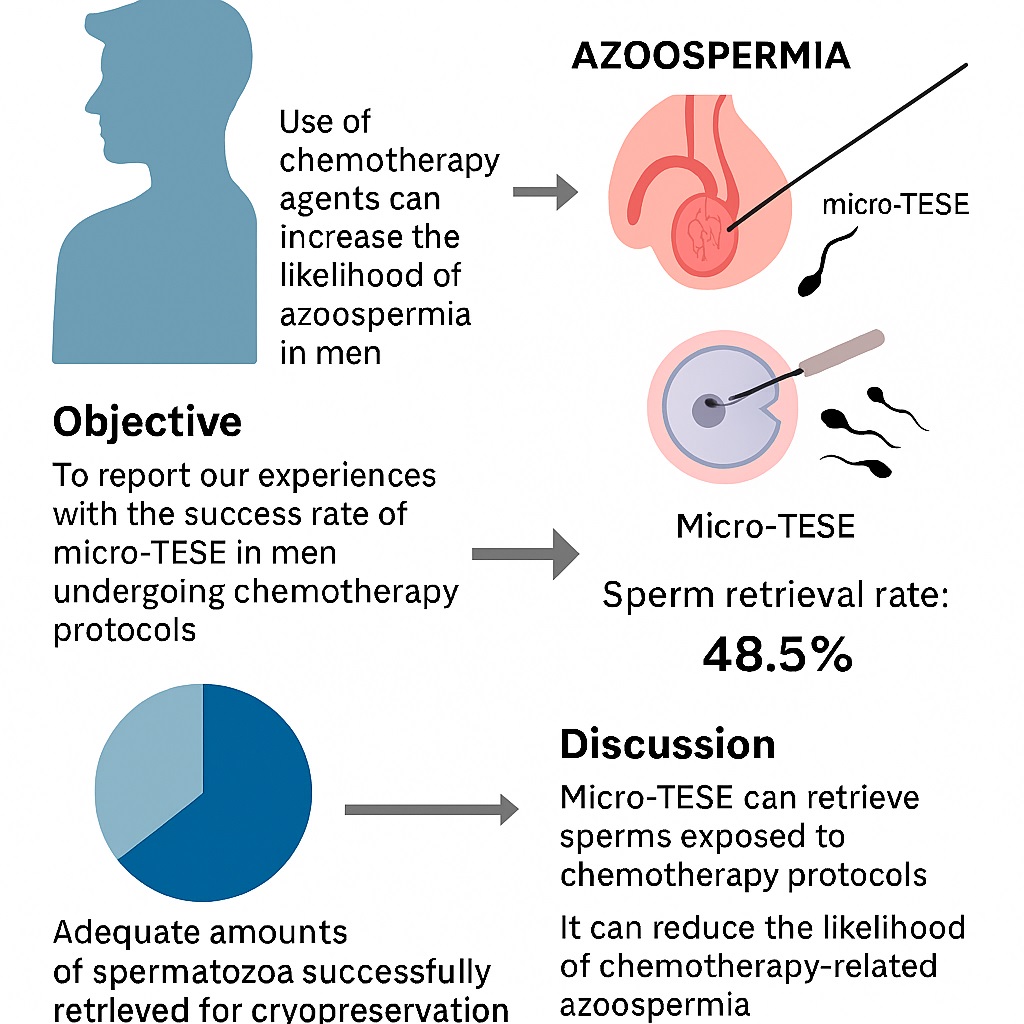
Background: The use of chemotherapy agents can increase the likelihood of azoospermia in men. Today, the application of micro-dissection testicular sperm extraction (micro-TESE) and subsequent intracytoplasmic sperm injection (ICSI) is recommended for sperm retrieval in such affected men.
Objective: We aimed to report our experiences with the success rate of the protocol of micro-TESE in maintaining sperm restoration in men undergoing chemotherapy protocols for different cancers.
Materials and Methods: In this cross-sectional study, data of 33 men who were scheduled for micro-TESE and subsequently ICSI due to non-obstructive azoospermia (following the use of chemotherapy agents because of different types of malignancies) and were referred to Royan Institute for Reproductive Biomedicine, Tehran, Iran from 2010-2023 were extracted from their medical records. At the end of the study, we measured the success rate of sperm retrieval using micro‑TESE in men with chemotherapy‑related non‑obstructive azoospermia.
Results: Adequate amounts of spermatozoa were successfully retrieved for cryopreservation and subsequent ICSI in 16 out of 33 cases, resulting in a sperm retrieval rate of 48.5%. None of the baseline parameters, including individuals’ age, time and duration of chemotherapy, type of cancer, history of smoking or alcohol use, or baseline hormonal states, might affect the rate of sperm retrieval.
Conclusion: Applying micro-TESE can retrieve sperm exposed to chemotherapy protocols. Also, it can be useful for reducing the likelihood of chemotherapy-related azoospermia.
Objective: We aimed to report our experiences with the success rate of the protocol of micro-TESE in maintaining sperm restoration in men undergoing chemotherapy protocols for different cancers.
Materials and Methods: In this cross-sectional study, data of 33 men who were scheduled for micro-TESE and subsequently ICSI due to non-obstructive azoospermia (following the use of chemotherapy agents because of different types of malignancies) and were referred to Royan Institute for Reproductive Biomedicine, Tehran, Iran from 2010-2023 were extracted from their medical records. At the end of the study, we measured the success rate of sperm retrieval using micro‑TESE in men with chemotherapy‑related non‑obstructive azoospermia.
Results: Adequate amounts of spermatozoa were successfully retrieved for cryopreservation and subsequent ICSI in 16 out of 33 cases, resulting in a sperm retrieval rate of 48.5%. None of the baseline parameters, including individuals’ age, time and duration of chemotherapy, type of cancer, history of smoking or alcohol use, or baseline hormonal states, might affect the rate of sperm retrieval.
Conclusion: Applying micro-TESE can retrieve sperm exposed to chemotherapy protocols. Also, it can be useful for reducing the likelihood of chemotherapy-related azoospermia.
Type of Study: Original Article |
Subject:
Reproductive Oncology
Send email to the article author
| Rights and permissions | |
 |
This work is licensed under a Creative Commons Attribution-NonCommercial 4.0 International License. |