International Journal of
Reproductive Biomedicine
Mon, Sep 28, 2026
[Archive]
Volume 24, Issue 3 (March 2026)
IJRM 2026, 24(3): 245-256 |
Back to browse issues page



Ethics code: IR.AJUMS.REC.1402.629


Download citation:
BibTeX | RIS | EndNote | Medlars | ProCite | Reference Manager | RefWorks
Send citation to:


BibTeX | RIS | EndNote | Medlars | ProCite | Reference Manager | RefWorks
Send citation to:
Bakhshipour F, Torabizadeh M, Jalali Far M A, Moramezi F, Saki N. Altered inflammatory and coagulation markers in women with a history of recurrent pregnancy loss: A case-control study. IJRM 2026; 24 (3) :245-256
URL: http://ijrm.ir/article-1-3688-en.html
URL: http://ijrm.ir/article-1-3688-en.html
Fatemeh Bakhshipour1 

 , Mehdi Torabizadeh2 , Mohammad Ali Jalali Far1 , Farideh Moramezi3 , Najmaldin Saki *4
, Mehdi Torabizadeh2 , Mohammad Ali Jalali Far1 , Farideh Moramezi3 , Najmaldin Saki *4
1- Thalassemia and Hemoglobinopathy Research Center, Health Research Institute, Ahvaz Jundishapur University of Medical Sciences, Ahvaz, Iran.
2- Golestan Hospital Clinical Research Development Unit, Ahvaz Jundishapur University of Medical Sciences, Ahvaz, Iran.
3- Fertility, Infertility and Perinatology Research Center, Ahvaz Jundishapur University of Medical Sciences, Ahvaz, Iran.
4- Thalassemia and Hemoglobinopathy Research Center, Health Research Institute, Ahvaz Jundishapur University of Medical Sciences, Ahvaz, Iran. ,najmaldinsaki@gmail.com; saki-nj@ajums.ac.ir
2- Golestan Hospital Clinical Research Development Unit, Ahvaz Jundishapur University of Medical Sciences, Ahvaz, Iran.
3- Fertility, Infertility and Perinatology Research Center, Ahvaz Jundishapur University of Medical Sciences, Ahvaz, Iran.
4- Thalassemia and Hemoglobinopathy Research Center, Health Research Institute, Ahvaz Jundishapur University of Medical Sciences, Ahvaz, Iran. ,
Abstract: (549 Views)
Background: Recurrent pregnancy loss (RPL) is a common pregnancy complication that significantly influences the lives of many couples worldwide. Previous studies have indicated that RPL may be associated with coagulation and inflammatory factors.
Objective: This study aimed to investigate the relationship between calprotectin levels and coagulation disorders in women with RPL.
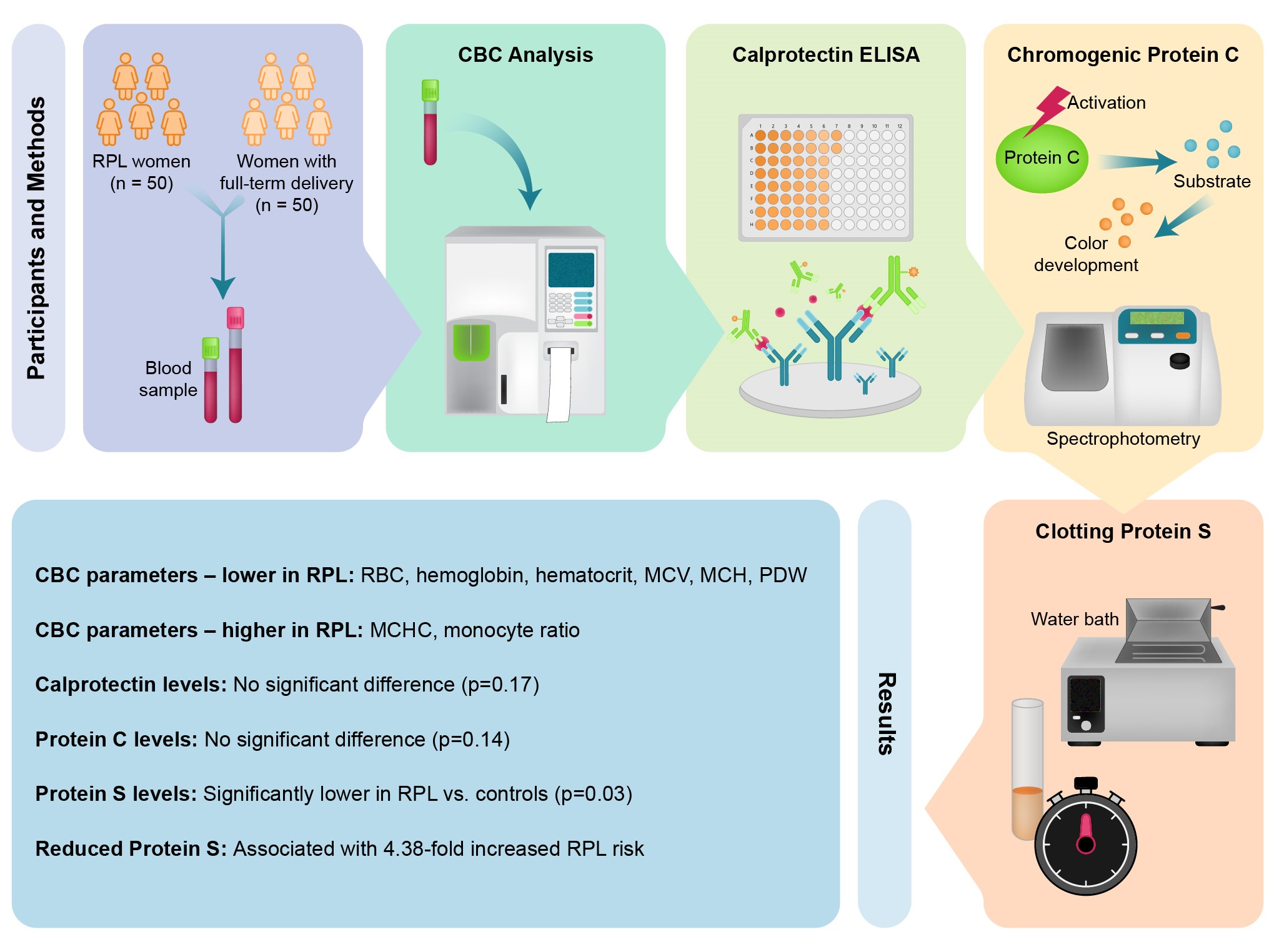
Materials and Methods: In this case-control study, a total of 100 women aged between 18 and 45 yr who had been admitted to Golestan hospital, Ahvaz, Iran from February 2024 to January 2025 enrolled. Participants were divided into 2 groups: women with RPL as the case group (n = 50), and women with no history of infertility or miscarriage as the control group (n = 50). Blood samples collected, and levels of protein C, protein S, and calprotectin measured using enzyme-linked immunosorbent assay and chromogenic assays.
Results: Protein S levels were significantly lower in the RPL group compared to controls (p = 0.03), whereas protein C and calprotectin levels did not differ significantly between the 2 groups (p = 0.14, 0.17). Altered hematological parameters, including a higher prevalence of anemia, were noted in RPL cases. Logistic regression indicated that reduced protein S levels were associated with a 4.38-fold increased risk of RPL.
Conclusion: This study reinforces the role of protein S deficiency in RPL, suggesting that even modest reductions may predispose placental thrombosis and fetal loss. Although protein C and calprotectin levels did not differ significantly, the results underscore the importance of evaluating both coagulation profiles and inflammatory markers in RPL.
Objective: This study aimed to investigate the relationship between calprotectin levels and coagulation disorders in women with RPL.
Materials and Methods: In this case-control study, a total of 100 women aged between 18 and 45 yr who had been admitted to Golestan hospital, Ahvaz, Iran from February 2024 to January 2025 enrolled. Participants were divided into 2 groups: women with RPL as the case group (n = 50), and women with no history of infertility or miscarriage as the control group (n = 50). Blood samples collected, and levels of protein C, protein S, and calprotectin measured using enzyme-linked immunosorbent assay and chromogenic assays.
Results: Protein S levels were significantly lower in the RPL group compared to controls (p = 0.03), whereas protein C and calprotectin levels did not differ significantly between the 2 groups (p = 0.14, 0.17). Altered hematological parameters, including a higher prevalence of anemia, were noted in RPL cases. Logistic regression indicated that reduced protein S levels were associated with a 4.38-fold increased risk of RPL.
Conclusion: This study reinforces the role of protein S deficiency in RPL, suggesting that even modest reductions may predispose placental thrombosis and fetal loss. Although protein C and calprotectin levels did not differ significantly, the results underscore the importance of evaluating both coagulation profiles and inflammatory markers in RPL.
Type of Study: Original Article |
Subject:
Fertility & Infertility
Send email to the article author
| Rights and permissions | |
 |
This work is licensed under a Creative Commons Attribution-NonCommercial 4.0 International License. |