
International Journal of
Reproductive Biomedicine
Tue, Oct 13, 2026
[Archive]
Volume 24, Issue 6 (June 2026)
IJRM 2026, 24(6): 527-536 |
Back to browse issues page



Ethics code: IR.SSU.SPH.REC.1401.134


Download citation:
BibTeX | RIS | EndNote | Medlars | ProCite | Reference Manager | RefWorks
Send citation to:


BibTeX | RIS | EndNote | Medlars | ProCite | Reference Manager | RefWorks
Send citation to:
Jambarsang S, Sefidkar R, Yoshany N, Khodayarian M. Secular trends in menarche age among Iranian girls: Probit analysis on cross-sectional data of Persian (Shahedieh) cohort. IJRM 2026; 24 (6) :527-536
URL: http://ijrm.ir/article-1-3852-en.html
URL: http://ijrm.ir/article-1-3852-en.html


1- Center for Healthcare Data Modeling, Departments of Biostatistics and Epidemiology, Shahid Sadoughi University of Medical Sciences, Yazd, Iran. & Clinical Research Development Center, Shahid Sadoughi Hospital, Shahid Sadoughi University of Medical Sciences, Yazd, Iran.
2- Center for Healthcare Data Modeling, Departments of Biostatistics and Epidemiology, Shahid Sadoughi University of Medical Sciences, Yazd, Iran.
3- Department of Health Education and Health Promotion, Social Determinants of Health Research Center, School of Public Health, Shahid Sadoughi University of Medical Sciences, Yazd, Iran.
4- Department of Health Education and Health Promotion, Social Determinants of Health Research Center, School of Public Health, Shahid Sadoughi University of Medical Sciences, Yazd, Iran. ,khodayarian@ssu.ac.ir
2- Center for Healthcare Data Modeling, Departments of Biostatistics and Epidemiology, Shahid Sadoughi University of Medical Sciences, Yazd, Iran.
3- Department of Health Education and Health Promotion, Social Determinants of Health Research Center, School of Public Health, Shahid Sadoughi University of Medical Sciences, Yazd, Iran.
4- Department of Health Education and Health Promotion, Social Determinants of Health Research Center, School of Public Health, Shahid Sadoughi University of Medical Sciences, Yazd, Iran. ,
Full-Text [PDF 583 kb]
(289 Downloads)
| Abstract (HTML) (383 Views)
Full-Text: (82 Views)
1. Introduction
The onset age of menarche is vital from the point of view of clinical, public, and social health (1). Menarche age is an important indicator that indicates the state of nutrition, maturity, fertility, and health of women (2). Immaturity of the hypothalamus-pituitary-ovary cascade and disruption of the menstrual cycle are often observed at this stage. Menstrual problems cause absenteeism from school, disrupt daily activities, and significantly worry teenagers and their families during puberty (3). Menarche age is affected by prenatal and postnatal factors, including birth weight, rapid weight gain, and stressful childhood experiences (4, 5). Globally, this age has declined dramatically, potentially associated with metabolic syndrome, cardiovascular disease, stroke risk, shorter stature, and breast cancer (6).
Recent studies have analyzed trends in older populations, and the cutoff for premature menarche remains unclear (7).
Previous studies have shown a rapid decline in trends from the nineteenth to the mid-twentieth century (8). However, from the mid-twentieth to the early twenty-first century, this downward trend slowed in some industrialized countries (9). Epidemiological results show the average age decreased from 17 yr in the nineteenth century to 12-13.5 yr in the twentieth century across most ethnic groups (10, 11). Over the last 3-5 decades, the age remained stable in countries like the US, UK, Greece, and Italy (12-14). In contrast, Denmark, the Netherlands, Colombia, and China showed a steady but slower downward trend (15-17). In Korea, menarche age decreased by 0.7 yr per decade between 1904 and 1994 (18). More recently, the average age of menarche among Korean girls born in 2003 were reported to be 12.6 yr, while the prevalence of premature menstruation increased to 3.2% in 2015 (7).
Iran is no exception. Studies conducted in different regions of Iran have reported an average menarche age of around 12.3-12.7 yr, with the prevalence of early menarche ranging from approximately 10% to nearly 47% (19-21). These studies have also shown significant associations between menarche age and factors such as body mass index (BMI), dietary habits, birth-related variables, socio-cultural and genetic factors, and maternal menarcheal age (19-22).
Since menarche age informs government institutions regarding sexual health education and planning, investigating Iranian trends is a priority. While regional studies exist, no research has specifically investigated menarcheal changes in Yazdi women. Therefore, the present study aims to estimate menarche age parameters over 3 decades using the Shahedieh cohort data and a Probit model to accurately analyze these trends in relation to social events. This study does not apply a specific definition for premature menarche; instead, it aims to estimate the percentile distribution of menarche age across 3 birth decades.
2. Materials and Methods
2.1. Study design
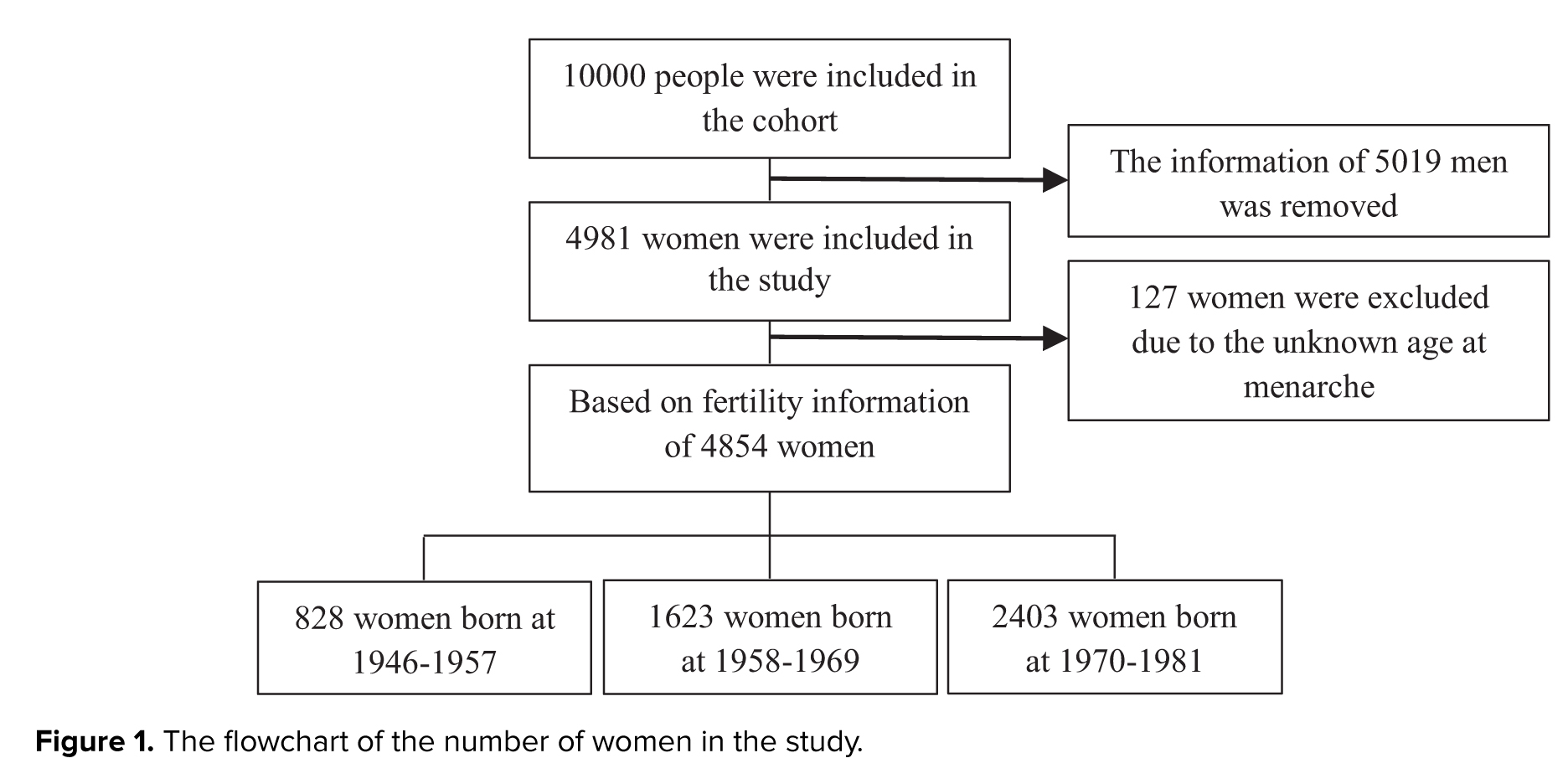
The baseline data were collected between 2014 and 2017 as part of the original PERSIAN cohort enrollment phase. For the purpose of this investigation, data regarding fertility history and age at menarche from 4854 women aged 35-70 yr were extracted and analyzed cross-sectionally in January 2026 (23). The study population for this analysis consisted of 4854 women, recruited from the general population of Shahedieh, Yazd, Iran. Data were collected at the baseline enrollment phase of the cohort using a structured questionnaire. A flow diagram illustrating the number of participants from each birth decade included in this study is presented in figure 1.
2.2. Study variables
Women in the survey were asked about their age in yr when their periods, or menstrual cycles, started.
The questionnaires tried to help people better remember the age of menarche by recalling the conditions at the time of the first menarche. For example, by asking if you were going to school. At what stage were you? Or what season was it? Answers were recorded as whole numbers. These recall aids (season, school grade, etc.) were used solely to improve memory accuracy and were not analyzed as independent variables. The only variable extracted and analyzed for this study was the reported age at menarche in years. People's age at the interview was recorded according to their date of birth. To minimize the impact of recall bias, the following strategies were employed: the questionnaire used structured recall aids, including asking about school grade, season, and memorable life events at the time of menarche. The large sample size (n = 4854) reduces the effect of random misclassification on percentile estimates. Probit analysis is robust to non-differential misclassification when estimating median and other percentiles. The observed secular trend (later menarche in the oldest cohort vs. younger cohorts) is consistent with other Iranian studies and with patterns in developing countries, suggesting that any residual recall bias is unlikely to reverse the direction of the trend.
2.3. Ethical Considerations
This study was approved by the research ethics committees of by the research ethics committees of School of Public Health, Shahid Sadoughi University of Medical Sciences, Yazd, Iran (Code: IR.SSU.SPH.REC.1401.134). Ethical issues, including getting permission from the research council of the university for conducting the study and assuring about confidentiality of the participants information, were addressed.
2.4. Statistical Analysis
Data included age at menarche (numerical) and birth cohorts (categorical: 1946-1957, 1958-1969, 1970-1981). Normality was confirmed via the Kolmogorov-Smirnov test and Q-Q plots, justifying the use of the Probit regression model.
To estimate menarcheal percentiles (10%, 25%, 50%, 75%, and 90%), a hypothetical time origin was established for each cohort. This allowed for the reconstruction of the number of girls who had attained menarche at each integer age (8-18 yr). Specifically, the time origin was set so that the youngest individual in each decade was exactly 8 yr old; for instance, the 1946-1957 cohort (enrolled at ages 59-70) used a 1965 reference point, where individuals born in 1957 were 8 and those born in 1946 were 18 (24).
The resulting proportions were entered into the Probit model to estimate the median age and specific percentiles, along with their 95% confidence intervals. All analyses were performed using Statistical Package for the Social Sciencesversion 23, with statistical significance set at p < 0.05.
3. Results
In the current study, fertility information and menarche age data of 4854 women (aged 35-70 yr) were extracted from the entry phase of the Shahedieh cohort study, Yazd, Iran.
The participants were categorized into 3 birth cohorts based on their birth year: 1946-1957 (n = 828), 1958-1969 (n = 1623), and 1970-1981 (n = 2403(.
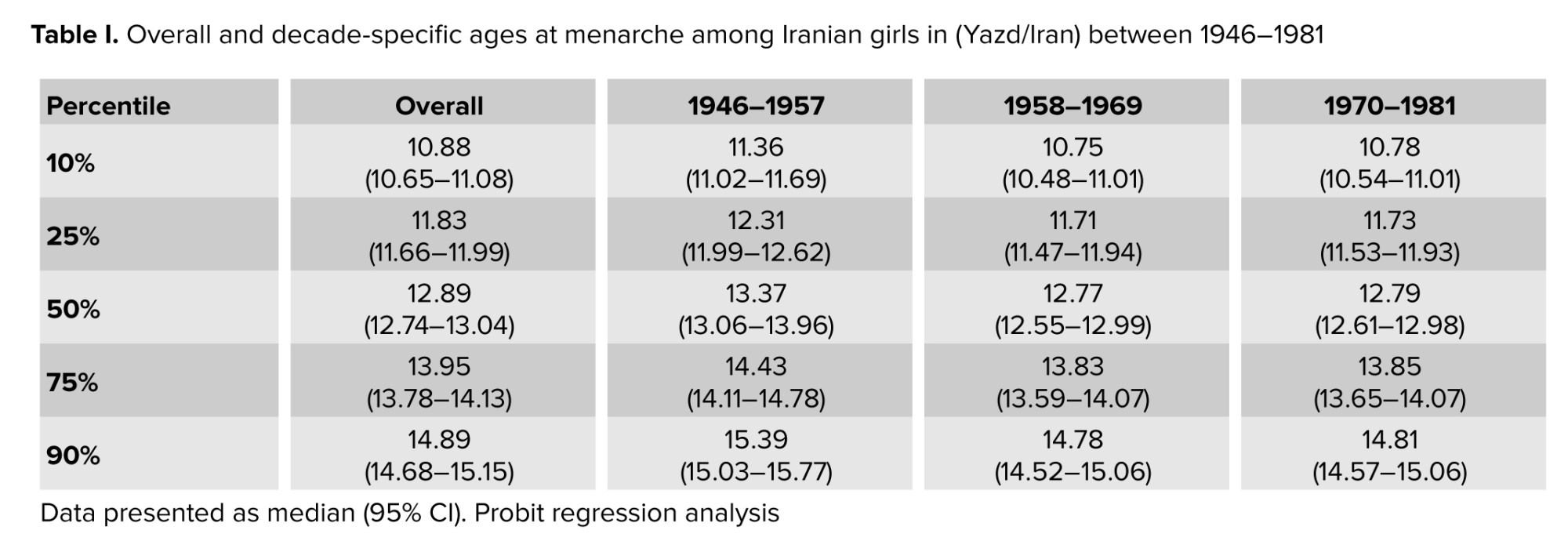
The age at menarche percentiles (10%, 25%, 50%, 75%, and 90%) for the overall sample and for each birth cohort, along with their 95% confidence intervals, are presented in table I.
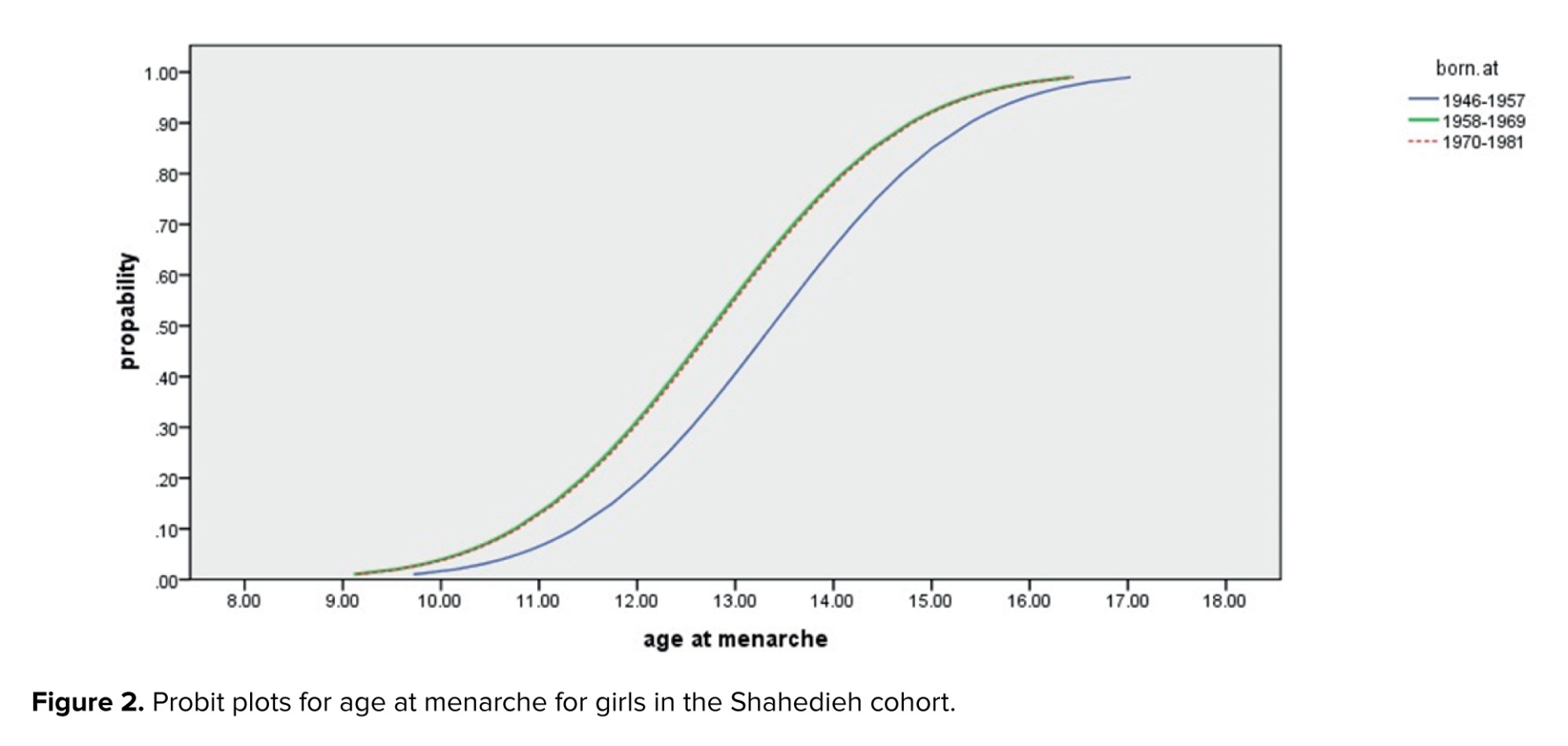
The overall median age at menarche for all participants was 12.9 yr. Only 10% of girls reached menarche by age 10.9 yr, while 90% had reached menarche by age 14.9 yr. Comparison across birth cohorts revealed a clear secular decline in age at menarche. Girls born in 1946-1957 had a significantly later age at menarche compared to those born in 1958-1969 and 1970-1981 at all percentile levels (10%, 25%, 50%, 75%, and 90%). In contrast, the age at menarche did not differ significantly between the 1958-1969 and 1970-1981 cohorts at any percentile. Specifically, the median age at menarche for the oldest cohort (1946-1957) was approximately 13.4 yr, whereas both younger cohorts had a median of approximately 12.8 yr. The secular trend is most pronounced at the lower percentiles (10% and 25%), as shown in table I. The probit plots in figure 2 illustrate that the menarche age distributions of the 1958-1969 and 1970-1981 cohorts are nearly overlapping, while the 1946-1957 cohort is shifted to the right (older ages). All comparisons between the 1946-1957 cohort and each of the 2 younger cohorts were statistically significant (p < 0.05). No significant differences were observed between the 1958-1969 and 1970-1981 cohorts at any percentile.
4. Discussion
In this research, a Probit model was used to estimate menarche age parameters across 3 decades measured in the study population. The trend of changes was examined in relation to social events. Findings showed the age ranges at which 10-90% of all women and decade-specific subgroups had attained menarche. Probit analysis revealed that girls born in 1946-1957 (aged 66-76 at the time of study) experienced menarche significantly later (11.36 yr) than those born 2 decades later (10.75-10.78 yr). This temporal decline aligns with recent findings from other Asian population-based studies. The mean menarche age across decades was found to be 12.89 yr, consistent with modern secular trend data from Western populations where median age had stabilized in the late 12-yr range (24). 90% of girls born in 1946-1957 reached menarche by age 15.39, compared to 14.78 and 14.81 yr for those born in 1958-1969 and 1970-1981, respectively. This decline was attributed to lifestyle-related variables; for instance, vigorous physical activity can delay menstruation (25). A multi-country analysis of 27 low- and middle-income countries reported a decreasing or stable menarcheal age trend. Notably, the association between socioeconomic status and menarche age is complex and context-dependent: poorer women experienced earlier menarche in some older studies, while affluent women did so in later studies (e.g., Indonesia, Yemen, and Philippines), with the opposite trend in Egypt. A rapid decline from 14.66 (1932) to 12.86 (2002) was observed, strongly linked to socioeconomic status. The authors emphasize the need for national studies on menarche as a global health indicator, given its impact on life-course health in aging populations (26). A very recent large-scale cohort study confirms a continuing secular decline in menarcheal age due to socioeconomic development and nutritional improvements (27). A large U.S.-based Probit analysis reported median menarche ages of 12.88 yr (white) and 12.16 yr (black), though the study excluded girls over 13, introducing bias (28). Several Iranian studies have documented a decline in menarcheal age throughout the nineteenth and twentieth centuries. One comprehensive national study (2 projects; 8220 and 10,228 married women aged 15-49) found mean menarche age decreased significantly over 9 yr from 13.86 ± 1.51-13.65 ± 1.47. Urban areas declined from 13.76-13.61, rural areas from 14.03-13.72. Birth cohort analysis showed a significant decline from those born in 1936-1945 (14.13 ± 1.59) to 1976-1985 (13.57 ± 1.34). These changes were attributed to improved economic conditions and nutritional status, consistent with the finding that better socio-economic conditions lead to earlier puberty (29). A cross-sectional study of 1862 high school girls (Shiraz) using Probit analysis reported a mean menarche age of 12.91 yr; 33.7% had their first menstruation in summer, with the highest mean age (13.01 yr) in winter. Stress, anxiety, and discomfort were reported by 70.3% of menstruating girls, indicating neglect of the menarche phenomenon. Higher socio-economic status was associated with earlier menarche, while thinner girls experienced later menarche. Thus, socioeconomic status and BMI had the most significant effects (30), supported by contemporary research linking rising BMI to secular acceleration of menarcheal timing (9). A meta-analysis of Iranian girls (1950-2013) estimated the average menarche age at 12.81 yr (95% confidence interval: 12.56-13.06) (31). Significant geographic variation exists: the lowest reported mean age is in Sari (11.4 ± 1.1) and the highest in Birjand (13.8 ± 1.6) (32, 33). Overall, the decreasing trend of menarche in Iranian girls parallels global trends. Determinants include biological and social factors, nutritional status, geographic location, and lifestyle; no single factor is responsible. Because the present study is a retrospective cohort, determinants could not be precisely investigated. However, the study population included healthy women without underlying diseases or cancer and with moderate physical activity levels, thus controlling for confounders. Intense professional physical activity can alter hypothalamic and pituitary hormones, affecting menstrual status and menarche onset (34). A comprehensive systematic review of studies from 2010-2024 reinforces the global downward trajectory of puberty timing driven by environmental and lifestyle factors (35).
However, the best method for studying menarche age is to conduct cohort studies with a large sample size in different regions of the country (36). The findings of this study are specific to the central Iranian population enrolled in the Persian cohort and should be generalized to other ethnic or geographic groups within Iran with caution. In the current study, the information related to women in the later stages of their lives was analyzed, for example, during the onset of menopause or after menopause. One of the main limitations of this study is recall bias, as women aged 35-70 yr were asked to remember the exact age of their first menstruation. This is particularly relevant for the oldest birth cohort (1946-1957), who were recalling an event that occurred 50-60 yr prior. We fully acknowledge this limitation and cannot claim that recall bias has been entirely eliminated. However, the data from this valuable cohort should not be discarded solely due to this limitation, as it provides the first secular trend analysis over 3 decades in this population. Nevertheless, recall bias remains a limitation that could not be fully controlled in this retrospective analysis. Future prospective cohort studies that record age at menarche contemporaneously are needed to confirm the observed secular trend.
In addition to recall-based estimates, age at menarche has also been assessed using status-quo data analyzed with probit models. For example, one cross-sectional study estimated the median age at menarche as 14.8 yr using probit analysis, whereas the recall method yielded a mean age of 15.8 yr. This illustrates that probit-based approaches can be useful when monarchial status is recorded at the time of survey, particularly in settings where recall bias may affect retrospective reporting. However, such studies generally represent applied epidemiologic analyses rather than explicit methodological treatments of the hypothetical time-origin framework (37).
To further enrich the methodological discussion on analyzing monarchial timing and related trends, we draw upon recent research that explicitly addresses both the “hypothetical time origin” framework and the application of probit models. One notable study conducted among a large cohort of Iranian girls (N = 13,886) utilized the status quo method for data analysis, a technique designed to estimate the timing of events from cross-sectional data. Complementing this methodological approach, the researchers employed Probit regression analysis to determine the median age of menarche onset, alongside the onset of breast and pubic hair development. This study provides robust estimates for the age of puberty onset in Iranian girls and highlights a secular trend toward earlier menarche. By incorporating the status quo method and probit regression, this research offers a pertinent example of how these specific analytical tools can be applied to understand the complexities of pubertal timing and its variations across populations (6).
5. Conclusion
Based on the review of the available evidence on the age of menarche in girls and the review of the present study's findings, it is concluded that, in general, the decreasing trend of menarche in Iranian girls is almost similar to the trend in other countries. Its determinants include biological and social factors, nutritional status, geographic location, and lifestyle, and it cannot be attributed to a specific factor. Because this study is a retrospective cohort study, it was not possible to investigate the determinants of menarche age accurately. The research population in the present study was healthy women without any history of underlying diseases or cancer and with moderate physical activity levels. Therefore, the confounding factors were under control. However, the best method for studying menarche age is to conduct cohort studies with a large sample size in different regions of the country. In the current study, the information related to women in the later stages of their lives was analyzed, for example, during the onset of menopause or after menopause. Unfortunately, the study has a recall bias.
Data Availability
The data supporting the findings of this study are available upon request from the corresponding author. However, due to privacy and ethical restrictions, the data are not publicly available.
Author Contributions
S. Jambarsang, R. Sefidkar, N. Yoshany, and M. Khodayarian contributed to the conception, data acquisition, interpretation, drafting, and critical revision of the work. Additionally, S. Jambarsang was specifically responsible for the study design and data analysis. All authors agreed to be accountable for all aspects of the work in ensuring that questions related to the accuracy or integrity of any part of the work are appropriately investigated and resolved. All authors have read and approved the final version of the manuscript.
Acknowledgments
Special thanks to Shahid Sadoughi University of Medical Sciences, Yazd, Iran for their continuous support and for providing departmental financial and material sources for completing this research (grant number: 14471). The authors declare that no artificial intelligence (AI) tools or AI-assisted technologies were used for the translation, revision, or grammatical editing of this manuscript.
Conflict of Interest
The authors declare that there is no conflict of interest.
The onset age of menarche is vital from the point of view of clinical, public, and social health (1). Menarche age is an important indicator that indicates the state of nutrition, maturity, fertility, and health of women (2). Immaturity of the hypothalamus-pituitary-ovary cascade and disruption of the menstrual cycle are often observed at this stage. Menstrual problems cause absenteeism from school, disrupt daily activities, and significantly worry teenagers and their families during puberty (3). Menarche age is affected by prenatal and postnatal factors, including birth weight, rapid weight gain, and stressful childhood experiences (4, 5). Globally, this age has declined dramatically, potentially associated with metabolic syndrome, cardiovascular disease, stroke risk, shorter stature, and breast cancer (6).
Recent studies have analyzed trends in older populations, and the cutoff for premature menarche remains unclear (7).
Previous studies have shown a rapid decline in trends from the nineteenth to the mid-twentieth century (8). However, from the mid-twentieth to the early twenty-first century, this downward trend slowed in some industrialized countries (9). Epidemiological results show the average age decreased from 17 yr in the nineteenth century to 12-13.5 yr in the twentieth century across most ethnic groups (10, 11). Over the last 3-5 decades, the age remained stable in countries like the US, UK, Greece, and Italy (12-14). In contrast, Denmark, the Netherlands, Colombia, and China showed a steady but slower downward trend (15-17). In Korea, menarche age decreased by 0.7 yr per decade between 1904 and 1994 (18). More recently, the average age of menarche among Korean girls born in 2003 were reported to be 12.6 yr, while the prevalence of premature menstruation increased to 3.2% in 2015 (7).
Iran is no exception. Studies conducted in different regions of Iran have reported an average menarche age of around 12.3-12.7 yr, with the prevalence of early menarche ranging from approximately 10% to nearly 47% (19-21). These studies have also shown significant associations between menarche age and factors such as body mass index (BMI), dietary habits, birth-related variables, socio-cultural and genetic factors, and maternal menarcheal age (19-22).
Since menarche age informs government institutions regarding sexual health education and planning, investigating Iranian trends is a priority. While regional studies exist, no research has specifically investigated menarcheal changes in Yazdi women. Therefore, the present study aims to estimate menarche age parameters over 3 decades using the Shahedieh cohort data and a Probit model to accurately analyze these trends in relation to social events. This study does not apply a specific definition for premature menarche; instead, it aims to estimate the percentile distribution of menarche age across 3 birth decades.
2. Materials and Methods
2.1. Study design
The baseline data were collected between 2014 and 2017 as part of the original PERSIAN cohort enrollment phase. For the purpose of this investigation, data regarding fertility history and age at menarche from 4854 women aged 35-70 yr were extracted and analyzed cross-sectionally in January 2026 (23). The study population for this analysis consisted of 4854 women, recruited from the general population of Shahedieh, Yazd, Iran. Data were collected at the baseline enrollment phase of the cohort using a structured questionnaire. A flow diagram illustrating the number of participants from each birth decade included in this study is presented in figure 1.
2.2. Study variables
Women in the survey were asked about their age in yr when their periods, or menstrual cycles, started.
The questionnaires tried to help people better remember the age of menarche by recalling the conditions at the time of the first menarche. For example, by asking if you were going to school. At what stage were you? Or what season was it? Answers were recorded as whole numbers. These recall aids (season, school grade, etc.) were used solely to improve memory accuracy and were not analyzed as independent variables. The only variable extracted and analyzed for this study was the reported age at menarche in years. People's age at the interview was recorded according to their date of birth. To minimize the impact of recall bias, the following strategies were employed: the questionnaire used structured recall aids, including asking about school grade, season, and memorable life events at the time of menarche. The large sample size (n = 4854) reduces the effect of random misclassification on percentile estimates. Probit analysis is robust to non-differential misclassification when estimating median and other percentiles. The observed secular trend (later menarche in the oldest cohort vs. younger cohorts) is consistent with other Iranian studies and with patterns in developing countries, suggesting that any residual recall bias is unlikely to reverse the direction of the trend.
2.3. Ethical Considerations
This study was approved by the research ethics committees of by the research ethics committees of School of Public Health, Shahid Sadoughi University of Medical Sciences, Yazd, Iran (Code: IR.SSU.SPH.REC.1401.134). Ethical issues, including getting permission from the research council of the university for conducting the study and assuring about confidentiality of the participants information, were addressed.
2.4. Statistical Analysis
Data included age at menarche (numerical) and birth cohorts (categorical: 1946-1957, 1958-1969, 1970-1981). Normality was confirmed via the Kolmogorov-Smirnov test and Q-Q plots, justifying the use of the Probit regression model.
To estimate menarcheal percentiles (10%, 25%, 50%, 75%, and 90%), a hypothetical time origin was established for each cohort. This allowed for the reconstruction of the number of girls who had attained menarche at each integer age (8-18 yr). Specifically, the time origin was set so that the youngest individual in each decade was exactly 8 yr old; for instance, the 1946-1957 cohort (enrolled at ages 59-70) used a 1965 reference point, where individuals born in 1957 were 8 and those born in 1946 were 18 (24).
The resulting proportions were entered into the Probit model to estimate the median age and specific percentiles, along with their 95% confidence intervals. All analyses were performed using Statistical Package for the Social Sciencesversion 23, with statistical significance set at p < 0.05.
3. Results
In the current study, fertility information and menarche age data of 4854 women (aged 35-70 yr) were extracted from the entry phase of the Shahedieh cohort study, Yazd, Iran.
The participants were categorized into 3 birth cohorts based on their birth year: 1946-1957 (n = 828), 1958-1969 (n = 1623), and 1970-1981 (n = 2403(.
The age at menarche percentiles (10%, 25%, 50%, 75%, and 90%) for the overall sample and for each birth cohort, along with their 95% confidence intervals, are presented in table I.
The overall median age at menarche for all participants was 12.9 yr. Only 10% of girls reached menarche by age 10.9 yr, while 90% had reached menarche by age 14.9 yr. Comparison across birth cohorts revealed a clear secular decline in age at menarche. Girls born in 1946-1957 had a significantly later age at menarche compared to those born in 1958-1969 and 1970-1981 at all percentile levels (10%, 25%, 50%, 75%, and 90%). In contrast, the age at menarche did not differ significantly between the 1958-1969 and 1970-1981 cohorts at any percentile. Specifically, the median age at menarche for the oldest cohort (1946-1957) was approximately 13.4 yr, whereas both younger cohorts had a median of approximately 12.8 yr. The secular trend is most pronounced at the lower percentiles (10% and 25%), as shown in table I. The probit plots in figure 2 illustrate that the menarche age distributions of the 1958-1969 and 1970-1981 cohorts are nearly overlapping, while the 1946-1957 cohort is shifted to the right (older ages). All comparisons between the 1946-1957 cohort and each of the 2 younger cohorts were statistically significant (p < 0.05). No significant differences were observed between the 1958-1969 and 1970-1981 cohorts at any percentile.
4. Discussion
In this research, a Probit model was used to estimate menarche age parameters across 3 decades measured in the study population. The trend of changes was examined in relation to social events. Findings showed the age ranges at which 10-90% of all women and decade-specific subgroups had attained menarche. Probit analysis revealed that girls born in 1946-1957 (aged 66-76 at the time of study) experienced menarche significantly later (11.36 yr) than those born 2 decades later (10.75-10.78 yr). This temporal decline aligns with recent findings from other Asian population-based studies. The mean menarche age across decades was found to be 12.89 yr, consistent with modern secular trend data from Western populations where median age had stabilized in the late 12-yr range (24). 90% of girls born in 1946-1957 reached menarche by age 15.39, compared to 14.78 and 14.81 yr for those born in 1958-1969 and 1970-1981, respectively. This decline was attributed to lifestyle-related variables; for instance, vigorous physical activity can delay menstruation (25). A multi-country analysis of 27 low- and middle-income countries reported a decreasing or stable menarcheal age trend. Notably, the association between socioeconomic status and menarche age is complex and context-dependent: poorer women experienced earlier menarche in some older studies, while affluent women did so in later studies (e.g., Indonesia, Yemen, and Philippines), with the opposite trend in Egypt. A rapid decline from 14.66 (1932) to 12.86 (2002) was observed, strongly linked to socioeconomic status. The authors emphasize the need for national studies on menarche as a global health indicator, given its impact on life-course health in aging populations (26). A very recent large-scale cohort study confirms a continuing secular decline in menarcheal age due to socioeconomic development and nutritional improvements (27). A large U.S.-based Probit analysis reported median menarche ages of 12.88 yr (white) and 12.16 yr (black), though the study excluded girls over 13, introducing bias (28). Several Iranian studies have documented a decline in menarcheal age throughout the nineteenth and twentieth centuries. One comprehensive national study (2 projects; 8220 and 10,228 married women aged 15-49) found mean menarche age decreased significantly over 9 yr from 13.86 ± 1.51-13.65 ± 1.47. Urban areas declined from 13.76-13.61, rural areas from 14.03-13.72. Birth cohort analysis showed a significant decline from those born in 1936-1945 (14.13 ± 1.59) to 1976-1985 (13.57 ± 1.34). These changes were attributed to improved economic conditions and nutritional status, consistent with the finding that better socio-economic conditions lead to earlier puberty (29). A cross-sectional study of 1862 high school girls (Shiraz) using Probit analysis reported a mean menarche age of 12.91 yr; 33.7% had their first menstruation in summer, with the highest mean age (13.01 yr) in winter. Stress, anxiety, and discomfort were reported by 70.3% of menstruating girls, indicating neglect of the menarche phenomenon. Higher socio-economic status was associated with earlier menarche, while thinner girls experienced later menarche. Thus, socioeconomic status and BMI had the most significant effects (30), supported by contemporary research linking rising BMI to secular acceleration of menarcheal timing (9). A meta-analysis of Iranian girls (1950-2013) estimated the average menarche age at 12.81 yr (95% confidence interval: 12.56-13.06) (31). Significant geographic variation exists: the lowest reported mean age is in Sari (11.4 ± 1.1) and the highest in Birjand (13.8 ± 1.6) (32, 33). Overall, the decreasing trend of menarche in Iranian girls parallels global trends. Determinants include biological and social factors, nutritional status, geographic location, and lifestyle; no single factor is responsible. Because the present study is a retrospective cohort, determinants could not be precisely investigated. However, the study population included healthy women without underlying diseases or cancer and with moderate physical activity levels, thus controlling for confounders. Intense professional physical activity can alter hypothalamic and pituitary hormones, affecting menstrual status and menarche onset (34). A comprehensive systematic review of studies from 2010-2024 reinforces the global downward trajectory of puberty timing driven by environmental and lifestyle factors (35).
However, the best method for studying menarche age is to conduct cohort studies with a large sample size in different regions of the country (36). The findings of this study are specific to the central Iranian population enrolled in the Persian cohort and should be generalized to other ethnic or geographic groups within Iran with caution. In the current study, the information related to women in the later stages of their lives was analyzed, for example, during the onset of menopause or after menopause. One of the main limitations of this study is recall bias, as women aged 35-70 yr were asked to remember the exact age of their first menstruation. This is particularly relevant for the oldest birth cohort (1946-1957), who were recalling an event that occurred 50-60 yr prior. We fully acknowledge this limitation and cannot claim that recall bias has been entirely eliminated. However, the data from this valuable cohort should not be discarded solely due to this limitation, as it provides the first secular trend analysis over 3 decades in this population. Nevertheless, recall bias remains a limitation that could not be fully controlled in this retrospective analysis. Future prospective cohort studies that record age at menarche contemporaneously are needed to confirm the observed secular trend.
In addition to recall-based estimates, age at menarche has also been assessed using status-quo data analyzed with probit models. For example, one cross-sectional study estimated the median age at menarche as 14.8 yr using probit analysis, whereas the recall method yielded a mean age of 15.8 yr. This illustrates that probit-based approaches can be useful when monarchial status is recorded at the time of survey, particularly in settings where recall bias may affect retrospective reporting. However, such studies generally represent applied epidemiologic analyses rather than explicit methodological treatments of the hypothetical time-origin framework (37).
To further enrich the methodological discussion on analyzing monarchial timing and related trends, we draw upon recent research that explicitly addresses both the “hypothetical time origin” framework and the application of probit models. One notable study conducted among a large cohort of Iranian girls (N = 13,886) utilized the status quo method for data analysis, a technique designed to estimate the timing of events from cross-sectional data. Complementing this methodological approach, the researchers employed Probit regression analysis to determine the median age of menarche onset, alongside the onset of breast and pubic hair development. This study provides robust estimates for the age of puberty onset in Iranian girls and highlights a secular trend toward earlier menarche. By incorporating the status quo method and probit regression, this research offers a pertinent example of how these specific analytical tools can be applied to understand the complexities of pubertal timing and its variations across populations (6).
5. Conclusion
Based on the review of the available evidence on the age of menarche in girls and the review of the present study's findings, it is concluded that, in general, the decreasing trend of menarche in Iranian girls is almost similar to the trend in other countries. Its determinants include biological and social factors, nutritional status, geographic location, and lifestyle, and it cannot be attributed to a specific factor. Because this study is a retrospective cohort study, it was not possible to investigate the determinants of menarche age accurately. The research population in the present study was healthy women without any history of underlying diseases or cancer and with moderate physical activity levels. Therefore, the confounding factors were under control. However, the best method for studying menarche age is to conduct cohort studies with a large sample size in different regions of the country. In the current study, the information related to women in the later stages of their lives was analyzed, for example, during the onset of menopause or after menopause. Unfortunately, the study has a recall bias.
Data Availability
The data supporting the findings of this study are available upon request from the corresponding author. However, due to privacy and ethical restrictions, the data are not publicly available.
Author Contributions
S. Jambarsang, R. Sefidkar, N. Yoshany, and M. Khodayarian contributed to the conception, data acquisition, interpretation, drafting, and critical revision of the work. Additionally, S. Jambarsang was specifically responsible for the study design and data analysis. All authors agreed to be accountable for all aspects of the work in ensuring that questions related to the accuracy or integrity of any part of the work are appropriately investigated and resolved. All authors have read and approved the final version of the manuscript.
Acknowledgments
Special thanks to Shahid Sadoughi University of Medical Sciences, Yazd, Iran for their continuous support and for providing departmental financial and material sources for completing this research (grant number: 14471). The authors declare that no artificial intelligence (AI) tools or AI-assisted technologies were used for the translation, revision, or grammatical editing of this manuscript.
Conflict of Interest
The authors declare that there is no conflict of interest.
Type of Study: Original Article |
Subject:
Reproductive Epidemiology
Send email to the article author
| Rights and permissions | |
 |
This work is licensed under a Creative Commons Attribution-NonCommercial 4.0 International License. |