International Journal of
Reproductive Biomedicine
Tue, Oct 13, 2026
[Archive]
Volume 24, Issue 1 (January 2026)
IJRM 2026, 24(1): 45-58 |
Back to browse issues page



Ethics code: 1818/14, July 7, 2022


Download citation:
BibTeX | RIS | EndNote | Medlars | ProCite | Reference Manager | RefWorks
Send citation to:


BibTeX | RIS | EndNote | Medlars | ProCite | Reference Manager | RefWorks
Send citation to:
Hammood M N, AL-Harbi H J, Alhamed T A, Hammod H J. The effects of different doses of Stanozolol on sperm parameters and testicular histology in male rats: An experimental study. IJRM 2026; 24 (1) :45-58
URL: http://ijrm.ir/article-1-3578-en.html
URL: http://ijrm.ir/article-1-3578-en.html
Mahmood Neamah Hammood *1 

 , Hussein Jasim AL-Harbi2 , Thoalffakar Abbas Alhamed3 , Hanan Jassim Hammod4
, Hussein Jasim AL-Harbi2 , Thoalffakar Abbas Alhamed3 , Hanan Jassim Hammod4
1- Directorate General of Education, Ministry of Education, Karbala, Iraq. , mahmood_neamah@karbala.edu.iq
2- Department of Forensic Science, College of Sciences, University of Al-Zahrawi, Karbala, Iraq.
3- Department of Biology, College of Education for Pure Sciences, University of Karbala, Karbala, Iraq.
4- Babylon Technical Institute, Al-Furat Al-Awsat Technical University, Babylon, Iraq.
2- Department of Forensic Science, College of Sciences, University of Al-Zahrawi, Karbala, Iraq.
3- Department of Biology, College of Education for Pure Sciences, University of Karbala, Karbala, Iraq.
4- Babylon Technical Institute, Al-Furat Al-Awsat Technical University, Babylon, Iraq.
Abstract: (764 Views)
Background: Stanozolol, an anabolic steroid, has potential therapeutic applications but is also linked to numerous adverse health effects.
Objective: This study aimed to assess the effects of different doses of Stanozolol on testicular tissue and sperm quality in rats.
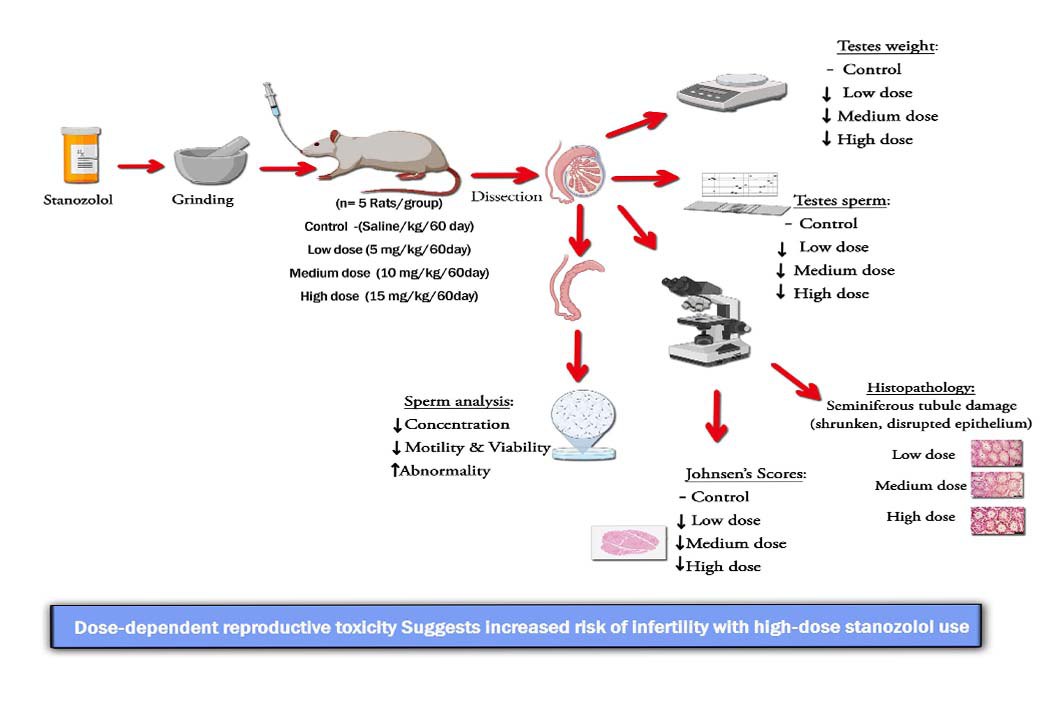
Materials and Methods: This experimental study was conducted at the Department of Biology, College of Education for Pure Sciences, University of Karbala, Karbala, Iraq, between September and November 2022. In this study, 20 male Wistar rats (8-10 wk old, 250-325 gr) were randomly divided into 4 groups (n = 5/group). The control group was orally gavaged with distilled water. Groups 2, 3, and 4 were administered Stanozolol at doses of 5, 10, and 15 mg/kg by gavage daily. After 60 days, the animals were sacrificed. The testes and epididymis were then removed, weighed, and prepared for histological examination and sperm parameter analysis.
Results: Compared to the control group, all groups that received Stanozolol showed a statistically significant decrease (p < 0.05) in testicular weight, sperm concentration, viability, and motility, alongside an increase in sperm abnormalities. Histopathological findings revealed that the Johnsen score and seminiferous tubule diameters decreased significantly in the 5 mg/kg (p = 0.002) and 15 mg/kg (p = 0.008) groups compared to the control (p < 0.05). Additional observations included damage and disorganization of the seminiferous tubules, a deficiency and disarrangement of spermatogenic cells, and degradation and sloughing of the germinal epithelial cells.
Conclusion: The present study concludes that the use of different doses of Stanozolol induces serious adverse effects on reproductive health, particularly on testicular tissue and sperm quality.
Objective: This study aimed to assess the effects of different doses of Stanozolol on testicular tissue and sperm quality in rats.
Materials and Methods: This experimental study was conducted at the Department of Biology, College of Education for Pure Sciences, University of Karbala, Karbala, Iraq, between September and November 2022. In this study, 20 male Wistar rats (8-10 wk old, 250-325 gr) were randomly divided into 4 groups (n = 5/group). The control group was orally gavaged with distilled water. Groups 2, 3, and 4 were administered Stanozolol at doses of 5, 10, and 15 mg/kg by gavage daily. After 60 days, the animals were sacrificed. The testes and epididymis were then removed, weighed, and prepared for histological examination and sperm parameter analysis.
Results: Compared to the control group, all groups that received Stanozolol showed a statistically significant decrease (p < 0.05) in testicular weight, sperm concentration, viability, and motility, alongside an increase in sperm abnormalities. Histopathological findings revealed that the Johnsen score and seminiferous tubule diameters decreased significantly in the 5 mg/kg (p = 0.002) and 15 mg/kg (p = 0.008) groups compared to the control (p < 0.05). Additional observations included damage and disorganization of the seminiferous tubules, a deficiency and disarrangement of spermatogenic cells, and degradation and sloughing of the germinal epithelial cells.
Conclusion: The present study concludes that the use of different doses of Stanozolol induces serious adverse effects on reproductive health, particularly on testicular tissue and sperm quality.
Type of Study: Original Article |
Subject:
Reproductive Biology
Send email to the article author
| Rights and permissions | |
 |
This work is licensed under a Creative Commons Attribution-NonCommercial 4.0 International License. |