International Journal of
Reproductive Biomedicine
Mon, Oct 19, 2026
[Archive]
Volume 24, Issue 8 (August 2026)
IJRM 2026, 24(8): 697-706 |
Back to browse issues page



Ethics code: IR.TUMS.SPH.REC.1398.215


Download citation:
BibTeX | RIS | EndNote | Medlars | ProCite | Reference Manager | RefWorks
Send citation to:


BibTeX | RIS | EndNote | Medlars | ProCite | Reference Manager | RefWorks
Send citation to:
Dehghan A, Pourmand M R. The impact of Staphylococcus aureus and Escherichia coli loads on semen quality in asymptomatic men: A cross-sectional study. IJRM 2026; 24 (8) :697-706
URL: http://ijrm.ir/article-1-3695-en.html
URL: http://ijrm.ir/article-1-3695-en.html


1- Microbial Biotechnology Research Center, Iran University of Medical Sciences, Tehran, Iran. & Department of Microbiology, School of Medicine, Iran University of Medical Sciences, Tehran, Iran.
2- Department of Pathobiology, School of Public Health, Tehran University of Medical Sciences, Tehran, Iran. & Biotechnology Research Center, Tehran University of Medical Sciences, Tehran, Iran. ,mpourmand@tums.ac.ir
2- Department of Pathobiology, School of Public Health, Tehran University of Medical Sciences, Tehran, Iran. & Biotechnology Research Center, Tehran University of Medical Sciences, Tehran, Iran. ,
Abstract: (257 Views)
Background: Staphylococcus aureus (S. aureus) and Escherichia coli (E. coli) are the most commonly considered causes of infection in genitourinary system. Asymptomatic bacteriospermia could contribute to infertility due to late detection. Pathogen quantity may impact semen quality.
Objective: This study examined how S. aureus and E. coli loads may affect semen quality of asymptomatic men.
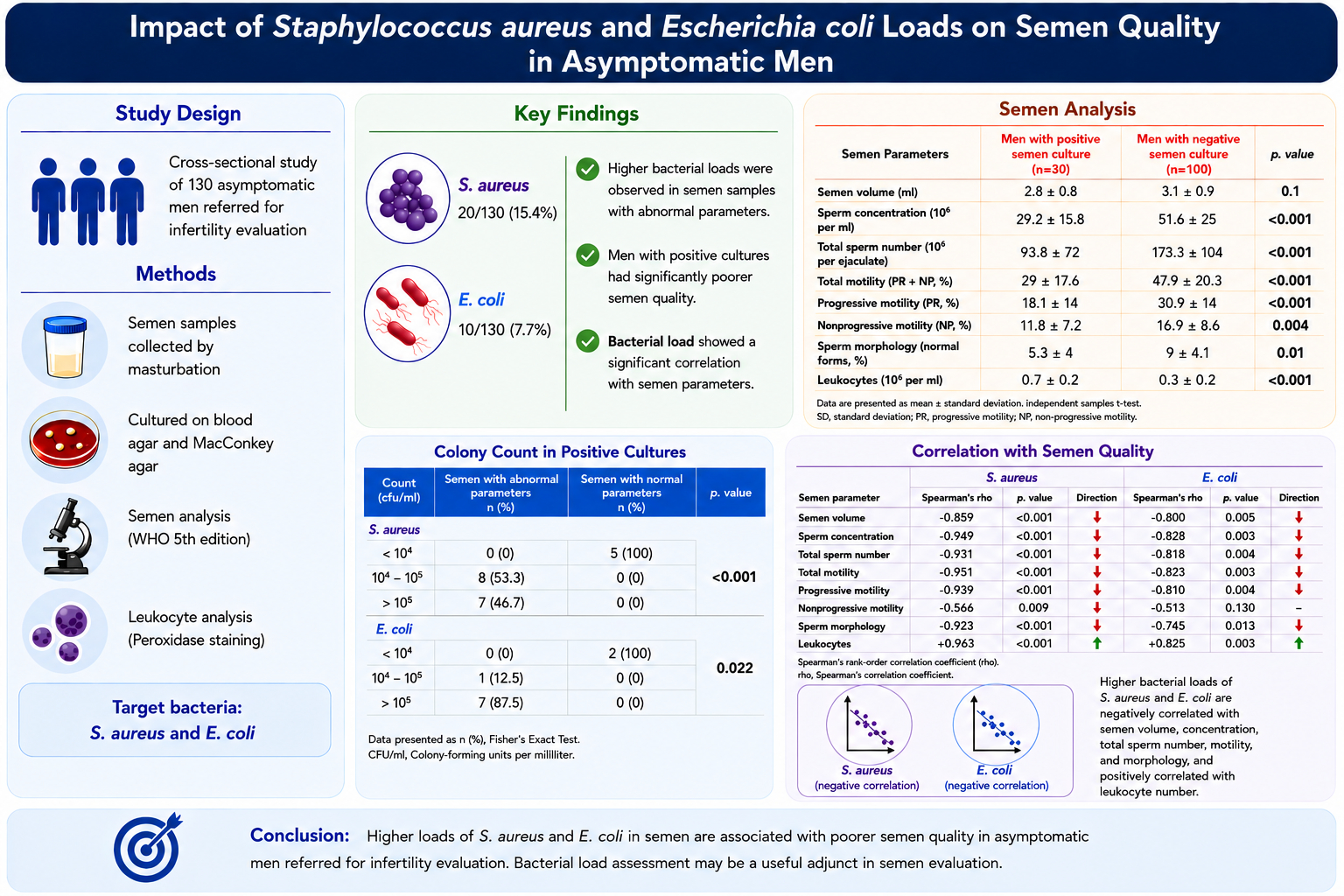
Materials and Methods: In this cross-sectional study, 130 asymptomatic men who were referred to Yas hospital complex in vitro fertilization center, Tehran, Iran, for infertility evaluation were enrolled after eligibility screening via a structured interview. Their semen samples were collected and analyzed. Microscopic and macroscopic examinations were performed using a computer-aided sperm analysis system and World Health Organization guidelines. The presence and number of leukocytes in semen were determined using the peroxidase staining method. For quantitative analysis, 2 semen samples were cultured simultaneously on blood and MacConkey agar.
Results: The results of semen analysis in 2 groups of men with and without positive culture showed significant differences in most parameters. The frequency of S. aureus and E. coli in semen samples was 20 (15.4%) and 10 (7.7%), respectively. Higher colony counts of S. aureus (p ˂ 0.001) and E. coli (p = 0.022) were observed in semen samples with abnormal parameters, whereas samples with normal parameters generally showed lower bacterial loads.
Conclusion: Higher bacterial loads of S. aureus and E. coli were associated with poorer semen quality in this sample of asymptomatic men referred for infertility evaluation. Bacterial load assessment may be useful as an adjunct in semen evaluation.
Objective: This study examined how S. aureus and E. coli loads may affect semen quality of asymptomatic men.
Materials and Methods: In this cross-sectional study, 130 asymptomatic men who were referred to Yas hospital complex in vitro fertilization center, Tehran, Iran, for infertility evaluation were enrolled after eligibility screening via a structured interview. Their semen samples were collected and analyzed. Microscopic and macroscopic examinations were performed using a computer-aided sperm analysis system and World Health Organization guidelines. The presence and number of leukocytes in semen were determined using the peroxidase staining method. For quantitative analysis, 2 semen samples were cultured simultaneously on blood and MacConkey agar.
Results: The results of semen analysis in 2 groups of men with and without positive culture showed significant differences in most parameters. The frequency of S. aureus and E. coli in semen samples was 20 (15.4%) and 10 (7.7%), respectively. Higher colony counts of S. aureus (p ˂ 0.001) and E. coli (p = 0.022) were observed in semen samples with abnormal parameters, whereas samples with normal parameters generally showed lower bacterial loads.
Conclusion: Higher bacterial loads of S. aureus and E. coli were associated with poorer semen quality in this sample of asymptomatic men referred for infertility evaluation. Bacterial load assessment may be useful as an adjunct in semen evaluation.
Type of Study: Original Article |
Subject:
Cellular and Molecular Biology of Reproduction
Send email to the article author
| Rights and permissions | |
 |
This work is licensed under a Creative Commons Attribution-NonCommercial 4.0 International License. |