International Journal of
Reproductive Biomedicine
Mon, Oct 19, 2026
[Archive]
Volume 24, Issue 8 (August 2026)
IJRM 2026, 24(8): 707-720 |
Back to browse issues page



Ethics code: IR.GOUMS.REC.1398.201


Download citation:
BibTeX | RIS | EndNote | Medlars | ProCite | Reference Manager | RefWorks
Send citation to:


BibTeX | RIS | EndNote | Medlars | ProCite | Reference Manager | RefWorks
Send citation to:
Ahmadi F, Behzadi B, Tajaldini M. Maternal characteristics, clinical indications, and neonatal outcomes in cesarean hysterectomy: A cross‑sectional study. IJRM 2026; 24 (8) :707-720
URL: http://ijrm.ir/article-1-3703-en.html
URL: http://ijrm.ir/article-1-3703-en.html


1- Department of Obstetrics and Gynecology, Golestan University of Medical Sciences, Gorgan, Iran.
2- Ischemic Disorders Research Center, Jorjani Clinical Sciences Research Institute, Golestan University of Medical Sciences, Gorgan, Iran. ,mtajodini@gmail.com; ahmadifarahnaz@goums.ac.ir
2- Ischemic Disorders Research Center, Jorjani Clinical Sciences Research Institute, Golestan University of Medical Sciences, Gorgan, Iran. ,
Abstract: (249 Views)
Background: Cesarean hysterectomy (CH) is a life-saving surgical procedure performed in obstetric emergencies, particularly in cases of uncontrollable hemorrhage, placenta previa, and abnormal placental adherence.
Objective: This study aimed to evaluate the maternal characteristics, associated clinical factors, complications, and neonatal outcomes observed in CH.
Materials and Methods: In this cross-sectional study, data of 89 women who underwent CH at Sayad Shirazi hospital, Gorgan, Iran, between 2013 and 2022 were extracted from participants’ medical records using a structured checklist covering maternal demographics, comorbidities, placental conditions, surgical outcomes, and neonatal results.
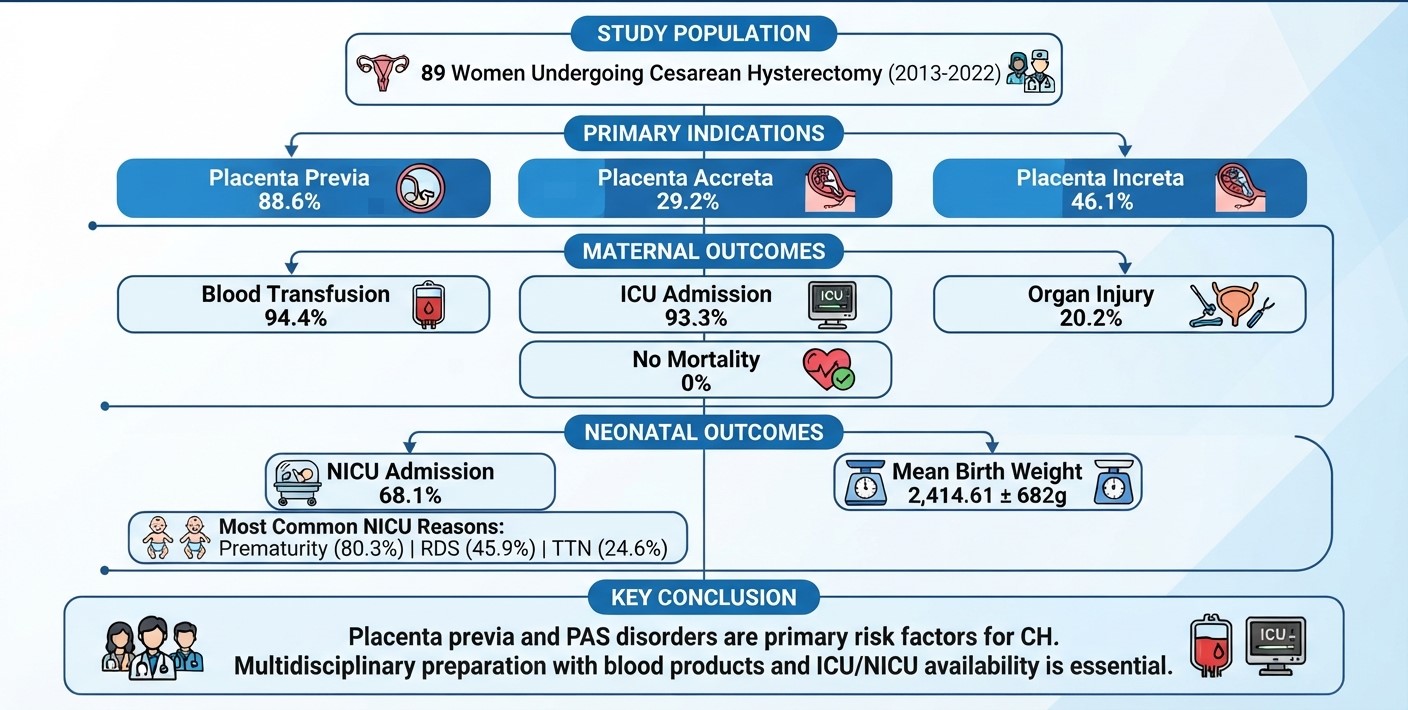
Results: The mean maternal age was 34.65 ± 5.2 yr, body mass index 28.78 ± 3.4 kg/m², and gestational age 34.54 ± 3.2 wk. Placenta previa was present in 88.6% of cases, with placenta increta (46.1%), accreta (29.2%), and percreta (21.3%) being the most common placenta accreta spectrum subtypes. Preoperative and postoperative hemoglobin levels were 11.2 ± 1.8 and 8.15 ± 1.56 g/dL, respectively. Blood transfusion was required in 94.4% of cases. Intensive care unit admission was required in 93.3%, with a mean stay of 2.01 ± 0.11 days. Intraoperative organ injury occurred in 20.2% of cases. Mean neonatal birth weight was 2414.61 ± 682 gr, with 68.1% requiring neonatal intensive care unit admission primarily due to prematurity. No maternal or neonatal deaths occurred.
Conclusion: Placenta previa and placenta accreta spectrum disorders are the primary risk factors for CH. Adequate preparation, including blood product reserves and intensive care unit/neonatal intensive care unit availability, is essential for managing these high-risk cases. As a descriptive study without a comparison group, these findings reflect observed patterns rather than causal associations.
Objective: This study aimed to evaluate the maternal characteristics, associated clinical factors, complications, and neonatal outcomes observed in CH.
Materials and Methods: In this cross-sectional study, data of 89 women who underwent CH at Sayad Shirazi hospital, Gorgan, Iran, between 2013 and 2022 were extracted from participants’ medical records using a structured checklist covering maternal demographics, comorbidities, placental conditions, surgical outcomes, and neonatal results.
Results: The mean maternal age was 34.65 ± 5.2 yr, body mass index 28.78 ± 3.4 kg/m², and gestational age 34.54 ± 3.2 wk. Placenta previa was present in 88.6% of cases, with placenta increta (46.1%), accreta (29.2%), and percreta (21.3%) being the most common placenta accreta spectrum subtypes. Preoperative and postoperative hemoglobin levels were 11.2 ± 1.8 and 8.15 ± 1.56 g/dL, respectively. Blood transfusion was required in 94.4% of cases. Intensive care unit admission was required in 93.3%, with a mean stay of 2.01 ± 0.11 days. Intraoperative organ injury occurred in 20.2% of cases. Mean neonatal birth weight was 2414.61 ± 682 gr, with 68.1% requiring neonatal intensive care unit admission primarily due to prematurity. No maternal or neonatal deaths occurred.
Conclusion: Placenta previa and placenta accreta spectrum disorders are the primary risk factors for CH. Adequate preparation, including blood product reserves and intensive care unit/neonatal intensive care unit availability, is essential for managing these high-risk cases. As a descriptive study without a comparison group, these findings reflect observed patterns rather than causal associations.
Type of Study: Original Article |
Subject:
Reproductive Anatomy
Send email to the article author
| Rights and permissions | |
 |
This work is licensed under a Creative Commons Attribution-NonCommercial 4.0 International License. |