
International Journal of
Reproductive Biomedicine
Sun, Oct 11, 2026
[Archive]
Volume 24, Issue 5 (May 2026)
IJRM 2026, 24(5): 391-402 |
Back to browse issues page



Ethics code: 2.KEH.131.09.2024


Download citation:
BibTeX | RIS | EndNote | Medlars | ProCite | Reference Manager | RefWorks
Send citation to:


BibTeX | RIS | EndNote | Medlars | ProCite | Reference Manager | RefWorks
Send citation to:
Mahardika F U, Hendarto H, Widjiati. Lesion size reduction in mouse model of endometriosis following clove (Syzygium aromaticum) leaf extract administration: An experimental study. IJRM 2026; 24 (5) :391-402
URL: http://ijrm.ir/article-1-3783-en.html
URL: http://ijrm.ir/article-1-3783-en.html


1- Reproductive Health Science, Master Program, Faculty of Medicine, University of Airlangga, Surabaya, Indonesia. , fitrianti.umayroh.mahardika-2022@fk.unair.ac.id
2- Department of Obstetrics and Gynecology, Faculty of Medicine, University of Airlangga, Surabaya, Indonesia.
3- Department of Veterinary Medicine, Faculty of Veterinary Medicine, University of Airlangga, Surabaya, Indonesia.
2- Department of Obstetrics and Gynecology, Faculty of Medicine, University of Airlangga, Surabaya, Indonesia.
3- Department of Veterinary Medicine, Faculty of Veterinary Medicine, University of Airlangga, Surabaya, Indonesia.
Abstract: (624 Views)
Background: Endometriosis affects about 10% of reproductive-age women, causing pelvic pain and infertility. Its progression involves angiogenesis and neurovascular innervation, mediated by vascular endothelial growth factor (VEGF) and brain-derived neurotrophic factor (BDNF). Clove leaf extract may suppress lesion growth by reducing these pathways through antioxidant and anti-inflammatory actions.
Objective: This study evaluated clove leaf extract’s impact on VEGF and BDNF pathways and lesion size in female mice with endometriosis, testing whether extract reduces VEGF, BDNF, and lesion area, with the hypothesis that intermediate dosage provides optimal efficacy.
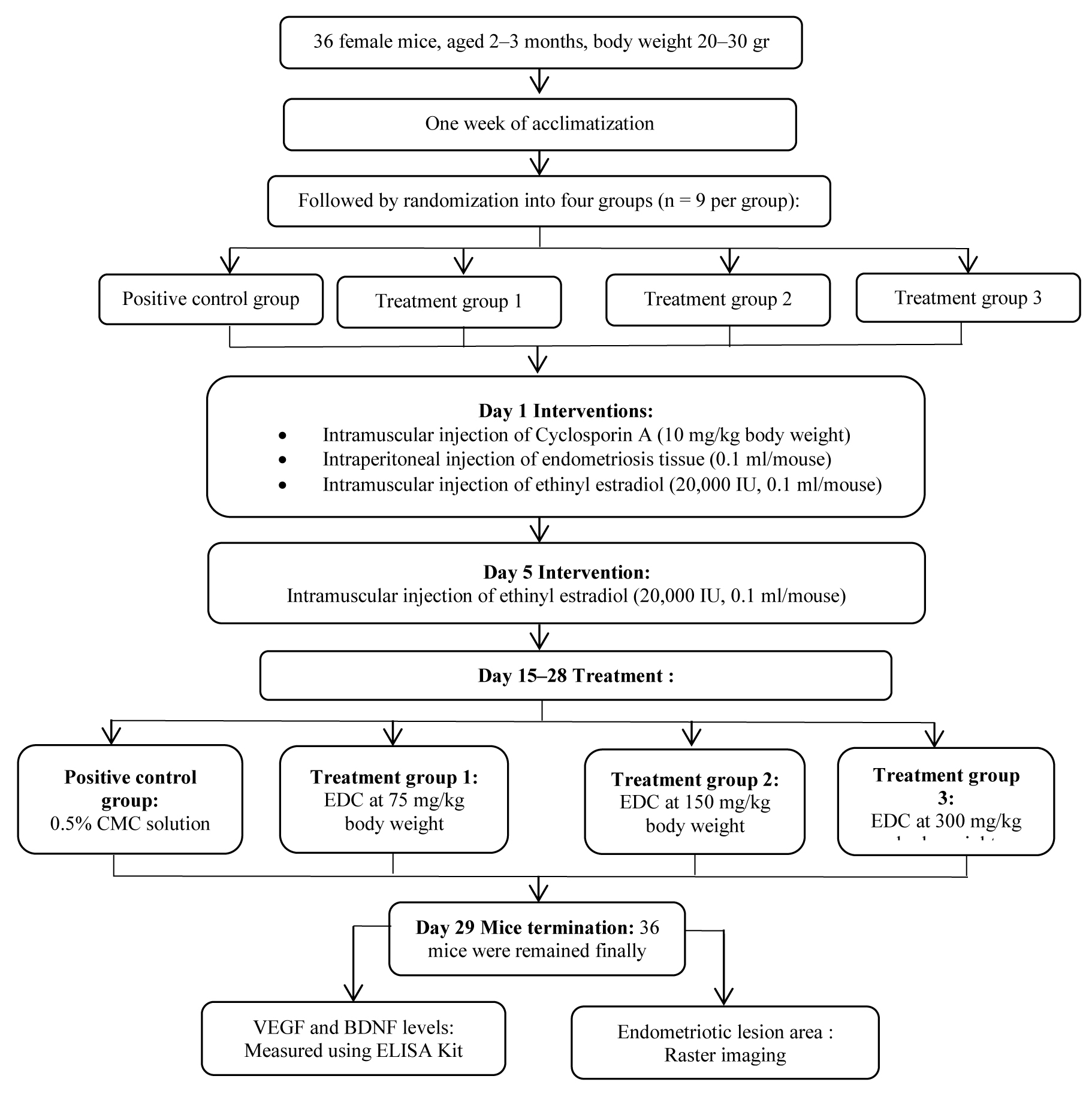
Materials and Methods: A total of 36 female BALB/c mouse endometriosis model (2-3 months old, weighing 20-30 gr) induced by uterine endometrial implantation with estrogen supplementation were randomly assigned to 4 groups: one untreated control group (K⁺) and 3 treatment groups receiving clove leaf extract at doses of 75 mg/kg-BW (P1), 150 mg/kg-BW (P2), and 300 mg/kg-BW (P3). Blood samples and peritoneal tissue were collected for analysis using commercial Enzyme-Linked Immunosorbent Assay kits targeting VEGF and BDNF, as well as Motic imaging for lesion assessment.
Results: Following 14 days of clove leaf extract administration, endometriosis lesion area significantly decreased (p = 0.001), whereas VEGF (p = 0.27) and BDNF (p = 0.13) remained unchanged. Histological analysis corroborated lesion reduction, confirming extract’s impact on lesion morphology without altering VEGF or BDNF.
Conclusion: The hypothesized involvement of VEGF and BDNF was not supported by the data. The principal finding is a reduction in lesion size, with the underlying mechanism remaining uncertain and potentially independent of VEGF/BDNF modulation.
Objective: This study evaluated clove leaf extract’s impact on VEGF and BDNF pathways and lesion size in female mice with endometriosis, testing whether extract reduces VEGF, BDNF, and lesion area, with the hypothesis that intermediate dosage provides optimal efficacy.
Materials and Methods: A total of 36 female BALB/c mouse endometriosis model (2-3 months old, weighing 20-30 gr) induced by uterine endometrial implantation with estrogen supplementation were randomly assigned to 4 groups: one untreated control group (K⁺) and 3 treatment groups receiving clove leaf extract at doses of 75 mg/kg-BW (P1), 150 mg/kg-BW (P2), and 300 mg/kg-BW (P3). Blood samples and peritoneal tissue were collected for analysis using commercial Enzyme-Linked Immunosorbent Assay kits targeting VEGF and BDNF, as well as Motic imaging for lesion assessment.
Results: Following 14 days of clove leaf extract administration, endometriosis lesion area significantly decreased (p = 0.001), whereas VEGF (p = 0.27) and BDNF (p = 0.13) remained unchanged. Histological analysis corroborated lesion reduction, confirming extract’s impact on lesion morphology without altering VEGF or BDNF.
Conclusion: The hypothesized involvement of VEGF and BDNF was not supported by the data. The principal finding is a reduction in lesion size, with the underlying mechanism remaining uncertain and potentially independent of VEGF/BDNF modulation.
Type of Study: Original Article |
Subject:
Cellular and Molecular Biology of Reproduction
Send email to the article author
| Rights and permissions | |
 |
This work is licensed under a Creative Commons Attribution-NonCommercial 4.0 International License. |