
International Journal of
Reproductive Biomedicine
Mon, Oct 19, 2026
[Archive]
Volume 24, Issue 8 (August 2026)
IJRM 2026, 24(8): 675-686 |
Back to browse issues page



Ethics code: IR.MUBABOL.HRI.REC.1402.087


Download citation:
BibTeX | RIS | EndNote | Medlars | ProCite | Reference Manager | RefWorks
Send citation to:


BibTeX | RIS | EndNote | Medlars | ProCite | Reference Manager | RefWorks
Send citation to:
Esmaeilzadeh S, Agajani Delavar M, Mirabi P. Assessing fertility-related quality of life and psychological distress among infertile women: A cross-sectional study. IJRM 2026; 24 (8) :675-686
URL: http://ijrm.ir/article-1-3792-en.html
URL: http://ijrm.ir/article-1-3792-en.html


1- Infertility and Reproductive Health Research Center, Health Research Institute, Babol University of Medical Sciences, Babol, Iran.
2- Infertility and Reproductive Health Research Center, Health Research Institute, Babol University of Medical Sciences, Babol, Iran. ,parvaneh_mirabi@yahoo.com; P.mirabi@mubabol.ac.ir
2- Infertility and Reproductive Health Research Center, Health Research Institute, Babol University of Medical Sciences, Babol, Iran. ,
Abstract: (271 Views)
Background: Infertility negatively impacts quality of life and psychological well-being, yet their inter-relationship in untreated women remains unclear.
Objective: To explore the association between fertility quality of life (FertiQoL) and psychological distress in untreated infertile women.
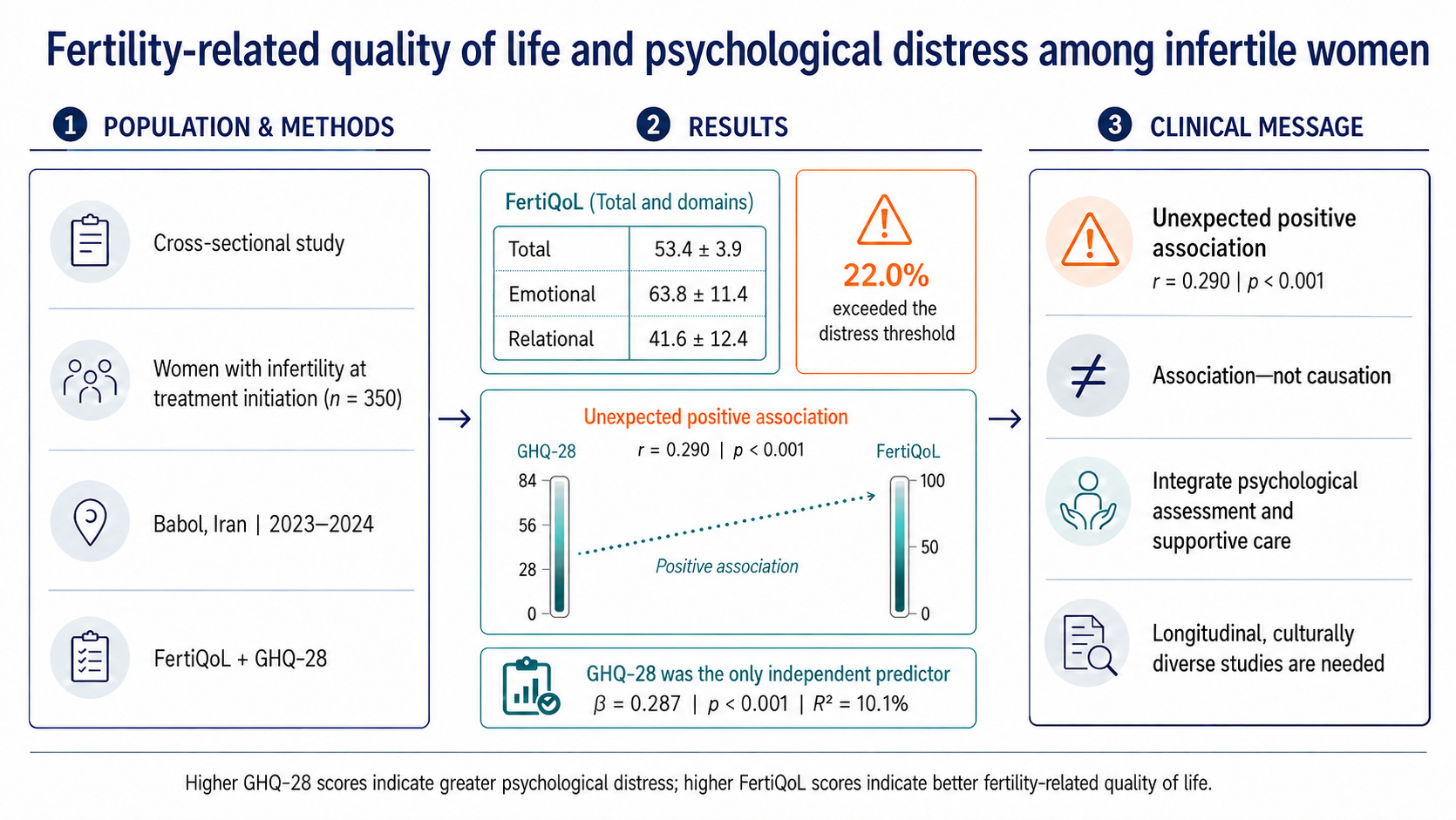
Materials and Methods: This cross-sectional study enrolled 350 infertile women at Fateme Zahra Center, Babol, Iran (October 2023-June 2024). Participants completed FertiQoL and general health questionnaire-28 (GHQ-28) before treatment initiation. The primary outcome was FertiQoL, measured using the total FertiQoL score. Associations between FertiQoL and psychological, demographic, and infertility-related characteristics were evaluated.
Results: The mean age of participants was 35.7 ± 7.2 yr. The mean total FertiQoL score was 53.4 ± 3.9, with the highest score in the emotional domain (63.8 ± 11.4) and the lowest in the relational domain (41.6 ± 12.4). The mean total GHQ-28 score was 53.4 ± 9.2, and 22.0% of women exceeded the clinical threshold for psychological distress. Total GHQ-28 score was positively correlated with total FertiQoL score (r = 0.290, p < 0.001). In multivariable analysis, GHQ-28 score was the only significant predictor of FertiQoL (β = 0.287, p < 0.001), explaining 10.1% of the variance in FertiQoL scores.
Conclusion: Psychological distress was significantly associated with FertiQoL among infertile women. Unexpectedly, higher GHQ-28 scores were associated with higher FertiQoL scores. Given the cross-sectional design, the underlying reasons for this finding remain unclear and warrant further investigation in longitudinal and culturally diverse populations.
Objective: To explore the association between fertility quality of life (FertiQoL) and psychological distress in untreated infertile women.
Materials and Methods: This cross-sectional study enrolled 350 infertile women at Fateme Zahra Center, Babol, Iran (October 2023-June 2024). Participants completed FertiQoL and general health questionnaire-28 (GHQ-28) before treatment initiation. The primary outcome was FertiQoL, measured using the total FertiQoL score. Associations between FertiQoL and psychological, demographic, and infertility-related characteristics were evaluated.
Results: The mean age of participants was 35.7 ± 7.2 yr. The mean total FertiQoL score was 53.4 ± 3.9, with the highest score in the emotional domain (63.8 ± 11.4) and the lowest in the relational domain (41.6 ± 12.4). The mean total GHQ-28 score was 53.4 ± 9.2, and 22.0% of women exceeded the clinical threshold for psychological distress. Total GHQ-28 score was positively correlated with total FertiQoL score (r = 0.290, p < 0.001). In multivariable analysis, GHQ-28 score was the only significant predictor of FertiQoL (β = 0.287, p < 0.001), explaining 10.1% of the variance in FertiQoL scores.
Conclusion: Psychological distress was significantly associated with FertiQoL among infertile women. Unexpectedly, higher GHQ-28 scores were associated with higher FertiQoL scores. Given the cross-sectional design, the underlying reasons for this finding remain unclear and warrant further investigation in longitudinal and culturally diverse populations.
Keywords: Infertility, Quality of life, Adaptation, Psychological distress, Resilience, Mental health.
Type of Study: Original Article |
Subject:
Reproductive Psycology
Send email to the article author
| Rights and permissions | |
 |
This work is licensed under a Creative Commons Attribution-NonCommercial 4.0 International License. |