International Journal of
Reproductive Biomedicine
Thu, Oct 22, 2026
[Archive]
Volume 24, Issue 7 (July 2026)
IJRM 2026, 24(7): 571-584 |
Back to browse issues page




Download citation:
BibTeX | RIS | EndNote | Medlars | ProCite | Reference Manager | RefWorks
Send citation to:


BibTeX | RIS | EndNote | Medlars | ProCite | Reference Manager | RefWorks
Send citation to:
Kiaee F, Shahi H. The lactate-myeloid-derived suppressor cells axis in endometriosis from molecular reprogramming to translational therapies: A review article. IJRM 2026; 24 (7) :571-584
URL: http://ijrm.ir/article-1-3796-en.html
URL: http://ijrm.ir/article-1-3796-en.html


1- Blood Transfusion Research Center, High Institute for Research and Education in Transfusion Medicine, Tehran, Iran.
2- Department of Immunology, School of Medicine, Shahid Beheshti University of Medical Sciences, Tehran, Iran. ,Shahi@sbmu.ac.ir
2- Department of Immunology, School of Medicine, Shahid Beheshti University of Medical Sciences, Tehran, Iran. ,
Abstract: (413 Views)
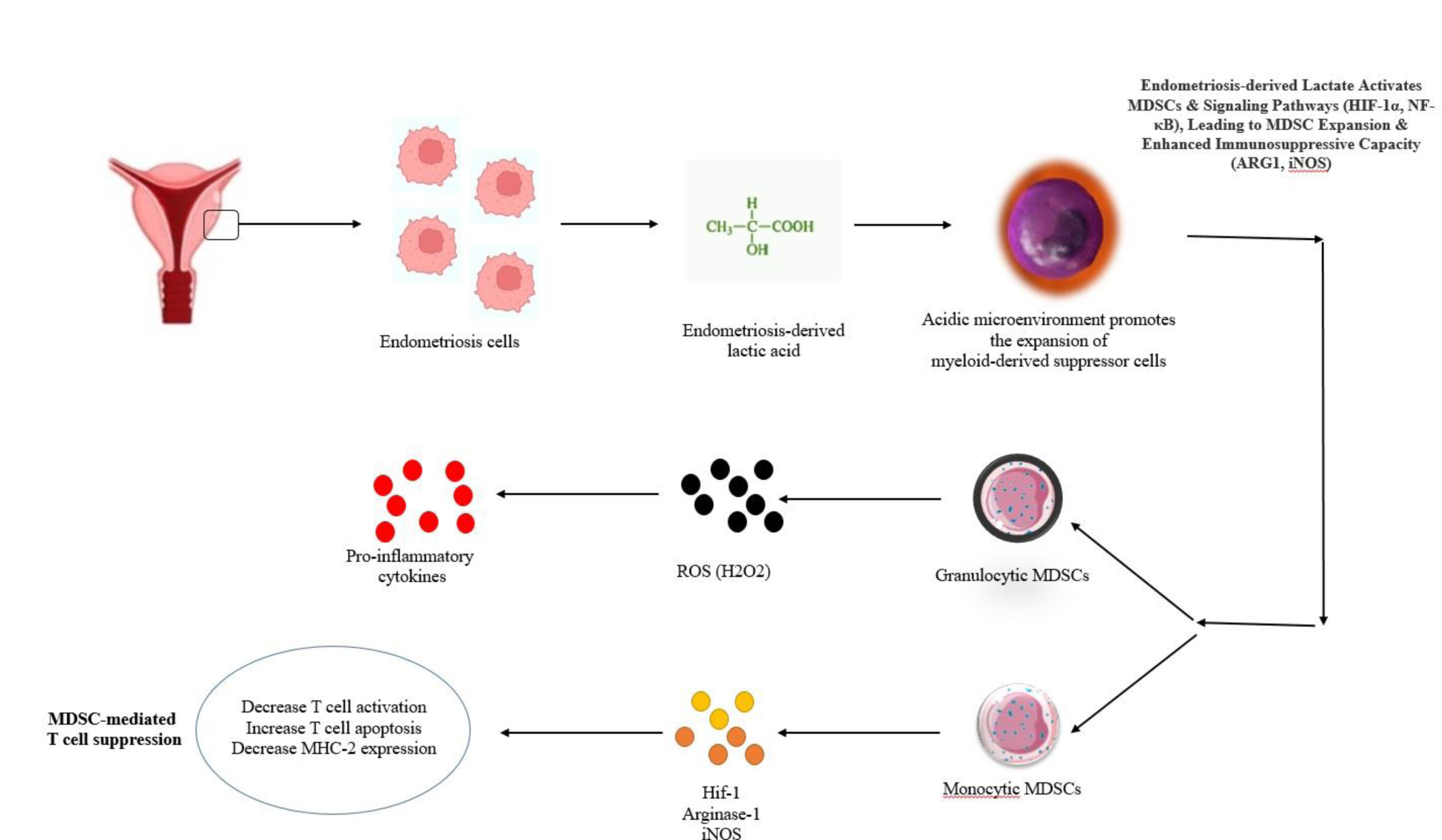
Endometriosis is a complex chronic condition, driven by estrogen, characterized by the growth of endometrial-like tissue outside the uterus. This often-debilitating disease affects millions of women globally, manifesting as severe pelvic pain, significant subfertility, and a profound reduction in the quality of their life. These clinical problems need advancements in both diagnostic tools and therapeutic strategies. This article delves into the intricate relationship between endometriosis-derived lactic acid and a specific subset of immune cells, known as myeloid-derived suppressor cells (MDSCs). We aim to elucidate the nuanced biological pathways that affect this significant interaction. Lactates subsequently drive the expansion and activation of MDSCs, which then increase immune suppression through key signaling molecules such as hypoxia-inducible factor 1-alpha, signal transducer and activator of transcription 3, nuclear factor kappa-light-chain-enhancer of activated B cells. Beyond its role in immune modulation, this complex interplay between lactic acid and MDSCs is emerging as a pivotal factor in the multifaceted pathogenesis of endometriosis. It significantly contributes to the disease's bad progression, including its invasive spread, the development of new blood vessels (angiogenesis), and the characteristic formation of fibrotic, scar-like tissue. This review hypothesizes that targeted modulation of lactate metabolism could serve as a promising therapeutic strategy to regulate MDSC activity. The purpose of this study is to clarify these intricate cellular and molecular events.
Type of Study: Review Article |
Subject:
Reproductive Biology
Send email to the article author
| Rights and permissions | |
 |
This work is licensed under a Creative Commons Attribution-NonCommercial 4.0 International License. |