
International Journal of
Reproductive Biomedicine
Tue, Oct 13, 2026
[Archive]
Volume 24, Issue 6 (June 2026)
IJRM 2026, 24(6): 517-526 |
Back to browse issues page



Ethics code: IR.ACECR.AVICENNA.REC.1402.022


Download citation:
BibTeX | RIS | EndNote | Medlars | ProCite | Reference Manager | RefWorks
Send citation to:


BibTeX | RIS | EndNote | Medlars | ProCite | Reference Manager | RefWorks
Send citation to:
Karimi A, Dadgar A, Saffari H, Vahedi N, Saket S, Arefi S. Evaluation of intralipid effect on pregnancy outcomes in women with recurrent implantation failure: A retrospective cohort study. IJRM 2026; 24 (6) :517-526
URL: http://ijrm.ir/article-1-3857-en.html
URL: http://ijrm.ir/article-1-3857-en.html
Atoosa Karimi1 

 , Aniseh Dadgar2 , Haniyeh Saffari1 , Nazanin Vahedi1 , Sasan Saket3 , Soheila Arefi *4
, Aniseh Dadgar2 , Haniyeh Saffari1 , Nazanin Vahedi1 , Sasan Saket3 , Soheila Arefi *4
1- Reproductive Biotechnology Research Center, Avicenna Research Institute, ACECR, Tehran, Iran.
2- Department of Epidemiology and Biostatistics, School of Public Health, Tehran University of Medical Sciences, Tehran, Iran.
3- Department of Pediatric Neurology, School of Medicine, Mofid Children's Hospital, Iranian Child Neurology Center of Excellence (ICNCE), Pediatric Neurology Research Center, Shahid Beheshti University of Medical Sciences, Tehran, Iran.
4- Reproductive Biotechnology Research Center, Avicenna Research Institute, ACECR, Tehran, Iran. ,s.arefi@avicenna.ac.ir
2- Department of Epidemiology and Biostatistics, School of Public Health, Tehran University of Medical Sciences, Tehran, Iran.
3- Department of Pediatric Neurology, School of Medicine, Mofid Children's Hospital, Iranian Child Neurology Center of Excellence (ICNCE), Pediatric Neurology Research Center, Shahid Beheshti University of Medical Sciences, Tehran, Iran.
4- Reproductive Biotechnology Research Center, Avicenna Research Institute, ACECR, Tehran, Iran. ,
Abstract: (478 Views)
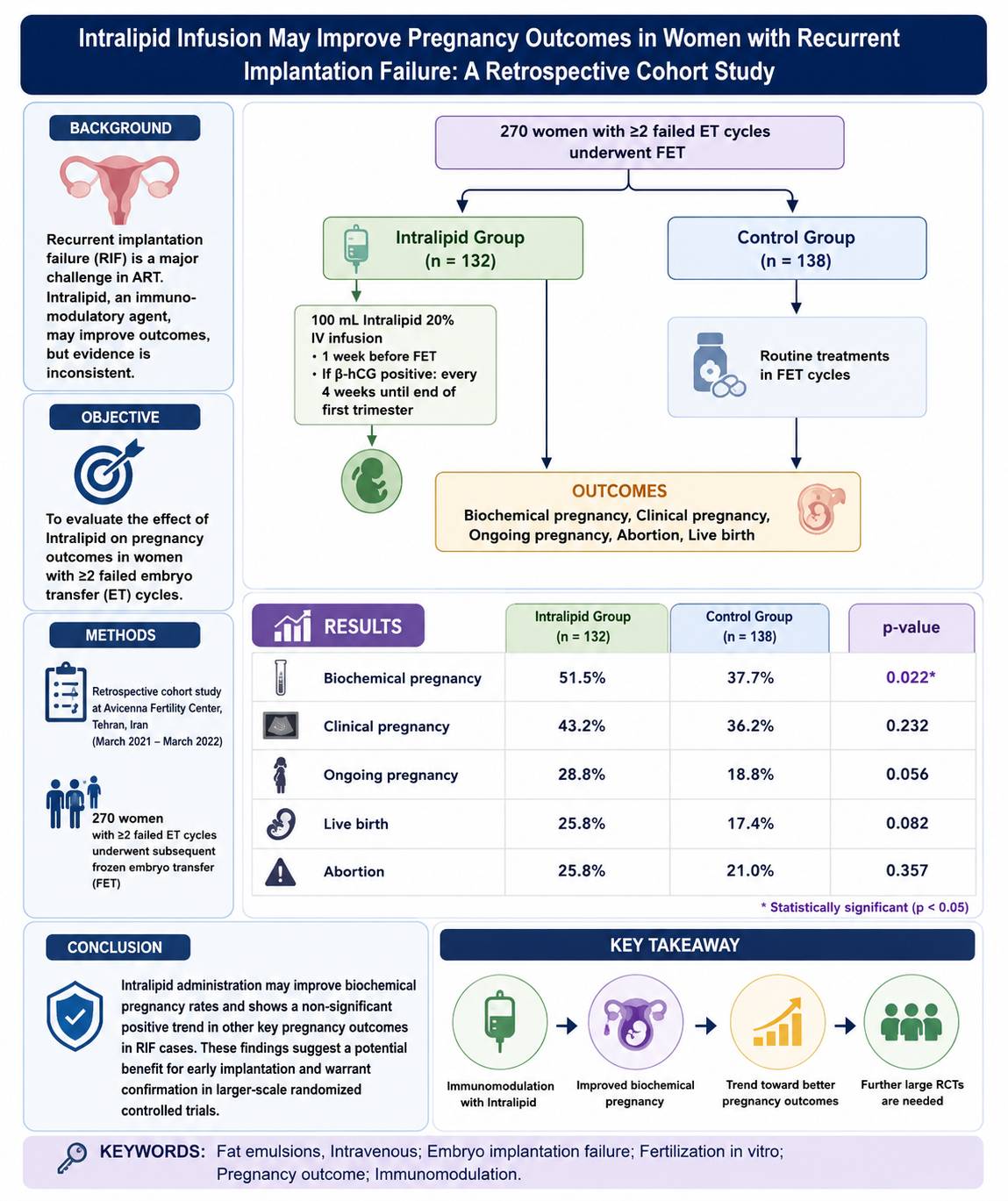
Background: Recurrent implantation failure remains a challenge in assisted reproduction. Intralipid has been proposed as an immunomodulatory intervention to improve outcomes, although evidence remains inconsistent.
Objective: This study aimed to evaluate the effect of intralipid on pregnancy outcomes in women with a history of at least 2 failed embryo transfer cycles.
Materials and Methods: In this retrospective cohort study, data of 270 women with ≥ 2 failed embryo transfer cycles, who underwent a subsequent frozen embryo transfer (FET) at Avicenna Fertility Center, Tehran, Iran, from March 2021-2022 were extracted from medical records. Participants were allocated to the intralipid group (n = 132), receiving 100 mL intravenous intralipid 20% 1 wk before FET, if beta-human chorionic gonadotropin was positive, the same dose was given every 4 wk until the end of the first trimester, or to the control group (n = 138), undergoing routine FET treatments. Outcomes included biochemical, clinical, and ongoing pregnancy, abortion, and live birth.
Results: Biochemical pregnancy rate was significantly higher in the intralipid group compared with controls (51.5% vs. 37.7%, p = 0.022). Clinical pregnancy (43.2% vs. 36.2%), ongoing pregnancy (28.8% vs. 18.8%), and live birth (25.8% vs. 17.4%) also favored the intralipid group, although these differences did not reach statistical significance (p > 0.05). Abortion rates were comparable between groups (25.8% vs. 21.0%, p = 0.357).
Conclusion: Intralipid may improve biochemical pregnancy rates and shows a non-significant positive trend in other pregnancy outcomes in recurrent implantation failure cases, warranting confirmation in larger randomized controlled trials.
Objective: This study aimed to evaluate the effect of intralipid on pregnancy outcomes in women with a history of at least 2 failed embryo transfer cycles.
Materials and Methods: In this retrospective cohort study, data of 270 women with ≥ 2 failed embryo transfer cycles, who underwent a subsequent frozen embryo transfer (FET) at Avicenna Fertility Center, Tehran, Iran, from March 2021-2022 were extracted from medical records. Participants were allocated to the intralipid group (n = 132), receiving 100 mL intravenous intralipid 20% 1 wk before FET, if beta-human chorionic gonadotropin was positive, the same dose was given every 4 wk until the end of the first trimester, or to the control group (n = 138), undergoing routine FET treatments. Outcomes included biochemical, clinical, and ongoing pregnancy, abortion, and live birth.
Results: Biochemical pregnancy rate was significantly higher in the intralipid group compared with controls (51.5% vs. 37.7%, p = 0.022). Clinical pregnancy (43.2% vs. 36.2%), ongoing pregnancy (28.8% vs. 18.8%), and live birth (25.8% vs. 17.4%) also favored the intralipid group, although these differences did not reach statistical significance (p > 0.05). Abortion rates were comparable between groups (25.8% vs. 21.0%, p = 0.357).
Conclusion: Intralipid may improve biochemical pregnancy rates and shows a non-significant positive trend in other pregnancy outcomes in recurrent implantation failure cases, warranting confirmation in larger randomized controlled trials.
Keywords: Fat emulsions, Intravenous, Embryo implantation failure, Fertilization in vitro, Pregnancy outcome, Immunomodulation.
Type of Study: Original Article |
Subject:
Assisted Reproductive Technologies
Send email to the article author
| Rights and permissions | |
 |
This work is licensed under a Creative Commons Attribution-NonCommercial 4.0 International License. |