International Journal of
Reproductive Biomedicine
Mon, Sep 28, 2026
[Archive]
Volume 24, Issue 3 (March 2026)
IJRM 2026, 24(3): 231-244 |
Back to browse issues page



Ethics code: IR.BUMS.REC.1401.247


Download citation:
BibTeX | RIS | EndNote | Medlars | ProCite | Reference Manager | RefWorks
Send citation to:


BibTeX | RIS | EndNote | Medlars | ProCite | Reference Manager | RefWorks
Send citation to:
Rezghi S, Hazari V, Dastjerdi R, Salehiniya H. Evaluation of coping mechanisms and depression, anxiety, and stress in women with infertility: A cross-sectional study. IJRM 2026; 24 (3) :231-244
URL: http://ijrm.ir/article-1-3385-en.html
URL: http://ijrm.ir/article-1-3385-en.html


1- Department of Obstetrics and Gynecology, Faculty of Medicine, Birjand University of Medical Sciences, Birjand, Iran.
2- Department of Obstetrics and Gynecology, School of Medicine, Rooyesh Infertility Center, Cellular and Molecular Research Center, Birjand University of Medical Sciences, Birjand, Iran. & Department of Obstetrics and Gynecology, School of Medicine, Clinical Research Development Unit (CRDU), Valiasr Hospital, Birjand University of Medical Sciences, Birjand, Iran. ,dr.vhazari@gmail.com; vajihehazari@bums.ac.ir
3- Department of General Courses, School of Medicine, Cardiovascular Diseases Research Center, Birjand University of Medical Sciences, Birjand, Iran.
4- Department of Epidemiology and Biostatistics, School of Health, Social Determinants of Health Research Center, Birjand University of Medical Sciences, Birjand, Iran.
2- Department of Obstetrics and Gynecology, School of Medicine, Rooyesh Infertility Center, Cellular and Molecular Research Center, Birjand University of Medical Sciences, Birjand, Iran. & Department of Obstetrics and Gynecology, School of Medicine, Clinical Research Development Unit (CRDU), Valiasr Hospital, Birjand University of Medical Sciences, Birjand, Iran. ,
3- Department of General Courses, School of Medicine, Cardiovascular Diseases Research Center, Birjand University of Medical Sciences, Birjand, Iran.
4- Department of Epidemiology and Biostatistics, School of Health, Social Determinants of Health Research Center, Birjand University of Medical Sciences, Birjand, Iran.
Abstract: (661 Views)
Background: Assessing depression, anxiety, and stress levels in women with infertility, along with their coping strategies, can significantly improve their mental health.
Objective: This study examined the relationship between coping mechanisms and psychological symptoms in women with infertility.
Materials and Methods: In this cross-sectional study, 386 Iranian women with infertility attending Rooyesh Infertility Center in Birjand, Iran, completed the coping inventory for stressful situations (Endler and Parker) and the depression, anxiety, and stress scale-21.
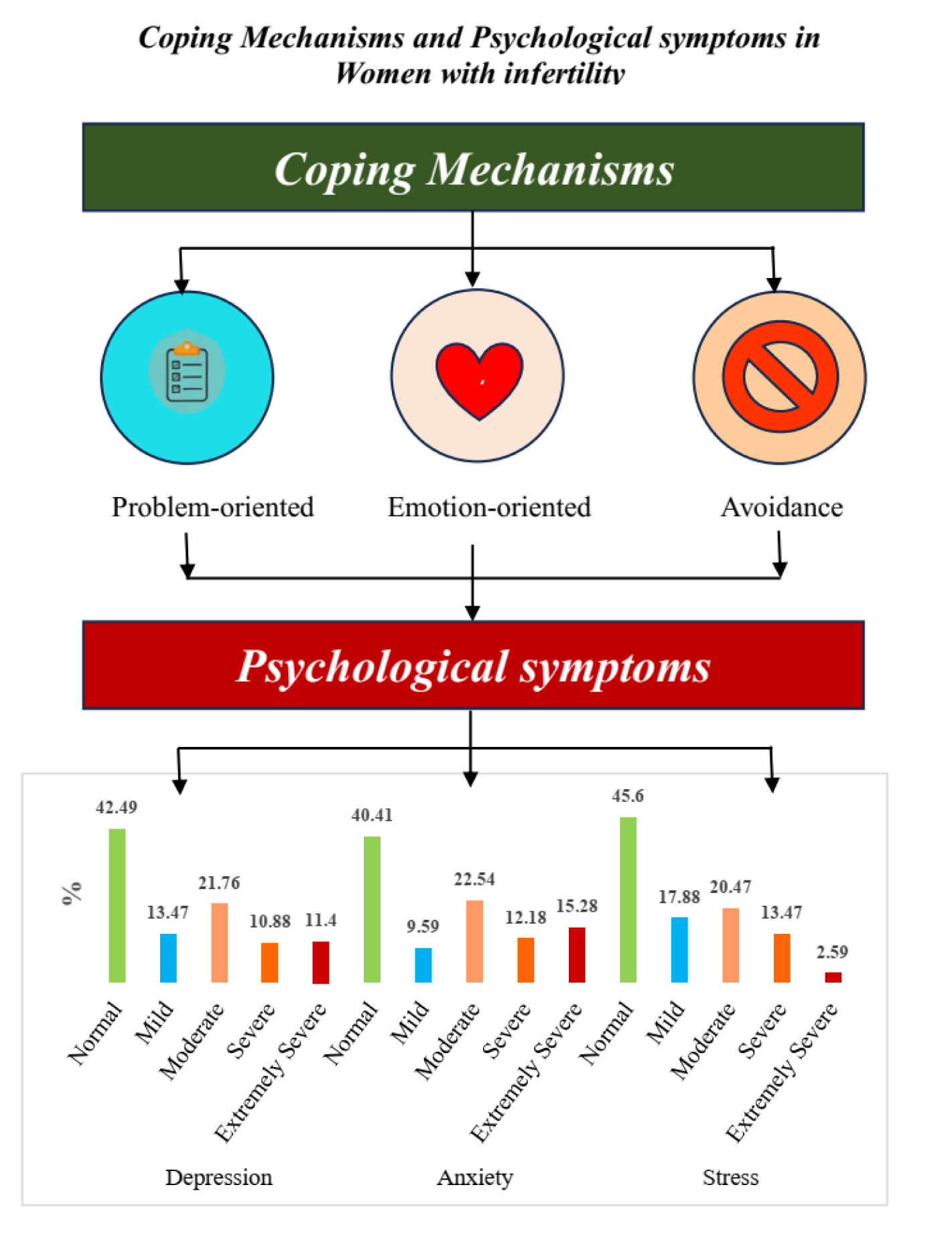
Results: Approximately 43% reported normal levels of depression, 40% normal anxiety, and 46% normal stress. Mean scores on the coping inventory for stressful situations were highest for problem-oriented coping (46.83 ± 11.36), followed by avoidance (41.49 ± 9.56) and emotion-oriented coping (40.11 ± 11.29). The results showed that greater use of problem-oriented coping was associated with lower levels of depression, anxiety, and stress (p < 0.01). In contrast, greater reliance on emotion-oriented coping was linked to higher depression and anxiety but lower stress (p < 0.001). Household income also demonstrated a significant positive relationship with depression and stress scores (p < 0.05).
Conclusion: Problem-oriented coping significantly reduces depression, anxiety, and stress in women with infertility, whereas emotion-oriented coping increases depression and anxiety but decreases stress. Implementing targeted coping strategies can effectively manage psychological symptoms. Healthcare providers may use problem-oriented approaches for long-term psychological support and emotion-oriented strategies for short-term relief.
Objective: This study examined the relationship between coping mechanisms and psychological symptoms in women with infertility.
Materials and Methods: In this cross-sectional study, 386 Iranian women with infertility attending Rooyesh Infertility Center in Birjand, Iran, completed the coping inventory for stressful situations (Endler and Parker) and the depression, anxiety, and stress scale-21.
Results: Approximately 43% reported normal levels of depression, 40% normal anxiety, and 46% normal stress. Mean scores on the coping inventory for stressful situations were highest for problem-oriented coping (46.83 ± 11.36), followed by avoidance (41.49 ± 9.56) and emotion-oriented coping (40.11 ± 11.29). The results showed that greater use of problem-oriented coping was associated with lower levels of depression, anxiety, and stress (p < 0.01). In contrast, greater reliance on emotion-oriented coping was linked to higher depression and anxiety but lower stress (p < 0.001). Household income also demonstrated a significant positive relationship with depression and stress scores (p < 0.05).
Conclusion: Problem-oriented coping significantly reduces depression, anxiety, and stress in women with infertility, whereas emotion-oriented coping increases depression and anxiety but decreases stress. Implementing targeted coping strategies can effectively manage psychological symptoms. Healthcare providers may use problem-oriented approaches for long-term psychological support and emotion-oriented strategies for short-term relief.
Type of Study: Original Article |
Subject:
Fertility & Infertility
Send email to the article author
| Rights and permissions | |
 |
This work is licensed under a Creative Commons Attribution-NonCommercial 4.0 International License. |