
International Journal of
Reproductive Biomedicine
Tue, Oct 6, 2026
[Archive]
Volume 24, Issue 4 (April 2026)
IJRM 2026, 24(4): 349-358 |
Back to browse issues page



Ethics code: IR.UMA.REC.1400.029


Download citation:
BibTeX | RIS | EndNote | Medlars | ProCite | Reference Manager | RefWorks
Send citation to:


BibTeX | RIS | EndNote | Medlars | ProCite | Reference Manager | RefWorks
Send citation to:
Haghighat K, Mahmoudi F, Khazali H. Effects of chrysin on Kisspeptin, neurokinin B, and dynorphin neurons and gonadotropin-releasing hormone gene expression in stress-induced rats: An experimental study. IJRM 2026; 24 (4) :349-358
URL: http://ijrm.ir/article-1-3643-en.html
URL: http://ijrm.ir/article-1-3643-en.html


1- Department of Biology, Faculty of Sciences, University of Mohaghegh Ardabili, Ardabil, Iran.
2- Department of Biology, Faculty of Sciences, University of Mohaghegh Ardabili, Ardabil, Iran. ,f.mahmoudi@uma.ac.ir
3- Department of Animal Sciences and Marine Biology, Faculty of Life Sciences and Biotechnology, Shahid Beheshti University, Tehran, Iran.
2- Department of Biology, Faculty of Sciences, University of Mohaghegh Ardabili, Ardabil, Iran. ,
3- Department of Animal Sciences and Marine Biology, Faculty of Life Sciences and Biotechnology, Shahid Beheshti University, Tehran, Iran.
Abstract: (598 Views)
Background: A subpopulation of neurons known as Kisspeptin, neurokinin B, and dynorphin (KNDy) are located in the hypothalamus. These neurons co-express and release the corresponding neuropeptides. KNDy neurons are important in the reproductive process and can be affected by a number of factors, such as stress.
Objective: To investigate the effect of chrysin as an anti-stress agent on the gene expression of hypothalamic Kisspeptin (Kiss1), tachykinin 2 (Tac2), pro-dynorphin (Pdyn), and gonadotropin-releasing hormone (GnRH) in stress model rats.
Materials and Methods: In this experimental study, 30 male Wistar rats (200 ± 10 gr, 8 wk old) were randomly assigned into 6 groups (n = 5/each). The rats were subjected to stress for 2 hr. The control and stress groups received normal saline. Chrysin (40 or 20 μg, intracerebroventricular injection, single dose) was injected into stress-induced rats, respectively. Also, intact groups received chrysin (40 or 20 μg, intracerebroventricular injection, single dose). Hypothalamic tissue was removed. Relative gene expression was assessed by a real-time polymerase chain reaction.
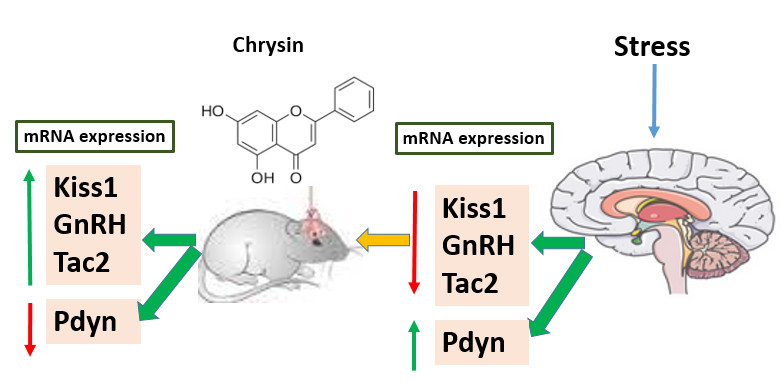
Results: Expression of Kiss1 (p ≤ 0.001), GnRH (p = 0.002), and Tac2 genes (p = 0.002) decreased, and the expression of Pdyn (p = 0.02) increased, in the stress group compared to the control group. No significant increase was observed in the expression of Kiss1, GnRH, and Tac2 genes in rats treated with chrysin (40 or 20 μg) compared to the stress group; however, it caused a significant decrease in the expression of Pdyn gene compared to the stress group (p = 0.02, p = 0.01).
Conclusion: Chrysin may regulate the reproductive axis via modulation of hypothalamic KNDy gene expression following stress suppression.
Objective: To investigate the effect of chrysin as an anti-stress agent on the gene expression of hypothalamic Kisspeptin (Kiss1), tachykinin 2 (Tac2), pro-dynorphin (Pdyn), and gonadotropin-releasing hormone (GnRH) in stress model rats.
Materials and Methods: In this experimental study, 30 male Wistar rats (200 ± 10 gr, 8 wk old) were randomly assigned into 6 groups (n = 5/each). The rats were subjected to stress for 2 hr. The control and stress groups received normal saline. Chrysin (40 or 20 μg, intracerebroventricular injection, single dose) was injected into stress-induced rats, respectively. Also, intact groups received chrysin (40 or 20 μg, intracerebroventricular injection, single dose). Hypothalamic tissue was removed. Relative gene expression was assessed by a real-time polymerase chain reaction.
Results: Expression of Kiss1 (p ≤ 0.001), GnRH (p = 0.002), and Tac2 genes (p = 0.002) decreased, and the expression of Pdyn (p = 0.02) increased, in the stress group compared to the control group. No significant increase was observed in the expression of Kiss1, GnRH, and Tac2 genes in rats treated with chrysin (40 or 20 μg) compared to the stress group; however, it caused a significant decrease in the expression of Pdyn gene compared to the stress group (p = 0.02, p = 0.01).
Conclusion: Chrysin may regulate the reproductive axis via modulation of hypothalamic KNDy gene expression following stress suppression.
Type of Study: Original Article |
Subject:
Reproductive Genetics
Send email to the article author
| Rights and permissions | |
 |
This work is licensed under a Creative Commons Attribution-NonCommercial 4.0 International License. |