
International Journal of
Reproductive Biomedicine
Wed, Oct 14, 2026
[Archive]
Volume 23, Issue 11 (November 2025)
IJRM 2025, 23(11): 881-896 |
Back to browse issues page




Download citation:
BibTeX | RIS | EndNote | Medlars | ProCite | Reference Manager | RefWorks
Send citation to:


BibTeX | RIS | EndNote | Medlars | ProCite | Reference Manager | RefWorks
Send citation to:
Baradaran Bagheri R, Mohammadian S. Unveiling the molecular nexus: Long non-coding RNAs, RNA-binding proteins, and DNA damage in ovarian ischemia-reperfusion injury: A narrative review. IJRM 2025; 23 (11) :881-896
URL: http://ijrm.ir/article-1-3693-en.html
URL: http://ijrm.ir/article-1-3693-en.html


1- Department of Obstetrics and Gynecology, Faculty of Medicine, Tabriz University of Medical Sciences, Tabriz, Iran.
2- Department of Obstetrics and Gynecology, Kamali Hospital, Alborz University of Medical Sciences, Karaj, Iran. ,shima.mohammadian@abzums.ac.ir
2- Department of Obstetrics and Gynecology, Kamali Hospital, Alborz University of Medical Sciences, Karaj, Iran. ,
Abstract: (805 Views)
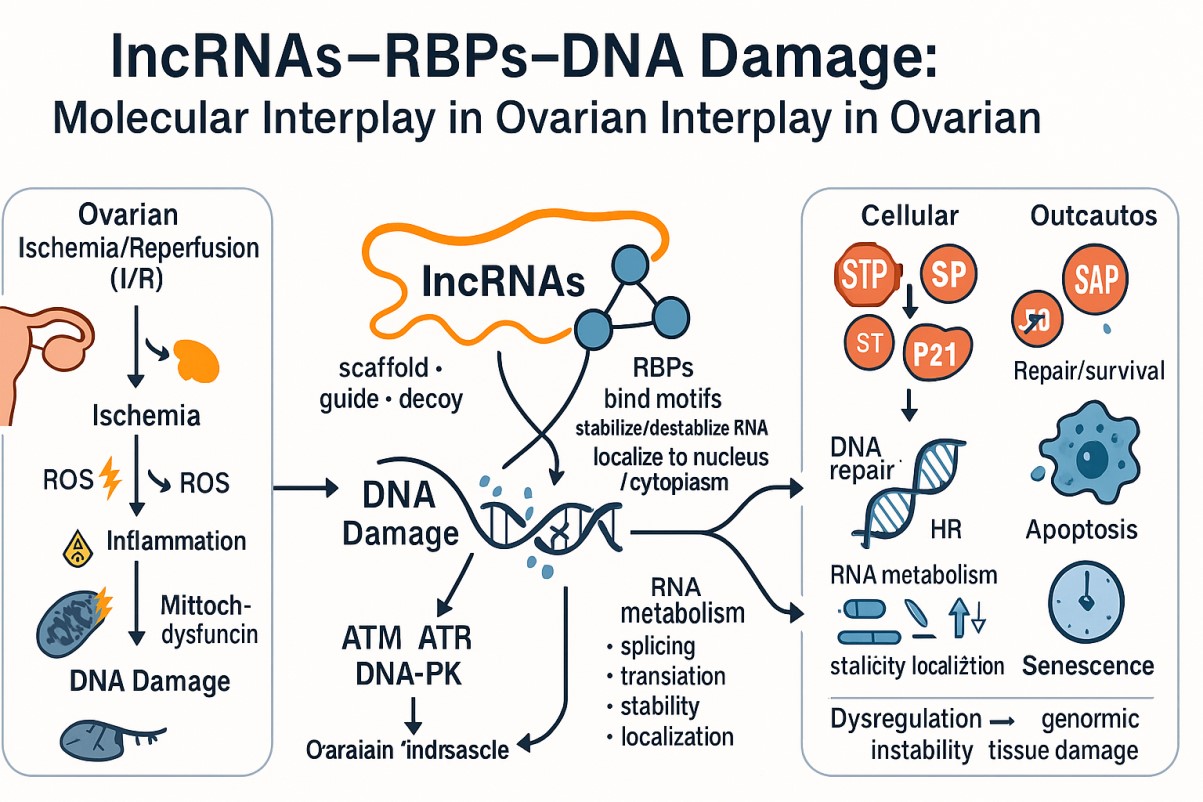
Ovarian ischemia-reperfusion injury (IRI) is a pathology that entails the interruption of blood supply to the ovary and subsequent restoration of flow, causing tissue damage and dysfunction. Therefore, the identification of cisternal components, long non-coding RNAs (lncRNAs), and RNA-binding proteins (RBPs), as well as their roles in the DNA damage response (DDR), is critical in understanding the underlying molecular mechanisms and finding potential therapeutic targets. Therefore, the expression profile of lncRNA and the regulation of DDR in various cellular processes can be controlled through interactions with RBPs. As scaffolds, guides or decoys regulating RNA processes, mediating DNA repair, and other cellular responses to genotoxic stress, lncRNAs play their roles. Alterations of lncRNA-RBP interactions have been involved in multiple diseases, including ovarian IRI, which prompts their further assessment as therapeutic targets. Abnormal RBPs will lead to the disruption of RNA homeostasis, a decline in DNA repair, and the exacerbation of the IRI-mediated tissue damage in the ovaries. These pathways are involved in cell cycle regulation, DNA repair, and apoptosis regulation in ovarian IRI, and manipulation of these pathways by lncRNAs and RBPs identified here may contribute to disease progression and/or serve as potential therapeutic targets. Studying these molecular processes promises almost targeted therapeutic approaches to individualized treatment. Future studies should try to understand the differential contribution of particular lncRNAs and RBPs, as well as DDR pathways involved in ovarian IRI, to provide better prognostic estimates and ameliorate ovarian function in patients.
Type of Study: Review Article |
Subject:
Reproductive Pattology
Send email to the article author
| Rights and permissions | |
 |
This work is licensed under a Creative Commons Attribution-NonCommercial 4.0 International License. |