Volume 24, Issue 6 (June 2026)
IJRM 2026, 24(6): 0-0 |
Back to browse issues page

Ethics code: IR.ACECR.AVICENNA.REC.1403.018


Download citation:
BibTeX | RIS | EndNote | Medlars | ProCite | Reference Manager | RefWorks
Send citation to:


BibTeX | RIS | EndNote | Medlars | ProCite | Reference Manager | RefWorks
Send citation to:
Ghadirkhomi E, Norouzi A. Accuracy of non-invasive prenatal screening compared with amniocentesis: A retrospective study. IJRM 2026; 24 (6)
URL: http://ijrm.ir/article-1-3793-en.html
URL: http://ijrm.ir/article-1-3793-en.html


1- Department of Genetics in Reproductive Disorders, Academic Center for Education, Culture, and Research (ACECR), Tabriz, Iran. , ghadirkhomi@acecr.ac.ir
2- Department of Genetics in Reproductive Disorders, Academic Center for Education, Culture, and Research (ACECR), Tabriz, Iran.
2- Department of Genetics in Reproductive Disorders, Academic Center for Education, Culture, and Research (ACECR), Tabriz, Iran.
Abstract: (25 Views)
Background: One significant concern during pregnancy is the possibility of chromosomal malformations. While prenatal screenings are intended to reassure parents about the health of their unborn child, how reliable are these results when deemed suspicious?
Objective: This study aimed to evaluate the predictive accuracy of non-invasive prenatal screening tests in comparison with amniocentesis as the gold standard diagnostic method for chromosomal abnormalities.
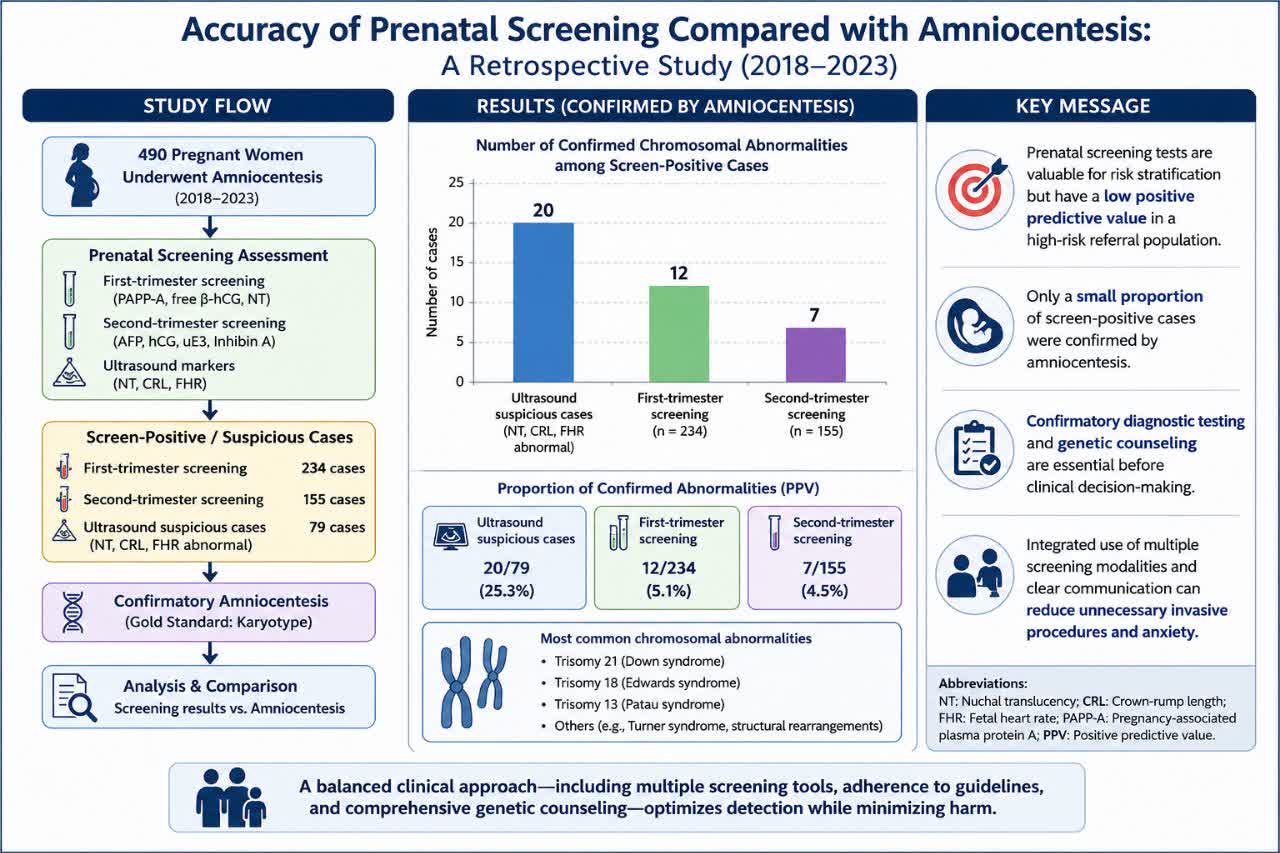
Materials and Methods: This retrospective descriptive-analytical study was performed using medical records of 490 pregnant women who underwent amniocentesis between 2018 and 2023. Data related to first- and second-trimester maternal serum screening results, ultrasound markers, and fetal karyotype findings were extracted and analyzed.
Results: Among 490 pregnant women who underwent amniocentesis, 79 cases were suspected of chromosomal abnormalities based on combined first-trimester ultrasound criteria. Cytogenetic analysis confirmed abnormalities in only 20 of these suspected cases (25.3%). After excluding very low-risk results (≥ 1:300), amniocentesis confirmed abnormalities in only 5.1% (12/234) of first-trimester and 4.5% (7/155) of second-trimester screen-positive cases. All comparisons between screening results and amniocentesis showed significant differences (p < 0.05).
Conclusion: These findings suggest that a more appropriate clinical approach involves the integrated use of multiple screening tools combined with genetic counseling and clear communication for prenatal care, as well as using validated noninvasive methods such as non-invasive prenatal testing before amniocentesis, thus rationally supporting parents when making decisions. Ultimately, although amniocentesis remains the most accurate diagnostic tool, the goal should be to use all available methods judiciously to minimize unnecessary interventions and psychological harm.
Objective: This study aimed to evaluate the predictive accuracy of non-invasive prenatal screening tests in comparison with amniocentesis as the gold standard diagnostic method for chromosomal abnormalities.
Materials and Methods: This retrospective descriptive-analytical study was performed using medical records of 490 pregnant women who underwent amniocentesis between 2018 and 2023. Data related to first- and second-trimester maternal serum screening results, ultrasound markers, and fetal karyotype findings were extracted and analyzed.
Results: Among 490 pregnant women who underwent amniocentesis, 79 cases were suspected of chromosomal abnormalities based on combined first-trimester ultrasound criteria. Cytogenetic analysis confirmed abnormalities in only 20 of these suspected cases (25.3%). After excluding very low-risk results (≥ 1:300), amniocentesis confirmed abnormalities in only 5.1% (12/234) of first-trimester and 4.5% (7/155) of second-trimester screen-positive cases. All comparisons between screening results and amniocentesis showed significant differences (p < 0.05).
Conclusion: These findings suggest that a more appropriate clinical approach involves the integrated use of multiple screening tools combined with genetic counseling and clear communication for prenatal care, as well as using validated noninvasive methods such as non-invasive prenatal testing before amniocentesis, thus rationally supporting parents when making decisions. Ultimately, although amniocentesis remains the most accurate diagnostic tool, the goal should be to use all available methods judiciously to minimize unnecessary interventions and psychological harm.
Keywords: Prenatal screening, Amniocentesis, Chromosomal abnormalities, Prenatal diagnosis, Genetic counseling.
Type of Study: Original Article |
Subject:
Reproductive Biology
Send email to the article author
| Rights and permissions | |
 |
This work is licensed under a Creative Commons Attribution-NonCommercial 4.0 International License. |