International Journal of
Reproductive Biomedicine
Tue, Sep 29, 2026
[Archive]
Volume 24, Issue 5 (May 2026)
IJRM 2026, 24(5): 413-420 |
Back to browse issues page



Ethics code: IR.SSU.RSI.REC.1401.017


Download citation:
BibTeX | RIS | EndNote | Medlars | ProCite | Reference Manager | RefWorks
Send citation to:


BibTeX | RIS | EndNote | Medlars | ProCite | Reference Manager | RefWorks
Send citation to:
Haghdani S, Vahidi . S, Sadeghi A, Gholami Banadkuki N. Comparison of intracytoplasmic sperm injection outcomes in men with spinal cord injury using sperm retrieved by electroejaculation and testicular sperm extraction methods: A retrospective cohort study. IJRM 2026; 24 (5) :413-420
URL: http://ijrm.ir/article-1-3797-en.html
URL: http://ijrm.ir/article-1-3797-en.html


1- Andrology Research Center, Yazd Reproductive Sciences Institute, Shahid Sadoughi University of Medical Sciences, Yazd, Iran. , saeed_haghdani@yahoo.com
2- Research and Clinical Center for Infertility, Yazd Reproductive Sciences Institute, Shahid Sadoughi University of Medical Sciences, Yazd, Iran.
3- Department of Surgical Technology, Faculty of Paramedical, Shahid Sadoughi University of Medical Sciences, Yazd, Iran.
4- Andrology Research Center, Yazd Reproductive Sciences Institute, Shahid Sadoughi University of Medical Sciences, Yazd, Iran.
2- Research and Clinical Center for Infertility, Yazd Reproductive Sciences Institute, Shahid Sadoughi University of Medical Sciences, Yazd, Iran.
3- Department of Surgical Technology, Faculty of Paramedical, Shahid Sadoughi University of Medical Sciences, Yazd, Iran.
4- Andrology Research Center, Yazd Reproductive Sciences Institute, Shahid Sadoughi University of Medical Sciences, Yazd, Iran.
Keywords: Spinal cord injury, Sperm retrieval, Intracytoplasmic sperm injections, Pregnancy outcomes.
Full-Text [PDF 389 kb]
(407 Downloads)
| Abstract (HTML) (512 Views)
Full-Text: (63 Views)
1. Introduction
Spinal cord injuries (SCI) occur due to different reasons, such as accidents or combat injuries (1). One of the significant concerns in these individuals is infertility, resulting from erectile and ejaculatory dysfunction, as well as impaired sperm quality (2, 3). In SCI cases, the rates of ejaculation range from 0-65.6%, depending on the injury level (3-5). About 10% are capable of having their own biological offspring without medical assistance (6). In individuals with SCI, sperm samples are obtained via different techniques, including electroejaculation (EE), vibratory stimulation, or testicular sperm extraction (TESE), combined with assisted reproductive technique (ART) such as intracytoplasmic injection (ICSI) (7). EE is a non-surgical technique where the ejaculation reflex is induced through low-voltage electric impulses on the prostate gland and the seminal vesicles, enabling sperm retrieval for ARTs with a high success rate of 85-100%. However, SCI cases have low sperm motility (8, 9). Moreover, applying this method requires a specific instrument and more skills and experience (7).
In conditions where EE obtains no sperm, sperm are retrieved directly and surgically from reproductive tissues, including the testis or epididymis, which is an alternative technique (10, 11). Despite the extensive applications of both approaches, a common consensus regarding a superior clinical outcome of sperm retrieval among men with SCI using one of these methods over another has not been achieved. Certain previous studies indicated a potentially higher fertilization and pregnancy potential of TESE sperm due to their reduced reactive oxygen species and DNA fragmentation indices, since testicular sperm are less affected by inflammatory mediators and seminal oxidative stress (12). However, more contemporary studies have confirmed similar ICSI rates between EE-ICSI and TESE-ICSI cycles, provided rigorous environmental conditions are met for both ICSI procedures and embryo culture (13). These findings suggest that sperm quality differences may be mitigated by optimized ICSI techniques, embryo selection, and improved cryopreservation protocols.
Recently, the importance of DNA integrity and quality in spermatozoa obtained by ART has also been stressed. Spermatozoa obtained by EE may exhibit higher levels of oxidative DNA damage, as well as protamine deficiency, which can impact the embryo's development and the chances of pregnancy (14, 15). However, TESE-derived spermatozoa, which are obtained before entering the semen environment, may show low DNA fragmentation, though immaturity-related anomalies in chromatin may exist. Modern ICSI methodologies enable the bypassing of problems associated with the semen by selecting intact morphological spermatozoa and providing optimal conditions for the oocyte (16).
Considering these scientific and clinical uncertainties, this study was conducted to comparatively analyze the ICSI success rates in men with SCI using both techniques of sperm procurement through EE and TESE.
To the best of our knowledge, this is the first comprehensive retrospective study conducted in an Iranian population, directly comparing clinical and live-birth outcomes between EE-ICSI and TESE-ICSI procedures in men with SCI, all treated within the same reproductive institute under uniform laboratory and clinical conditions. This approach minimizes confounding factors related to operator technique, laboratory environment, or population heterogeneity.
By standardizing the clinical and embryological protocols across both groups, our study provides a unique, controlled evaluation of the real-world effectiveness of these 2 sperm retrieval methods. It offers region-specific evidence from a Middle Eastern population that has been under-represented in previous reports.
2. Materials and Methods
2.1. Study design and participants
This retrospective cohort study was conducted on 37 participants with SCI who were referred to the Yazd Reproductive Sciences Institute, Yazd, Iran, for fertility treatment from August 2017 to September 2023. The levels of spinal cord lesions ranged from C4 to L2. Sperm retrieval procedure was performed by the EE method or TESE. Sufficient information about the sperm retrieval techniques was given to the couples. The choice of sperm retrieval technique (EE or TESE) was based on clinical assessment, including the neurological level and completeness of SCI, previous failure of EE, risk of autonomic dysreflexia, and the physician's discretion. As this was a retrospective study, random allocation was not carried out.
2.2. Eligibility criteria
Inclusion criteria included confirmed diagnosis of SCI through neurological examination and imaging (magnetic resonance imaging or computed tomography), documented ejaculatory dysfunction or anejaculation, couples with male-factor infertility according to the World Health Organisation (2010) guidelines, female partners ≤ 40 yr with normal reproductive function, availability of complete clinical, laboratory, and follow-up data, and written informed consent for participation. Exclusion criteria included additional infertility causes unrelated to SCI (e.g., varicocele, genetic disorders, hormonal abnormalities), female-factor infertility (e.g., endometriosis, diminished ovarian reserve), incomplete medical or embryological data, and declined consent for data use.
2.3. Ovarian stimulation and oocyte retrieval
The ICSI technique was carried out for both sperm retrieval methods. For the ICSI technique, ovarian stimulation and oocyte retrieval were performed. There are different protocols for this purpose. In general, Decapeptyl (3.75 mg), a gonadotropin-releasing hormone agonist, and menotropin, a human menopausal gonadotropin, were administered. Oocyte retrieval was transvaginal ultrasound-guided 36 hr after human chorionic gonadotropin administration. Mature oocytes in the metaphase II stage, identified by the extrusion of the first polar body, were inseminated by the ICSI technique. The ICSI technique was performed using micropipettes and microinjectors. After injection, all oocytes were incubated for 16-18 hr, and fertilization was assessed by the presence of 2 pronuclei and extrusion of the second polar body. Embryo development and the number of cell cleavages were recorded 44-48 hr after injection. Embryos were transferred via ultrasound guidance. Progesterone (600 mg/day) was administered for luteal phase support. A serum human chorionic gonadotropin level above 10 mIU/mL measured 12 days after embryo transfer was considered a positive pregnancy test. The presence of a heartbeat via ultrasound indicated a clinical pregnancy.
2.4. Sperm retrieval procedures
2.4.1. EE
Before EE, to empty the bladder, catheterization was performed, and 20 ml Ham’s F10 culture medium was instilled into the bladder. Then, for EE, the Seager Model 14 (Dalzell USA Medical System) was used. The probe was placed on the anterior rectal wall, and autonomic dysreflexia was controlled in all cases. In antegrade and/or retrograde samples, semen was analyzed and prepared. Retrograde samples were obtained from the bladder via catheterization.
2.4.2. TESE
Under local anesthesia, a vertical incision was made along the scrotal raphe. To expose the tunica albuginea, all skin, dartos muscle, and tunica vaginalis were opened. A testicular sample (0.05 ml) was extracted with curved scissors via mild pressure on the testicular mass. After that, testicular tissue biopsies were transferred in the petri dish containing 4-(2-hydroxyethyl)-1-piperazineethanesulfonic acid-buffered modified Earle’s medium and sent to the laboratory, where the samples were dissected and carefully scanned for the presence of sperm under an inverted microscope (400× magnification). In the condition that no sperm was found in the samples, second biopsies were taken from different parts of the testis.
2.5. Ethical Considerations
This study was reviewed and approved by the ethics committee of Shahid Sadoughi University of Medical Sciences, Yazd, Iran (Code: IR.SSU.RSI.REC.1401.017). All procedures performed in this study involving human participants were conducted in accordance with the ethical standards of the institutional and national research committee, as well as the 1964 Helsinki Declaration and its later amendments or comparable ethical standards. Written informed consent was obtained from all participating couples. All personal identifiers were removed to ensure the anonymity and privacy of participants. The data were used solely for scientific purposes and stored securely with access limited to the research team.
2.6. Statistical Analysis
Continuous variables (e.g., testicular volume and hormonal levels) were assessed for normality using the Shapiro-Wilk test. Normally distributed data were expressed as mean ± standard deviation, while non-normally distributed data were expressed as median and interquartile range. Independent samples t tests were used to compare normally distributed continuous variables between the 2 groups. For non-normally distributed variables, the Mann-Whitney U test was applied. Categorical variables, including chemical pregnancy, clinical pregnancy, and live birth rates, were presented as frequency and percentage and compared using the Chi-square test or Fisher’s exact test when appropriate. P < 0.05 was considered statistically significant. All data were analyzed using the Statistical Package for the Social Sciences (SPSS) version 20 (IBM, California, United States).
3. Results
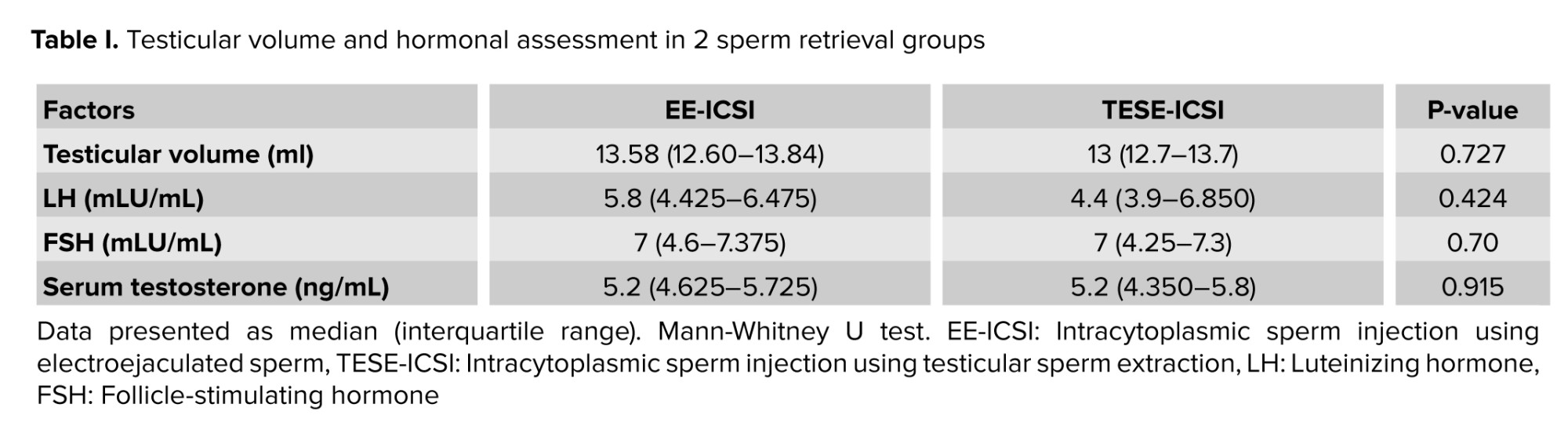
54 ICSI cycles were performed in 37 participants with SCI who underwent infertility treatment between 2017 and 2023. The EE procedure was performed in 12 men, and 25 men underwent TESE. In the testicular sperm retrieval group, 2 individuals were single, and follow-up data were missing for 3 participants. Analysis of the data revealed that 21 (38.8%) chemical pregnancies were identified. Moreover, 19 (35.18%) clinical pregnancies were achieved. The take-home baby rate was 20.3%. Testicular volume and hormonal status are presented in table I.
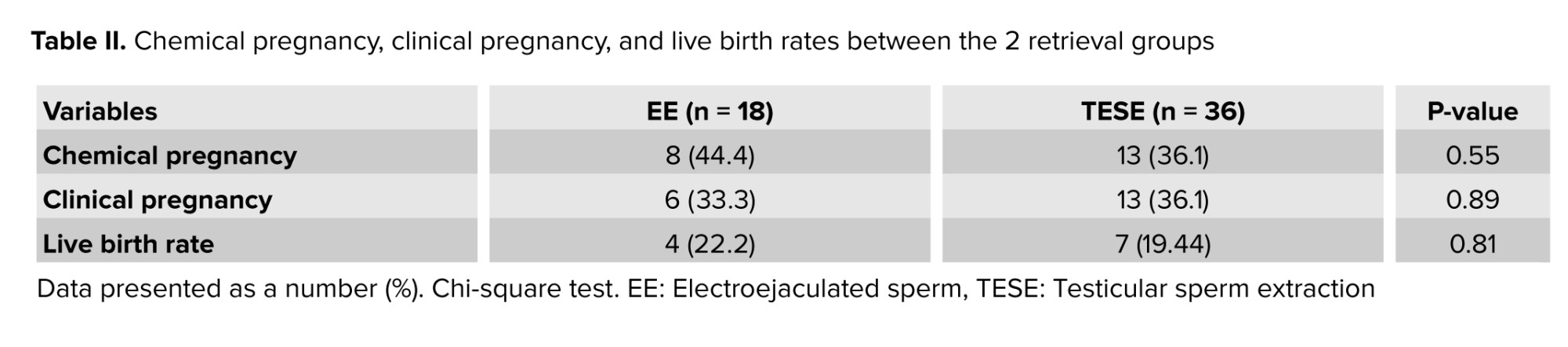
As shown in table II, the clinical and chemical pregnancy rates, as well as the live birth rates, were not significantly different between the 2 groups.
4. Discussion
This study demonstrated that no significant differences were observed in rates of chemical pregnancy, clinical pregnancy, and live birth between the 2 retrieval techniques. The similarity in clinical outcomes presented for both groups, EE and TESE, corresponds to recent publications. Ibrahim et al. noted that both EE and TESE resulted in comparable fertilization and implantation rates once advanced protocols of ICSI were applied (17). In another study, testicular sperm aspiration/extraction and ICSI in men with SCI yielded clinical pregnancy rates of 30.2% per cycle and 59.3% per couple. The live birth rate was 62.5% per couple (1). In another report, different sperm retrieval techniques, including EE, prostatic massage, and TESE, for semen collection in men with SCI were associated with similar pregnancy outcomes (7). In another study, ICSI was carried out in 37 men with SCI, and rates of pregnancy per couple and per ICSI cycle were 86.5% and 34.3%, respectively. This study revealed that sperm quality decreased over time after injury (6). Therefore, the chance of TESE decreases with time after SCI, especially after more than 12 yr. In fact, the age of SCI-affected individuals is an essential factor. As a result, based on the mentioned studies, both methods could be applied to the case, depending on the candidate’s characteristics for ICSI.
Our research has also identified that hormonal levels of follicle-stimulating hormone, luteinizing hormone, and testosterone did not significantly differ between EE and TESE groups, reinforcing the idea that SCI essentially impairs ejaculatory function and leaves spermatogenesis unchanged. Recent endocrinological reports suggest that men with chronic SCI typically retain normal serum testosterone levels while exhibiting some features of mild secondary hypogonadism due to immobilization, metabolic disturbances, and chronic inflammation (18). These hormonal observations agree with previous findings, which demonstrated that spermatogenic potential is largely preserved in SCI men. However, semen parameters such as motility and morphology are impaired due to inflammatory and thermal stress within the genital tract (19). Both techniques have distinct clinical merits and limitations from a procedural standpoint. EE is non-surgical, less invasive, and repeatable, thus suitable as a first-line approach, especially in men with preserved reflexogenic ejaculation pathways. However, EE entails the risk of autonomic dysreflexia, hypertension, and rectal mucosal injury in men with high-level spinal lesions (20). TESE, although invasive, is preferable in cases of failure or inadequate sperm recovered following EE. A sequential application of both techniques, starting first with EE and moving to TESE only, when necessary, has been advanced as the most efficient and least traumatic strategy for treating SCI-related infertility (1, 21, 22).
Another study did not find any statistical difference in pregnancy and live birth outcomes with regard to EE-ICSI and TESE-ICSI cycles. They concluded that laboratory optimization and oocyte quality played a more important role in reproductive success than did the source of sperm (13). These findings reinforce the concept that technological advances in micromanipulation and embryo culture have largely equalized the efficacy of sperm obtained from different anatomical sources. Biologically, sperm obtained via EE and TESE differ in their oxidative and functional parameters; however, these biological differences do not seem to impact clinical outcome. EE-sourced sperm are usually exposed to seminal plasma, which results in a higher reactive oxygen species level and DNA fragmentation (12). In contrast, testicular sperm are retrieved before they can undergo epididymal maturation; they exhibit a lower degree of oxidative stress but with higher immaturity in terms of their chromatin compactness (23). However, both intrinsic differences can be overcome with novel sperm selection techniques, such as motile sperm organelle morphology examination and microfluidic sorting, which have been developed to allow an embryologist to choose morphologically intact spermatozoa, so the effects of DNA damage on fertilization and embryo development can be minimized (24).
The present study has certain limitations. The retrospective design, small cohort size, and the absence of extended molecular analysis, including DNA fragmentation index, oxidative stress assays, and sperm epigenetic profiling. Due to the retrospective design, complete ASIA classification scores and detailed comorbidity profiles were not available for all patients, which is a recognized limitation. Future prospective and multicenter studies using molecular sperm quality metrics are required to shed light on subtle biological differences between EE- and TESE-derived sperm. In addition, follow-up studies into the long-term outcome of offspring born through both techniques would yield important safety and genetic outcome data.
5. Conclusion
Both electroejaculated and testicular sperm can be effectively used for ICSI in men with SCI, with no significant differences observed in chemical pregnancy, clinical pregnancy, or live birth rates between the 2 sperm retrieval methods. These findings suggest that both techniques remain viable options for managing infertility in men with SCI, and the choice of method can be individualized based on patient condition, available expertise, and prior outcomes. Future studies with larger sample sizes and prospective designs are needed to confirm these findings and to further explore long-term reproductive outcomes. Such data will help improve fertility management and counselling, particularly in regions with a rising incidence of traumatic SCI.
Data Availability
Data supporting the findings of this study are available upon reasonable request from the corresponding author.
Author Contributions
S. Haghdani: Conceptualized and designed the study; participated in patient recruitment and clinical data collection; contributed to data analysis and interpretation; and participated in manuscript drafting and revision. S. Vahidi: Conceptualized and designed the study; supervised the project; contributed to data interpretation; and critically revised the manuscript for important intellectual content. A. Sadeghi: Performed the sperm retrieval procedures and provided technical expertise for both EE and TESE; assisted in methodology design and reviewed the manuscript for accuracy and clarity. N. Gholami Banadkuki: Conducted data analysis and statistical evaluation; prepared the initial draft of the manuscript; contributed to literature review and referencing; and assisted in final manuscript editing.
Acknowledgments
The authors would like to thank the staff of the Andrology Research Center and the Yazd Reproductive Sciences Institute, Yazd, Iran for their valuable assistance in data collection and laboratory support throughout this study. No external financial support or funding was received for this work.
Artificial intelligence tools (Grammarly) were used only for language editing, grammar correction, and formatting assistance during manuscript preparation. The authors confirm that all intellectual and scientific content, study design, data analysis, interpretation, and conclusions were entirely developed by the human authors. The final version of the manuscript was thoroughly reviewed and approved by all authors.
Conflict of Interest
The authors declare that there is no conflict of interest.
Spinal cord injuries (SCI) occur due to different reasons, such as accidents or combat injuries (1). One of the significant concerns in these individuals is infertility, resulting from erectile and ejaculatory dysfunction, as well as impaired sperm quality (2, 3). In SCI cases, the rates of ejaculation range from 0-65.6%, depending on the injury level (3-5). About 10% are capable of having their own biological offspring without medical assistance (6). In individuals with SCI, sperm samples are obtained via different techniques, including electroejaculation (EE), vibratory stimulation, or testicular sperm extraction (TESE), combined with assisted reproductive technique (ART) such as intracytoplasmic injection (ICSI) (7). EE is a non-surgical technique where the ejaculation reflex is induced through low-voltage electric impulses on the prostate gland and the seminal vesicles, enabling sperm retrieval for ARTs with a high success rate of 85-100%. However, SCI cases have low sperm motility (8, 9). Moreover, applying this method requires a specific instrument and more skills and experience (7).
In conditions where EE obtains no sperm, sperm are retrieved directly and surgically from reproductive tissues, including the testis or epididymis, which is an alternative technique (10, 11). Despite the extensive applications of both approaches, a common consensus regarding a superior clinical outcome of sperm retrieval among men with SCI using one of these methods over another has not been achieved. Certain previous studies indicated a potentially higher fertilization and pregnancy potential of TESE sperm due to their reduced reactive oxygen species and DNA fragmentation indices, since testicular sperm are less affected by inflammatory mediators and seminal oxidative stress (12). However, more contemporary studies have confirmed similar ICSI rates between EE-ICSI and TESE-ICSI cycles, provided rigorous environmental conditions are met for both ICSI procedures and embryo culture (13). These findings suggest that sperm quality differences may be mitigated by optimized ICSI techniques, embryo selection, and improved cryopreservation protocols.
Recently, the importance of DNA integrity and quality in spermatozoa obtained by ART has also been stressed. Spermatozoa obtained by EE may exhibit higher levels of oxidative DNA damage, as well as protamine deficiency, which can impact the embryo's development and the chances of pregnancy (14, 15). However, TESE-derived spermatozoa, which are obtained before entering the semen environment, may show low DNA fragmentation, though immaturity-related anomalies in chromatin may exist. Modern ICSI methodologies enable the bypassing of problems associated with the semen by selecting intact morphological spermatozoa and providing optimal conditions for the oocyte (16).
Considering these scientific and clinical uncertainties, this study was conducted to comparatively analyze the ICSI success rates in men with SCI using both techniques of sperm procurement through EE and TESE.
To the best of our knowledge, this is the first comprehensive retrospective study conducted in an Iranian population, directly comparing clinical and live-birth outcomes between EE-ICSI and TESE-ICSI procedures in men with SCI, all treated within the same reproductive institute under uniform laboratory and clinical conditions. This approach minimizes confounding factors related to operator technique, laboratory environment, or population heterogeneity.
By standardizing the clinical and embryological protocols across both groups, our study provides a unique, controlled evaluation of the real-world effectiveness of these 2 sperm retrieval methods. It offers region-specific evidence from a Middle Eastern population that has been under-represented in previous reports.
2. Materials and Methods
2.1. Study design and participants
This retrospective cohort study was conducted on 37 participants with SCI who were referred to the Yazd Reproductive Sciences Institute, Yazd, Iran, for fertility treatment from August 2017 to September 2023. The levels of spinal cord lesions ranged from C4 to L2. Sperm retrieval procedure was performed by the EE method or TESE. Sufficient information about the sperm retrieval techniques was given to the couples. The choice of sperm retrieval technique (EE or TESE) was based on clinical assessment, including the neurological level and completeness of SCI, previous failure of EE, risk of autonomic dysreflexia, and the physician's discretion. As this was a retrospective study, random allocation was not carried out.
2.2. Eligibility criteria
Inclusion criteria included confirmed diagnosis of SCI through neurological examination and imaging (magnetic resonance imaging or computed tomography), documented ejaculatory dysfunction or anejaculation, couples with male-factor infertility according to the World Health Organisation (2010) guidelines, female partners ≤ 40 yr with normal reproductive function, availability of complete clinical, laboratory, and follow-up data, and written informed consent for participation. Exclusion criteria included additional infertility causes unrelated to SCI (e.g., varicocele, genetic disorders, hormonal abnormalities), female-factor infertility (e.g., endometriosis, diminished ovarian reserve), incomplete medical or embryological data, and declined consent for data use.
2.3. Ovarian stimulation and oocyte retrieval
The ICSI technique was carried out for both sperm retrieval methods. For the ICSI technique, ovarian stimulation and oocyte retrieval were performed. There are different protocols for this purpose. In general, Decapeptyl (3.75 mg), a gonadotropin-releasing hormone agonist, and menotropin, a human menopausal gonadotropin, were administered. Oocyte retrieval was transvaginal ultrasound-guided 36 hr after human chorionic gonadotropin administration. Mature oocytes in the metaphase II stage, identified by the extrusion of the first polar body, were inseminated by the ICSI technique. The ICSI technique was performed using micropipettes and microinjectors. After injection, all oocytes were incubated for 16-18 hr, and fertilization was assessed by the presence of 2 pronuclei and extrusion of the second polar body. Embryo development and the number of cell cleavages were recorded 44-48 hr after injection. Embryos were transferred via ultrasound guidance. Progesterone (600 mg/day) was administered for luteal phase support. A serum human chorionic gonadotropin level above 10 mIU/mL measured 12 days after embryo transfer was considered a positive pregnancy test. The presence of a heartbeat via ultrasound indicated a clinical pregnancy.
2.4. Sperm retrieval procedures
2.4.1. EE
Before EE, to empty the bladder, catheterization was performed, and 20 ml Ham’s F10 culture medium was instilled into the bladder. Then, for EE, the Seager Model 14 (Dalzell USA Medical System) was used. The probe was placed on the anterior rectal wall, and autonomic dysreflexia was controlled in all cases. In antegrade and/or retrograde samples, semen was analyzed and prepared. Retrograde samples were obtained from the bladder via catheterization.
2.4.2. TESE
Under local anesthesia, a vertical incision was made along the scrotal raphe. To expose the tunica albuginea, all skin, dartos muscle, and tunica vaginalis were opened. A testicular sample (0.05 ml) was extracted with curved scissors via mild pressure on the testicular mass. After that, testicular tissue biopsies were transferred in the petri dish containing 4-(2-hydroxyethyl)-1-piperazineethanesulfonic acid-buffered modified Earle’s medium and sent to the laboratory, where the samples were dissected and carefully scanned for the presence of sperm under an inverted microscope (400× magnification). In the condition that no sperm was found in the samples, second biopsies were taken from different parts of the testis.
2.5. Ethical Considerations
This study was reviewed and approved by the ethics committee of Shahid Sadoughi University of Medical Sciences, Yazd, Iran (Code: IR.SSU.RSI.REC.1401.017). All procedures performed in this study involving human participants were conducted in accordance with the ethical standards of the institutional and national research committee, as well as the 1964 Helsinki Declaration and its later amendments or comparable ethical standards. Written informed consent was obtained from all participating couples. All personal identifiers were removed to ensure the anonymity and privacy of participants. The data were used solely for scientific purposes and stored securely with access limited to the research team.
2.6. Statistical Analysis
Continuous variables (e.g., testicular volume and hormonal levels) were assessed for normality using the Shapiro-Wilk test. Normally distributed data were expressed as mean ± standard deviation, while non-normally distributed data were expressed as median and interquartile range. Independent samples t tests were used to compare normally distributed continuous variables between the 2 groups. For non-normally distributed variables, the Mann-Whitney U test was applied. Categorical variables, including chemical pregnancy, clinical pregnancy, and live birth rates, were presented as frequency and percentage and compared using the Chi-square test or Fisher’s exact test when appropriate. P < 0.05 was considered statistically significant. All data were analyzed using the Statistical Package for the Social Sciences (SPSS) version 20 (IBM, California, United States).
3. Results
54 ICSI cycles were performed in 37 participants with SCI who underwent infertility treatment between 2017 and 2023. The EE procedure was performed in 12 men, and 25 men underwent TESE. In the testicular sperm retrieval group, 2 individuals were single, and follow-up data were missing for 3 participants. Analysis of the data revealed that 21 (38.8%) chemical pregnancies were identified. Moreover, 19 (35.18%) clinical pregnancies were achieved. The take-home baby rate was 20.3%. Testicular volume and hormonal status are presented in table I.
As shown in table II, the clinical and chemical pregnancy rates, as well as the live birth rates, were not significantly different between the 2 groups.
4. Discussion
This study demonstrated that no significant differences were observed in rates of chemical pregnancy, clinical pregnancy, and live birth between the 2 retrieval techniques. The similarity in clinical outcomes presented for both groups, EE and TESE, corresponds to recent publications. Ibrahim et al. noted that both EE and TESE resulted in comparable fertilization and implantation rates once advanced protocols of ICSI were applied (17). In another study, testicular sperm aspiration/extraction and ICSI in men with SCI yielded clinical pregnancy rates of 30.2% per cycle and 59.3% per couple. The live birth rate was 62.5% per couple (1). In another report, different sperm retrieval techniques, including EE, prostatic massage, and TESE, for semen collection in men with SCI were associated with similar pregnancy outcomes (7). In another study, ICSI was carried out in 37 men with SCI, and rates of pregnancy per couple and per ICSI cycle were 86.5% and 34.3%, respectively. This study revealed that sperm quality decreased over time after injury (6). Therefore, the chance of TESE decreases with time after SCI, especially after more than 12 yr. In fact, the age of SCI-affected individuals is an essential factor. As a result, based on the mentioned studies, both methods could be applied to the case, depending on the candidate’s characteristics for ICSI.
Our research has also identified that hormonal levels of follicle-stimulating hormone, luteinizing hormone, and testosterone did not significantly differ between EE and TESE groups, reinforcing the idea that SCI essentially impairs ejaculatory function and leaves spermatogenesis unchanged. Recent endocrinological reports suggest that men with chronic SCI typically retain normal serum testosterone levels while exhibiting some features of mild secondary hypogonadism due to immobilization, metabolic disturbances, and chronic inflammation (18). These hormonal observations agree with previous findings, which demonstrated that spermatogenic potential is largely preserved in SCI men. However, semen parameters such as motility and morphology are impaired due to inflammatory and thermal stress within the genital tract (19). Both techniques have distinct clinical merits and limitations from a procedural standpoint. EE is non-surgical, less invasive, and repeatable, thus suitable as a first-line approach, especially in men with preserved reflexogenic ejaculation pathways. However, EE entails the risk of autonomic dysreflexia, hypertension, and rectal mucosal injury in men with high-level spinal lesions (20). TESE, although invasive, is preferable in cases of failure or inadequate sperm recovered following EE. A sequential application of both techniques, starting first with EE and moving to TESE only, when necessary, has been advanced as the most efficient and least traumatic strategy for treating SCI-related infertility (1, 21, 22).
Another study did not find any statistical difference in pregnancy and live birth outcomes with regard to EE-ICSI and TESE-ICSI cycles. They concluded that laboratory optimization and oocyte quality played a more important role in reproductive success than did the source of sperm (13). These findings reinforce the concept that technological advances in micromanipulation and embryo culture have largely equalized the efficacy of sperm obtained from different anatomical sources. Biologically, sperm obtained via EE and TESE differ in their oxidative and functional parameters; however, these biological differences do not seem to impact clinical outcome. EE-sourced sperm are usually exposed to seminal plasma, which results in a higher reactive oxygen species level and DNA fragmentation (12). In contrast, testicular sperm are retrieved before they can undergo epididymal maturation; they exhibit a lower degree of oxidative stress but with higher immaturity in terms of their chromatin compactness (23). However, both intrinsic differences can be overcome with novel sperm selection techniques, such as motile sperm organelle morphology examination and microfluidic sorting, which have been developed to allow an embryologist to choose morphologically intact spermatozoa, so the effects of DNA damage on fertilization and embryo development can be minimized (24).
The present study has certain limitations. The retrospective design, small cohort size, and the absence of extended molecular analysis, including DNA fragmentation index, oxidative stress assays, and sperm epigenetic profiling. Due to the retrospective design, complete ASIA classification scores and detailed comorbidity profiles were not available for all patients, which is a recognized limitation. Future prospective and multicenter studies using molecular sperm quality metrics are required to shed light on subtle biological differences between EE- and TESE-derived sperm. In addition, follow-up studies into the long-term outcome of offspring born through both techniques would yield important safety and genetic outcome data.
5. Conclusion
Both electroejaculated and testicular sperm can be effectively used for ICSI in men with SCI, with no significant differences observed in chemical pregnancy, clinical pregnancy, or live birth rates between the 2 sperm retrieval methods. These findings suggest that both techniques remain viable options for managing infertility in men with SCI, and the choice of method can be individualized based on patient condition, available expertise, and prior outcomes. Future studies with larger sample sizes and prospective designs are needed to confirm these findings and to further explore long-term reproductive outcomes. Such data will help improve fertility management and counselling, particularly in regions with a rising incidence of traumatic SCI.
Data Availability
Data supporting the findings of this study are available upon reasonable request from the corresponding author.
Author Contributions
S. Haghdani: Conceptualized and designed the study; participated in patient recruitment and clinical data collection; contributed to data analysis and interpretation; and participated in manuscript drafting and revision. S. Vahidi: Conceptualized and designed the study; supervised the project; contributed to data interpretation; and critically revised the manuscript for important intellectual content. A. Sadeghi: Performed the sperm retrieval procedures and provided technical expertise for both EE and TESE; assisted in methodology design and reviewed the manuscript for accuracy and clarity. N. Gholami Banadkuki: Conducted data analysis and statistical evaluation; prepared the initial draft of the manuscript; contributed to literature review and referencing; and assisted in final manuscript editing.
Acknowledgments
The authors would like to thank the staff of the Andrology Research Center and the Yazd Reproductive Sciences Institute, Yazd, Iran for their valuable assistance in data collection and laboratory support throughout this study. No external financial support or funding was received for this work.
Artificial intelligence tools (Grammarly) were used only for language editing, grammar correction, and formatting assistance during manuscript preparation. The authors confirm that all intellectual and scientific content, study design, data analysis, interpretation, and conclusions were entirely developed by the human authors. The final version of the manuscript was thoroughly reviewed and approved by all authors.
Conflict of Interest
The authors declare that there is no conflict of interest.
Type of Study: Original Article |
Subject:
Reproductive Andrology
Send email to the article author
| Rights and permissions | |
 |
This work is licensed under a Creative Commons Attribution-NonCommercial 4.0 International License. |