International Journal of
Reproductive Biomedicine
Tue, Sep 29, 2026
[Archive]
Volume 24, Issue 8 (August 2026)
IJRM 2026, 24(8): 663-674 |
Back to browse issues page



Ethics code: IR.SSU.MEDICINE.REC.1402.125


Download citation:
BibTeX | RIS | EndNote | Medlars | ProCite | Reference Manager | RefWorks
Send citation to:


BibTeX | RIS | EndNote | Medlars | ProCite | Reference Manager | RefWorks
Send citation to:
Sadeghzadeh S, Malcher A, Ebrahimi Askari R, Sefid F, Ibrahim R, Pastuszak K, et al . Rare missense variants identified by whole-genome sequencing in men with oligoasthenoteratozoospermia: An experimental study. IJRM 2026; 24 (8) :663-674
URL: http://ijrm.ir/article-1-3853-en.html
URL: http://ijrm.ir/article-1-3853-en.html
Sara Sadeghzadeh1 

 , Agnieszka Malcher2 , Razieh Ebrahimi Askari3 , Fatemeh Sefid1 , Rim Ibrahim2 , Krzysztof Pastuszak4 , Aashish Srivastava5 , Mohammadreza Dehghani6 , Serajoddin Vahidi7 , Marzieh Lotfi8 , Nasrin Ghasemi *9 , Maciej Kurpisz2
, Agnieszka Malcher2 , Razieh Ebrahimi Askari3 , Fatemeh Sefid1 , Rim Ibrahim2 , Krzysztof Pastuszak4 , Aashish Srivastava5 , Mohammadreza Dehghani6 , Serajoddin Vahidi7 , Marzieh Lotfi8 , Nasrin Ghasemi *9 , Maciej Kurpisz2
1- Department of Molecular Medicine, Faculty of Advanced Technologies in Medicine, Shahid Sadoughi University of Medical Sciences, Yazd, Iran.
2- Institute of Human Genetics, Polish Academy of Sciences, Poznan, Poland.
3- Department of Medical Genetics, Faculty of Medicine, Shahid Sadoughi University of Medical Sciences, Yazd, Iran.
4- Department of Algorithms and System Modelling, Gdansk University of Technology, Gdansk, Poland. & Department of Translational Oncology, Medical University of Gdansk, Gdansk, Poland. Centre of Biostatistics and Bioinformatics, Medical University of Gdansk, Gdansk, Poland.
5- Genome Core Facility, Clinical Laboratory, Haukeland University Hospital, Bergen, Norway.
6- Department of Medical Genetics, Faculty of Medicine, Shahid Sadoughi University of Medical Sciences, Yazd, Iran. & Abortion Research Center, Yazd Reproductive Sciences Institute, Shahid Sadoughi University of Medical Sciences, Yazd, Iran.
7- Andrology Research Center, Yazd Reproductive Sciences Institute, Shahid Sadoughi University of Medical Sciences, Yazd, Iran.
8- Department of Molecular Medicine, Faculty of Advanced Technologies in Medicine, Shahid Sadoughi University of Medical Sciences, Yazd, Iran. & Abortion Research Center, Yazd Reproductive Sciences Institute, Shahid Sadoughi University of Medical Sciences, Yazd, Iran.
9- Department of Medical Genetics, Faculty of Medicine, Shahid Sadoughi University of Medical Sciences, Yazd, Iran. & Abortion Research Center, Yazd Reproductive Sciences Institute, Shahid Sadoughi University of Medical Sciences, Yazd, Iran. ,ghasemi@ssu.ac.ir
2- Institute of Human Genetics, Polish Academy of Sciences, Poznan, Poland.
3- Department of Medical Genetics, Faculty of Medicine, Shahid Sadoughi University of Medical Sciences, Yazd, Iran.
4- Department of Algorithms and System Modelling, Gdansk University of Technology, Gdansk, Poland. & Department of Translational Oncology, Medical University of Gdansk, Gdansk, Poland. Centre of Biostatistics and Bioinformatics, Medical University of Gdansk, Gdansk, Poland.
5- Genome Core Facility, Clinical Laboratory, Haukeland University Hospital, Bergen, Norway.
6- Department of Medical Genetics, Faculty of Medicine, Shahid Sadoughi University of Medical Sciences, Yazd, Iran. & Abortion Research Center, Yazd Reproductive Sciences Institute, Shahid Sadoughi University of Medical Sciences, Yazd, Iran.
7- Andrology Research Center, Yazd Reproductive Sciences Institute, Shahid Sadoughi University of Medical Sciences, Yazd, Iran.
8- Department of Molecular Medicine, Faculty of Advanced Technologies in Medicine, Shahid Sadoughi University of Medical Sciences, Yazd, Iran. & Abortion Research Center, Yazd Reproductive Sciences Institute, Shahid Sadoughi University of Medical Sciences, Yazd, Iran.
9- Department of Medical Genetics, Faculty of Medicine, Shahid Sadoughi University of Medical Sciences, Yazd, Iran. & Abortion Research Center, Yazd Reproductive Sciences Institute, Shahid Sadoughi University of Medical Sciences, Yazd, Iran. ,
Abstract: (47 Views)
Background: Oligoasthenoteratozoospermia (OAT) is a major cause of male infertility, characterized by low sperm count, poor motility, and abnormal morphology. While genetic factors contribute to a substantial proportion of cases, the specific variants underlying OAT remain largely unknown, especially in populations with high rates of consanguinity.
Objective: To identify rare candidate variants potentially associated with OAT using whole-genome sequencing (WGS) in 7 men from consanguineous families.
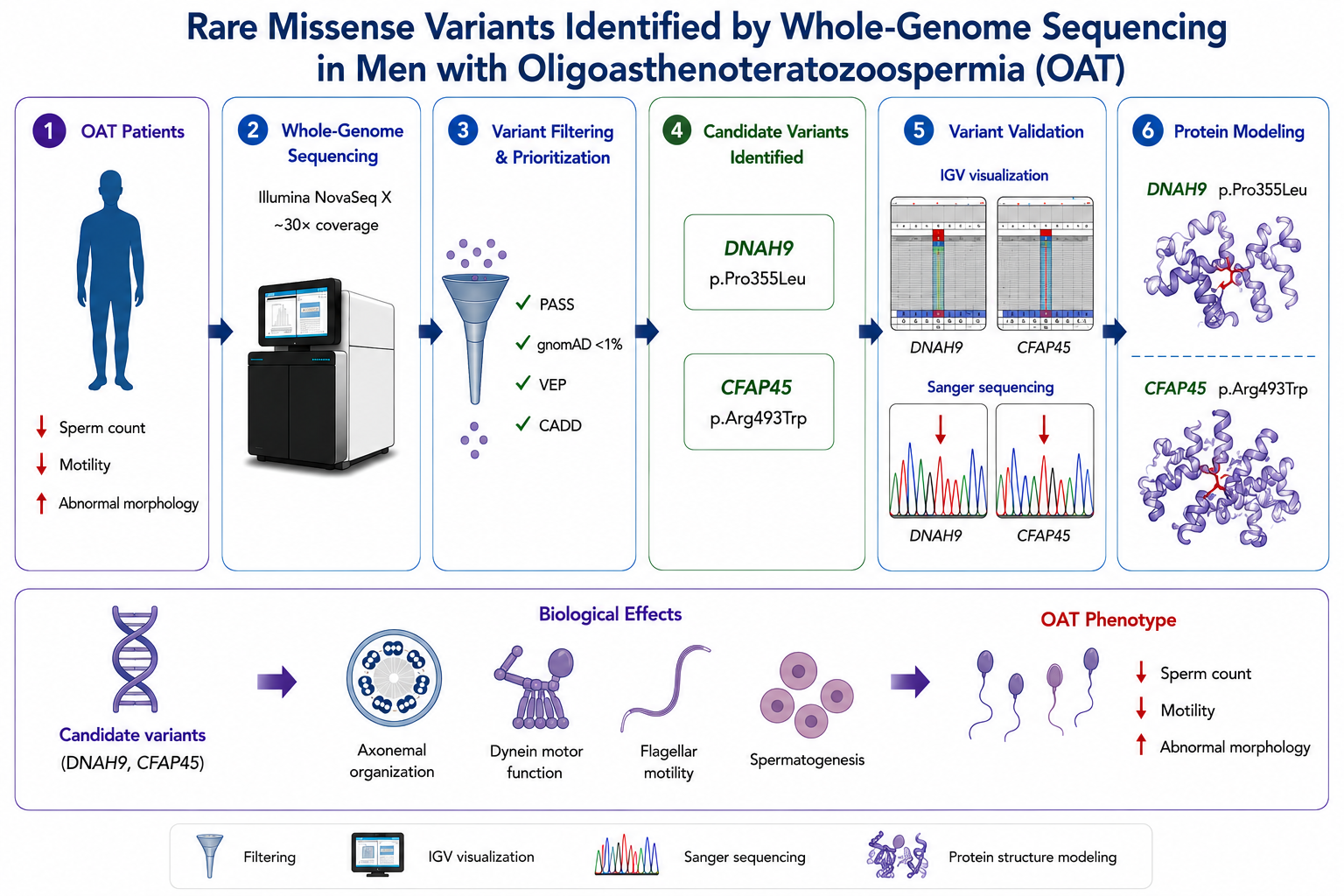
Materials and Methods: 7 men with OAT from consanguineous families, with normal karyotypes and no Y-chromosome microdeletions, were selected. WGS was performed, and variants were called using DeepVariant. These variants were then annotated using the Ensembl variant effect predictor. Rare variants were prioritized based on their predicted pathogenicity and relevance to reproduction, and candidate variants were validated. Protein structure modeling and analysis of mutation-induced effects on molecular interactions were carried out using Swiss model and AlphaFold.
Results: We identified 2 rare homozygous missense variants in DNAH9 (p.Pro355Leu) and CFAP45 (p.Arg493Trp) in the index case with OAT. Both genes have been implicated in sperm flagellar structure and motility. Additional variants in genes associated with spermiogenesis, acrosomal integrity, and testicular function were also identified.
Conclusion: Our findings demonstrate the potential utility of WGS in identifying rare candidate variants potentially associated with OAT. The identified DNAH9 and CFAP45 variants, together with additional candidate variants, may contribute to the impaired sperm function observed in this man. This study also highlights the value of genome-wide analyses in improving our understanding of male infertility, particularly in consanguineous populations, and provides a foundation for future functional studies and personalized diagnostic approaches.
Objective: To identify rare candidate variants potentially associated with OAT using whole-genome sequencing (WGS) in 7 men from consanguineous families.
Materials and Methods: 7 men with OAT from consanguineous families, with normal karyotypes and no Y-chromosome microdeletions, were selected. WGS was performed, and variants were called using DeepVariant. These variants were then annotated using the Ensembl variant effect predictor. Rare variants were prioritized based on their predicted pathogenicity and relevance to reproduction, and candidate variants were validated. Protein structure modeling and analysis of mutation-induced effects on molecular interactions were carried out using Swiss model and AlphaFold.
Results: We identified 2 rare homozygous missense variants in DNAH9 (p.Pro355Leu) and CFAP45 (p.Arg493Trp) in the index case with OAT. Both genes have been implicated in sperm flagellar structure and motility. Additional variants in genes associated with spermiogenesis, acrosomal integrity, and testicular function were also identified.
Conclusion: Our findings demonstrate the potential utility of WGS in identifying rare candidate variants potentially associated with OAT. The identified DNAH9 and CFAP45 variants, together with additional candidate variants, may contribute to the impaired sperm function observed in this man. This study also highlights the value of genome-wide analyses in improving our understanding of male infertility, particularly in consanguineous populations, and provides a foundation for future functional studies and personalized diagnostic approaches.
Type of Study: Original Article |
Subject:
Reproductive Genetics
Send email to the article author
| Rights and permissions | |
 |
This work is licensed under a Creative Commons Attribution-NonCommercial 4.0 International License. |