International Journal of
Reproductive Biomedicine
Tue, Oct 13, 2026
[Archive]
Volume 23, Issue 11 (November 2025)
IJRM 2025, 23(11): 911-926 |
Back to browse issues page



Ethics code: IR.UMA.REC.1403.031


Download citation:
BibTeX | RIS | EndNote | Medlars | ProCite | Reference Manager | RefWorks
Send citation to:


BibTeX | RIS | EndNote | Medlars | ProCite | Reference Manager | RefWorks
Send citation to:
Farhadi A, Zolfagharpour F, Abdolmaleki A, Asadi A, Zabihi A. Protective effects of selenium nanoparticles against X-ray-induced testicular damage in rats: An integrated experimental and Monte Carlo simulation study. IJRM 2025; 23 (11) :911-926
URL: http://ijrm.ir/article-1-3595-en.html
URL: http://ijrm.ir/article-1-3595-en.html


1- Department of Physics, Faculty of Science, University of Mohaghegh Ardabili, Ardabil, Iran.
2- Department of Physics, Faculty of Science, University of Mohaghegh Ardabili, Ardabil, Iran. ,Zolfagharpour@uma.ac.ir
3- Department of Biophysics, Faculty of Advanced Technologies, University of Mohaghegh Ardabili, Namin, Ardabil, Iran.
4- Department of Biology, Faculty of Science, University of Mohaghegh Ardabili, Ardabil, Iran.
5- AstroCeNT, Nicolaus Copernicus Astronomical Center of the Polish Academy of Sciences, Warsaw, Poland.
2- Department of Physics, Faculty of Science, University of Mohaghegh Ardabili, Ardabil, Iran. ,
3- Department of Biophysics, Faculty of Advanced Technologies, University of Mohaghegh Ardabili, Namin, Ardabil, Iran.
4- Department of Biology, Faculty of Science, University of Mohaghegh Ardabili, Ardabil, Iran.
5- AstroCeNT, Nicolaus Copernicus Astronomical Center of the Polish Academy of Sciences, Warsaw, Poland.
Abstract: (815 Views)
Background: Ionizing radiation induces oxidative damage in biological tissues, particularly in sensitive organs such as the testes. Selenium nanoparticles (SeNPs), known for their antioxidant properties, may help mitigate this damage.
Objective: This study investigated the protective effects of SeNPs against X-ray-induced testicular damage in rats.
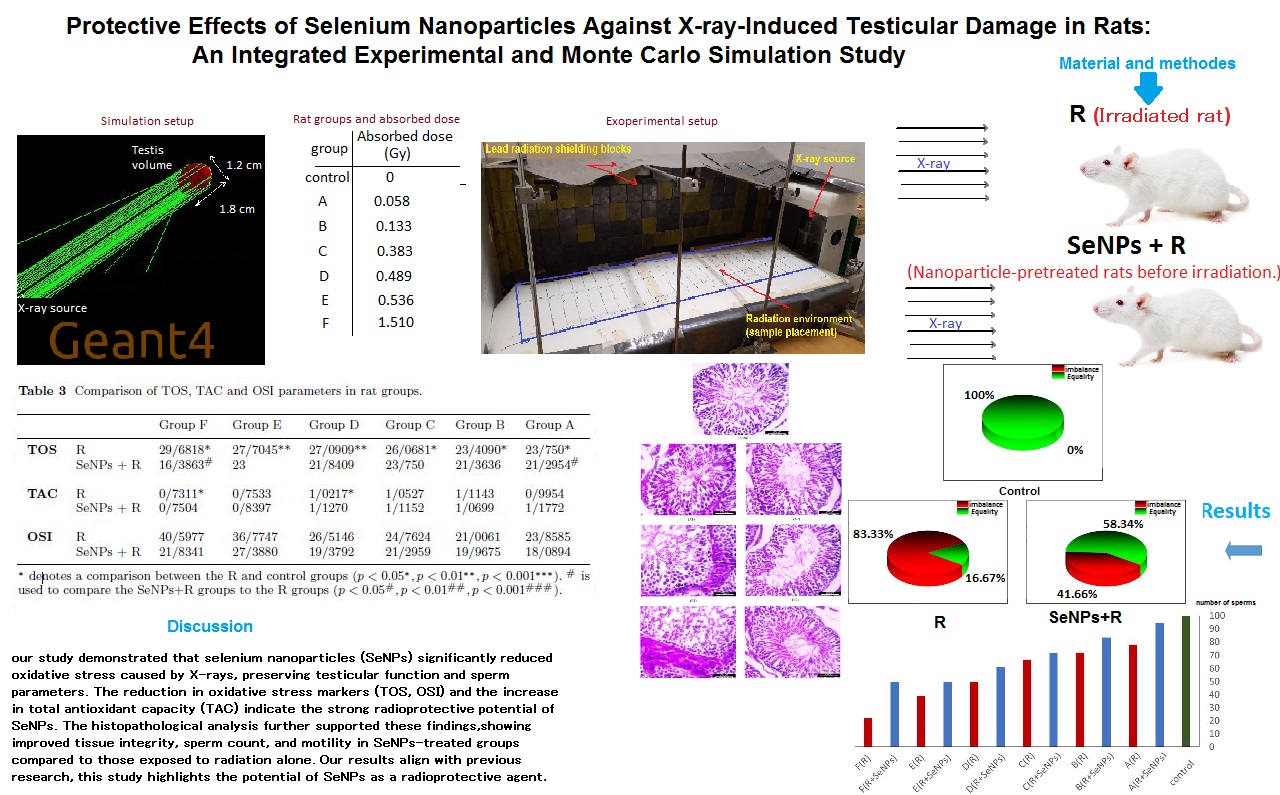
Materials and Methods: This integrated and Monte Carlo simulation experimental study involved 42 male Wistar rats (8-10 wk, 200-250 gr), randomly assigned to 7 groups (n = 6/each). One group served as the control, while the others were exposed to 35 kilovolts X-rays at varying doses. In half of the irradiated groups, SeNPs (5 mg/kg) were administered intraperitoneally before irradiation. Biological evaluations included weight gain, testicular weight, sperm quality, histological examination, and measurements of total antioxidant capacity, total oxidant status, and oxidative stress index. A Geant4-DNA simulation assessed hydroxyl radical production and G-values across different SeNP concentrations during radiation’s chemical stage.
Results: SeNPs treatment improved biological outcomes compared with untreated irradiated rats. Sperm count increased by 7-55% (p < 0.010), motility by 2-7% (p < 0.050), and abnormal sperm frequency decreased by 6-18% (p < 0.010). Total antioxidant capacity increased by 2.5-15% (p < 0.050), while total oxidant status and oxidative stress index decreased (p < 0.010). Histological analysis showed preserved seminiferous tubules and reduced tissue damage. Testicular weight imbalance was reduced by 50%. Simulations showed 82-93% reduction in hydroxyl radical G-values with SeNPs.
Conclusion: SeNPs significantly mitigated X-ray-induced oxidative and structural testicular damage in rats.
Objective: This study investigated the protective effects of SeNPs against X-ray-induced testicular damage in rats.
Materials and Methods: This integrated and Monte Carlo simulation experimental study involved 42 male Wistar rats (8-10 wk, 200-250 gr), randomly assigned to 7 groups (n = 6/each). One group served as the control, while the others were exposed to 35 kilovolts X-rays at varying doses. In half of the irradiated groups, SeNPs (5 mg/kg) were administered intraperitoneally before irradiation. Biological evaluations included weight gain, testicular weight, sperm quality, histological examination, and measurements of total antioxidant capacity, total oxidant status, and oxidative stress index. A Geant4-DNA simulation assessed hydroxyl radical production and G-values across different SeNP concentrations during radiation’s chemical stage.
Results: SeNPs treatment improved biological outcomes compared with untreated irradiated rats. Sperm count increased by 7-55% (p < 0.010), motility by 2-7% (p < 0.050), and abnormal sperm frequency decreased by 6-18% (p < 0.010). Total antioxidant capacity increased by 2.5-15% (p < 0.050), while total oxidant status and oxidative stress index decreased (p < 0.010). Histological analysis showed preserved seminiferous tubules and reduced tissue damage. Testicular weight imbalance was reduced by 50%. Simulations showed 82-93% reduction in hydroxyl radical G-values with SeNPs.
Conclusion: SeNPs significantly mitigated X-ray-induced oxidative and structural testicular damage in rats.
Type of Study: Original Article |
Subject:
Reproductive Andrology
Send email to the article author
| Rights and permissions | |
 |
This work is licensed under a Creative Commons Attribution-NonCommercial 4.0 International License. |