
International Journal of
Reproductive Biomedicine




BibTeX | RIS | EndNote | Medlars | ProCite | Reference Manager | RefWorks
Send citation to:


URL: http://ijrm.ir/article-1-3675-en.html
 , Tahereh Abbasi2 , Manizheh Habibpour *3 , Sepideh Peyvandi4 , Hamed Jafarpour2 , Reza Ali Mohammadpour Tahamtan5 , Noushin Gordani6
2- Student Research Committee, Faculty of Medicine, Mazandaran University of Medical Sciences, Sari, Iran.
3- Department of Laboratory Sciences, School of Allied Medical Sciences, Mazandaran University of Medical Sciences, Sari, Iran. & Department of Laboratory Hematology and Blood Banking, School of Allied Medical Sciences, Kerman University of Medical Sciences, Kerman, Iran. ,
4- Department of Obstetrics and Gynecology, School of Medicine, Mazandaran University of Medical Sciences, Sari, Iran., Infertility Center, Imam Hospital, Amir Mazandarani Ave., Sari, Iran.
5- Department of Biostatistics and Epidemiology, School of Health, Diabetes Research Center, Cancer Research Institute, Mazandaran University of Medical Sciences, Sari, Iran.
6- Mazandaran University of Medical Sciences, Sari, Iran.
Background: Diminished ovarian reserve is one of the most important issues in in vitro fertilization cycles. Some authors have reported beneficial effects of dual triggering in women with poor ovarian response, whereas other investigators have demonstrated contrary results.
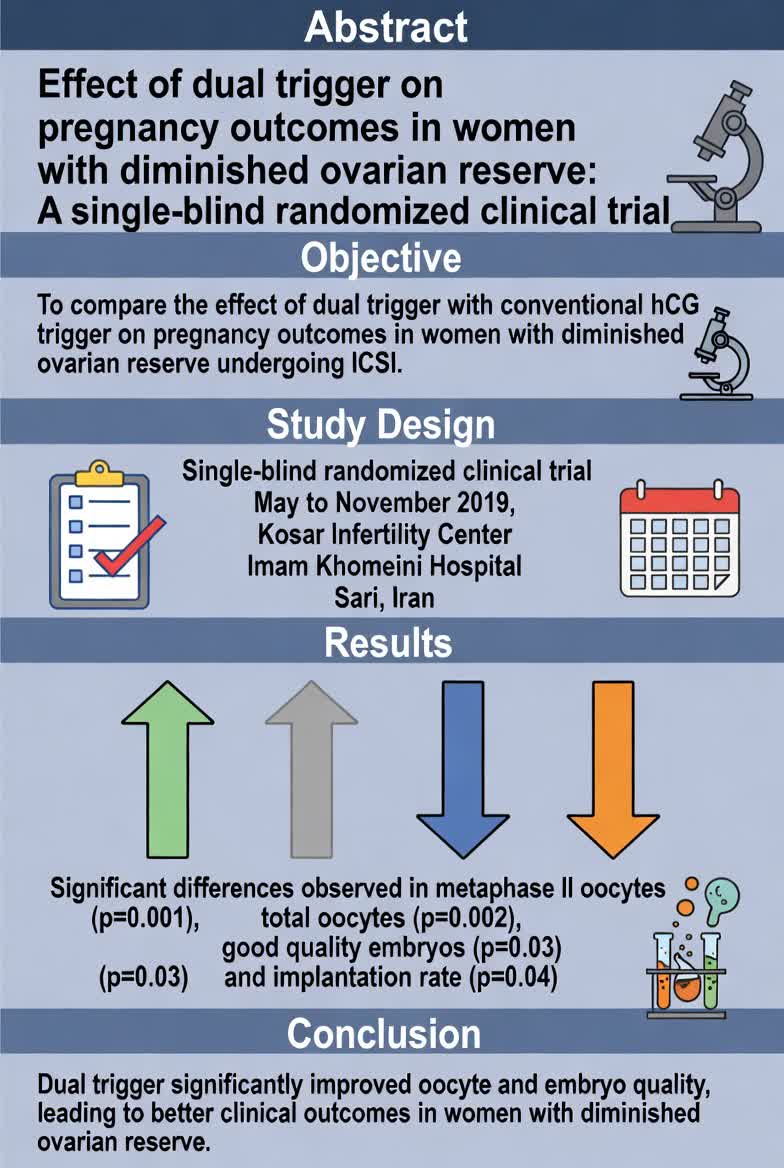
Objective: The study aims to investigate the effect of final follicular maturation using a dual trigger (human chorionic gonadotropin [HCG] plus gonadotropin-releasing hormone [GnRH] agonist) compared to HCG alone in GnRH-antagonist cycles on oocyte retrieval, maturation, embryo quality, and clinical pregnancy in frozen cycles.
Materials and Methods: This single-blind randomized clinical trial was conducted from May and November 2019 on 80 infertile women with poor ovarian response undergoing an intracytoplasmic sperm injection-embryo transfer cycle with a GnRH-antagonist protocol. All participants received 10,000 IU of urinary HCG for final oocyte maturation. The dual trigger group received an additional 0.2 mg of triptorelin acetate, while the HCG alone group did not. The primary outcome was the clinical pregnancy rate. Secondary outcomes included the number of oocytes retrieved, mature oocytes, fertilization rate, embryo quality, implantation rate, and miscarriage rate.
Results: The dual trigger group showed a significantly higher number of total oocytes, metaphase II oocytes, good-quality embryos, and implantation rate compared to the HCG alone group (p ≤ 0.050). However, no significant difference was observed between the groups in clinical pregnancy or abortion rates (p > 0.050).
Conclusion: Final oocyte maturation using a dual trigger (GnRH agonist + HCG) improves the number of good-quality embryos and can be a practical approach to enhance the efficiency of the fertilization process in infertile women with diminished ovarian reserve.
| Rights and permissions | |
 |
This work is licensed under a Creative Commons Attribution-NonCommercial 4.0 International License. |