
International Journal of
Reproductive Biomedicine
Tue, Oct 13, 2026
[Archive]
Volume 24, Issue 4 (April 2026)
IJRM 2026, 24(4): 287-296 |
Back to browse issues page



Ethics code: E-30785963–020-220146


Download citation:
BibTeX | RIS | EndNote | Medlars | ProCite | Reference Manager | RefWorks
Send citation to:


BibTeX | RIS | EndNote | Medlars | ProCite | Reference Manager | RefWorks
Send citation to:
Korkmaz O, Karabulut S, Yilmaz E, Delikara N. Clinician-related variability as an ındependent determinant of ın vitro fertilization success: A retrospective cohort study of ıntracytoplasmic sperm ınjection cycles. IJRM 2026; 24 (4) :287-296
URL: http://ijrm.ir/article-1-3712-en.html
URL: http://ijrm.ir/article-1-3712-en.html


1- Department of Histology and Embryology, Faculty of Medicine, Malatya Turgut Özal University, Malatya, Türkiye.
2- Department of Histology and Embryology, International Faculty of Medicine, Istanbul Medipol University, Istanbul, Türkiye. ,sedakarabulut@medipol.edu.tr
3- In Vitro Fertilization Center, Istanbul Medical Park Hospital, Istanbul, Türkiye.
4- In Vitro Fertilization Center, Istanbul Kadıköy Florence Nightingale Hospital, Istanbul, Türkiye.
2- Department of Histology and Embryology, International Faculty of Medicine, Istanbul Medipol University, Istanbul, Türkiye. ,
3- In Vitro Fertilization Center, Istanbul Medical Park Hospital, Istanbul, Türkiye.
4- In Vitro Fertilization Center, Istanbul Kadıköy Florence Nightingale Hospital, Istanbul, Türkiye.
Abstract: (684 Views)
Background: In vitro fertilization (IVF) outcomes are shaped by individual factors, laboratory conditions, and clinician performance; however, while embryologists and laboratory conditions are well studied, clinician-related variables remain less explored.
Objective: This study aims to evaluate whether pregnancy outcomes vary in IVF cycles managed by different clinicians.
Materials and Methods: In this cohort study, data of 3017 women who underwent intracytoplasmic sperm injection at the IVF Center of Kadıköy Florence Nightingale hospital, İstanbul, Türkiye from January 2013-December 2020 were extracted from their medical records and retrospectively reviewed. Clinical pregnancy rates were compared between clinicians.
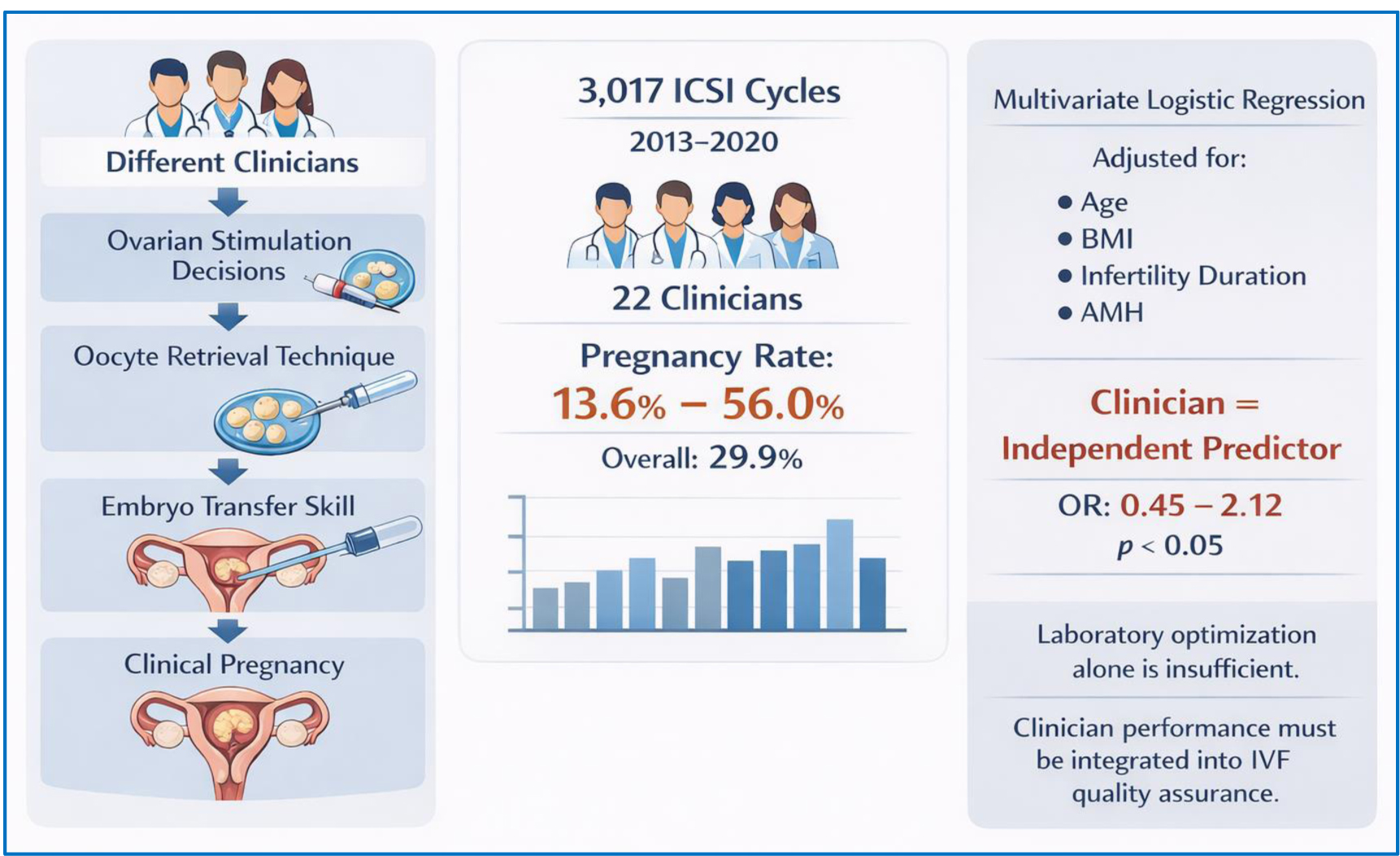
Results: Clinical pregnancy rates differed significantly between clinicians, ranging from 13.6-56.0% (p = 0.023). The overall pregnancy rate was 29.9%. In the multivariate analysis, even after adjusting for maternal age, body mass index, duration of infertility, and anti-Müllerian hormone levels, the clinician variable retained its significance as an independent predictor (adjusted odds ratios: 0.45-2.12, p = 0.018).
Conclusion: Our study shows that clinician-related factors independently shape IVF success. Clinical expertise, judgment, and surgical skills affect outcomes throughout the IVF cycle, not only at embryo transfer. Improving laboratory conditions alone is insufficient; clinician training, performance standardization, and ongoing professional development are also essential. Thus, clinician performance should be integrated into quality assurance and further evaluated in prospective multicenter studies.
Objective: This study aims to evaluate whether pregnancy outcomes vary in IVF cycles managed by different clinicians.
Materials and Methods: In this cohort study, data of 3017 women who underwent intracytoplasmic sperm injection at the IVF Center of Kadıköy Florence Nightingale hospital, İstanbul, Türkiye from January 2013-December 2020 were extracted from their medical records and retrospectively reviewed. Clinical pregnancy rates were compared between clinicians.
Results: Clinical pregnancy rates differed significantly between clinicians, ranging from 13.6-56.0% (p = 0.023). The overall pregnancy rate was 29.9%. In the multivariate analysis, even after adjusting for maternal age, body mass index, duration of infertility, and anti-Müllerian hormone levels, the clinician variable retained its significance as an independent predictor (adjusted odds ratios: 0.45-2.12, p = 0.018).
Conclusion: Our study shows that clinician-related factors independently shape IVF success. Clinical expertise, judgment, and surgical skills affect outcomes throughout the IVF cycle, not only at embryo transfer. Improving laboratory conditions alone is insufficient; clinician training, performance standardization, and ongoing professional development are also essential. Thus, clinician performance should be integrated into quality assurance and further evaluated in prospective multicenter studies.
Keywords: In vitro fertilization, Clinician performance, Pregnancy rate, Infertility treatment, Embryo transfer.
Type of Study: Original Article |
Subject:
Reproductive Biology
Send email to the article author
| Rights and permissions | |
 |
This work is licensed under a Creative Commons Attribution-NonCommercial 4.0 International License. |