International Journal of
Reproductive Biomedicine
Fri, Oct 23, 2026
[Archive]
Volume 24, Issue 2 (February 2026)
IJRM 2026, 24(2): 101-108 |
Back to browse issues page

Ethics code: IR.SSU.MEDICINE.REC.1402.122


Download citation:
BibTeX | RIS | EndNote | Medlars | ProCite | Reference Manager | RefWorks
Send citation to:


BibTeX | RIS | EndNote | Medlars | ProCite | Reference Manager | RefWorks
Send citation to:
Namjoo K, Iravani F, Montazeri F, Jafari Najaf Abadi M H, Kalantar S M, Ghasemi N. Meiotic gene expression of STAG3 and DMC1 in blood: A novel non-invasive biomarker approach for diminished ovarian reserve: A case-control study. IJRM 2026; 24 (2) :101-108
URL: http://ijrm.ir/article-1-3728-en.html
URL: http://ijrm.ir/article-1-3728-en.html
Khosro Namjoo1 

 , Farzaneh Iravani2 , Fateme Montazeri3 , Mohammad Hassan Jafari Najaf Abadi4 , Seyed Mehdi Kalantar2 , Nasrin Ghasemi *5
, Farzaneh Iravani2 , Fateme Montazeri3 , Mohammad Hassan Jafari Najaf Abadi4 , Seyed Mehdi Kalantar2 , Nasrin Ghasemi *5
1- Department of Medical Genetics, School of Medicine, Shahid Sadoughi University of Medical Sciences, Yazd, Iran.
2- Department of Medical Genetics, School of Medicine, Shahid Sadoughi University of Medical Sciences, Yazd, Iran. & Abortion Research Center, Yazd Reproductive Sciences Institute, Shahid Sadoughi University of Medical Sciences, Yazd, Iran.
3- Abortion Research Center, Yazd Reproductive Sciences Institute, Shahid Sadoughi University of Medical Sciences, Yazd, Iran.
4- Department of Medical Biotechnology, School of Medicine, Shahid Sadoughi University of Medical Sciences, Yazd, Iran.
5- Department of Medical Genetics, School of Medicine, Shahid Sadoughi University of Medical Sciences, Yazd, Iran. & Abortion Research Center, Yazd Reproductive Sciences Institute, Shahid Sadoughi University of Medical Sciences, Yazd, Iran. ,nghasemi479@gmail.com; ghasemi@ssu.ac.ir
2- Department of Medical Genetics, School of Medicine, Shahid Sadoughi University of Medical Sciences, Yazd, Iran. & Abortion Research Center, Yazd Reproductive Sciences Institute, Shahid Sadoughi University of Medical Sciences, Yazd, Iran.
3- Abortion Research Center, Yazd Reproductive Sciences Institute, Shahid Sadoughi University of Medical Sciences, Yazd, Iran.
4- Department of Medical Biotechnology, School of Medicine, Shahid Sadoughi University of Medical Sciences, Yazd, Iran.
5- Department of Medical Genetics, School of Medicine, Shahid Sadoughi University of Medical Sciences, Yazd, Iran. & Abortion Research Center, Yazd Reproductive Sciences Institute, Shahid Sadoughi University of Medical Sciences, Yazd, Iran. ,
Abstract: (1842 Views)
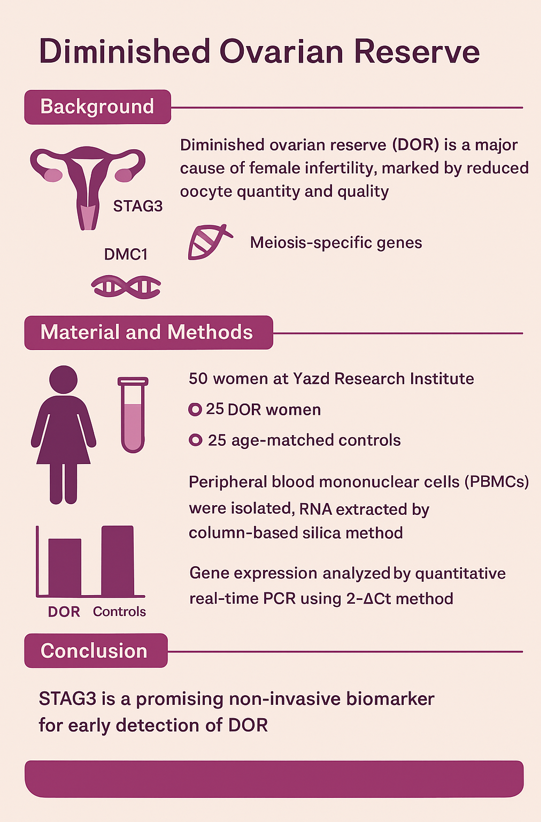
Background: Diminished ovarian reserve (DOR) is a major cause of female infertility, marked by reduced oocyte quantity and quality. STAG3 and DMC1 are meiosis-specific genes essential for chromosomal integrity and homologous recombination. While their downregulation in granulosa cells of DOR women has been reported, expression in peripheral blood remains unexplored.
Objective: To evaluate peripheral blood STAG3 and DMC1 expression as potential non-invasive biomarkers in DOR.
Materials and Methods: This case-control study included 50 women at Yazd Research Institute, Yazd, Iran, comprising 25 DOR women (anti-Müllerian hormone < 1.1 ng/mL) and 25 age-matched controls. Peripheral blood mononuclear cells were isolated, RNA extracted by column-based silica method, and gene expression analyzed by quantitative real-time polymerase chain reaction using the 2^-ΔCt method.
Results: Demographic analysis revealed no significant differences in age or body mass index between DOR women and controls. As expected, anti-Müllerian hormone levels (0.61 vs. 2.12 ng/mL) and antral follicle counts (3.52 vs. 8.64) were significantly lower in the DOR group. Quantitative real-time polymerase chain reaction analysis revealed a significant downregulation of STAG3 expression in peripheral blood mononuclear cells of DOR women compared with controls (p = 0.0011). DMC1 expression showed a downward trend but did not reach statistical significance (p = 0.1132). These results suggest a potential role of STAG3 dysregulation in DOR pathogenesis.
Conclusion: These findings indicate differential expression of meiotic genes in the peripheral blood of DOR women, supporting STAG3 as a promising non-invasive biomarker for early detection of DOR and contributing to a better understanding of its molecular basis in reproductive medicine.
Objective: To evaluate peripheral blood STAG3 and DMC1 expression as potential non-invasive biomarkers in DOR.
Materials and Methods: This case-control study included 50 women at Yazd Research Institute, Yazd, Iran, comprising 25 DOR women (anti-Müllerian hormone < 1.1 ng/mL) and 25 age-matched controls. Peripheral blood mononuclear cells were isolated, RNA extracted by column-based silica method, and gene expression analyzed by quantitative real-time polymerase chain reaction using the 2^-ΔCt method.
Results: Demographic analysis revealed no significant differences in age or body mass index between DOR women and controls. As expected, anti-Müllerian hormone levels (0.61 vs. 2.12 ng/mL) and antral follicle counts (3.52 vs. 8.64) were significantly lower in the DOR group. Quantitative real-time polymerase chain reaction analysis revealed a significant downregulation of STAG3 expression in peripheral blood mononuclear cells of DOR women compared with controls (p = 0.0011). DMC1 expression showed a downward trend but did not reach statistical significance (p = 0.1132). These results suggest a potential role of STAG3 dysregulation in DOR pathogenesis.
Conclusion: These findings indicate differential expression of meiotic genes in the peripheral blood of DOR women, supporting STAG3 as a promising non-invasive biomarker for early detection of DOR and contributing to a better understanding of its molecular basis in reproductive medicine.
Type of Study: Original Article |
Subject:
Reproductive Genetics
Send email to the article author
| Rights and permissions | |
 |
This work is licensed under a Creative Commons Attribution-NonCommercial 4.0 International License. |