International Journal of
Reproductive Biomedicine
Mon, Oct 19, 2026
[Archive]
Volume 24, Issue 5 (May 2026)
IJRM 2026, 24(5): 433-444 |
Back to browse issues page



Ethics code: IR.ARAKU.REC.1402.094


Download citation:
BibTeX | RIS | EndNote | Medlars | ProCite | Reference Manager | RefWorks
Send citation to:


BibTeX | RIS | EndNote | Medlars | ProCite | Reference Manager | RefWorks
Send citation to:
Soleimani Mehranjani M, Garavand S, Ahmadi S. Selenium mitigates cyclophosphamide-induced toxicity on sperm quality in mice: An experimental study. IJRM 2026; 24 (5) :433-444
URL: http://ijrm.ir/article-1-3735-en.html
URL: http://ijrm.ir/article-1-3735-en.html
Selenium mitigates cyclophosphamide-induced toxicity on sperm quality in mice: An experimental study


1- Department of Biology, Faculty of Science, Arak University, Arak, Iran. , m-soleimani@araku.ac.ir
2- Department of Biology, Faculty of Science, Arak University, Arak, Iran.
2- Department of Biology, Faculty of Science, Arak University, Arak, Iran.
Abstract: (558 Views)
Background: Cyclophosphamide (CP), a commonly used chemotherapy drug, induces oxidative stress and damages testicular tissue, leading to impaired spermatogenesis.
Objective: This study aimed to evaluate the effects of selenium, a potent antioxidant, on sperm parameters in adult mice treated with CP.
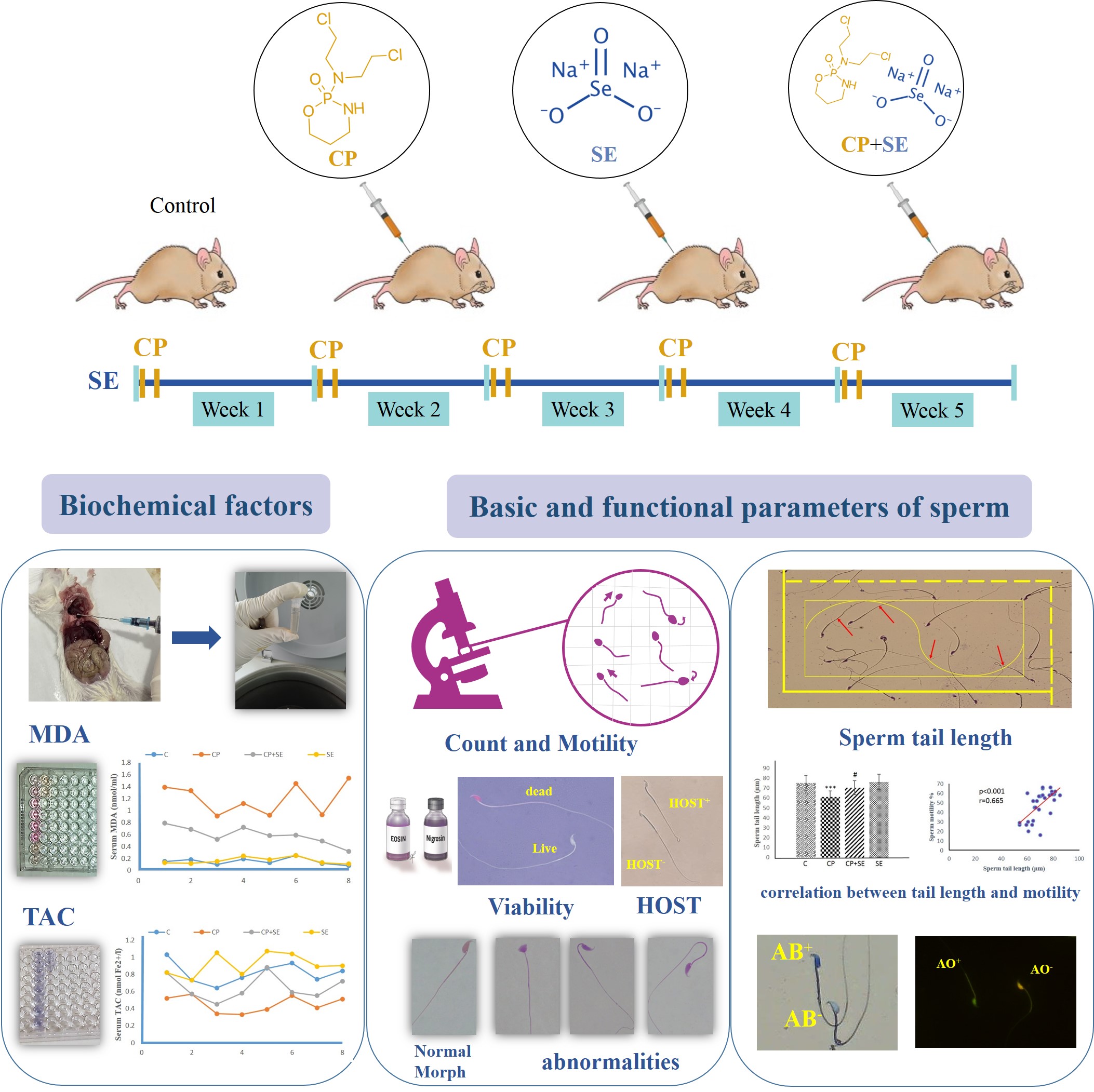
Materials and Methods: In this experimental study, 32 adult male NMRI mice were randomly divided into 4 groups (n = 8/each): A) control, B) CP (100 mg/kg/wk, intraperitoneally), C) selenium (1 mg/kg/day, intraperitoneally), and D) CP + selenium. After 35 days of treatment, spermatozoa were collected from the caudal epididymis. Basic sperm parameters (motility, count, viability, morphology, and tail length), and functional parameters (plasma membrane integrity, nuclear maturity, and DNA damage) were evaluated. Daily sperm production was evaluated using the left testis. Serum levels of malondialdehyde (MDA) and total antioxidant capacity (TAC) were also measured.
Results: In the CP group, sperm motility, count, viability, membrane integrity, normal morphology, tail length (p < 0.001), nuclear maturity (p < 0.05), DNA integrity, daily sperm production (p < 0.001), and TAC (p < 0.001) were significantly reduced, while MDA levels increased (p < 0.001) vs. controls. In the CP + selenium group, motility (p < 0.001), count (p < 0.01), viability (p < 0.001), membrane integrity, normal morphology (p < 0.01), tail length (p < 0.05), DNA integrity, daily sperm production (p < 0.001), and TAC (p < 0.05) significantly improved, with reduced MDA levels (p < 0.001) compared to CP group.
Conclusion: CP impaired sperm quality and antioxidant status through oxidative stress in mice, whereas selenium co-administration mitigated these adverse effects by improving sperm parameters, enhancing antioxidant capacity, and reducing lipid peroxidation, indicating protection against CP-induced reproductive toxicity.
Objective: This study aimed to evaluate the effects of selenium, a potent antioxidant, on sperm parameters in adult mice treated with CP.
Materials and Methods: In this experimental study, 32 adult male NMRI mice were randomly divided into 4 groups (n = 8/each): A) control, B) CP (100 mg/kg/wk, intraperitoneally), C) selenium (1 mg/kg/day, intraperitoneally), and D) CP + selenium. After 35 days of treatment, spermatozoa were collected from the caudal epididymis. Basic sperm parameters (motility, count, viability, morphology, and tail length), and functional parameters (plasma membrane integrity, nuclear maturity, and DNA damage) were evaluated. Daily sperm production was evaluated using the left testis. Serum levels of malondialdehyde (MDA) and total antioxidant capacity (TAC) were also measured.
Results: In the CP group, sperm motility, count, viability, membrane integrity, normal morphology, tail length (p < 0.001), nuclear maturity (p < 0.05), DNA integrity, daily sperm production (p < 0.001), and TAC (p < 0.001) were significantly reduced, while MDA levels increased (p < 0.001) vs. controls. In the CP + selenium group, motility (p < 0.001), count (p < 0.01), viability (p < 0.001), membrane integrity, normal morphology (p < 0.01), tail length (p < 0.05), DNA integrity, daily sperm production (p < 0.001), and TAC (p < 0.05) significantly improved, with reduced MDA levels (p < 0.001) compared to CP group.
Conclusion: CP impaired sperm quality and antioxidant status through oxidative stress in mice, whereas selenium co-administration mitigated these adverse effects by improving sperm parameters, enhancing antioxidant capacity, and reducing lipid peroxidation, indicating protection against CP-induced reproductive toxicity.
Type of Study: Original Article |
Subject:
Reproductive Biology
Send email to the article author
| Rights and permissions | |
 |
This work is licensed under a Creative Commons Attribution-NonCommercial 4.0 International License. |