
International Journal of
Reproductive Biomedicine
Tue, Oct 20, 2026
[Archive]
Volume 24, Issue 5 (May 2026)
IJRM 2026, 24(5): 403-412 |
Back to browse issues page



Ethics code: IR.ABZUMS.REC.1403.133


Download citation:
BibTeX | RIS | EndNote | Medlars | ProCite | Reference Manager | RefWorks
Send citation to:


BibTeX | RIS | EndNote | Medlars | ProCite | Reference Manager | RefWorks
Send citation to:
Baradaran Bagheri R, Hosseini S S, Hosseingholipour S, Mohammadian S. Does the transfer of a poor-quality embryo along with a good-quality embryo influence the intracytoplasmic sperm injectionembryo transfer outcomes? A cross-sectional study. IJRM 2026; 24 (5) :403-412
URL: http://ijrm.ir/article-1-3764-en.html
URL: http://ijrm.ir/article-1-3764-en.html


1- Department of Obstetrics and Gynecology, Alzahra Hospital, Tabriz University of Medical Sciences, Tabriz, Iran.
2- Department of Obstetrics and Gynecology, Faculty of Medicine, Kamali Infertility Center, Alborz University of Medical Sciences, Karaj, Iran.
3- Department of Obstetrics and Gynecology, Faculty of Medicine, Alborz University of Medical Sciences, Karaj, Iran. ,sabagpour@gmail.com; sabagpour@abzums.ac.ir
2- Department of Obstetrics and Gynecology, Faculty of Medicine, Kamali Infertility Center, Alborz University of Medical Sciences, Karaj, Iran.
3- Department of Obstetrics and Gynecology, Faculty of Medicine, Alborz University of Medical Sciences, Karaj, Iran. ,
Abstract: (550 Views)
Background: Embryo quality is one of the most important factors influencing the success of assisted reproductive treatments.
Objective: This study aimed to evaluate the effect of transferring poor-quality embryos along with good-quality embryos on intracytoplasmic sperm injection outcomes.
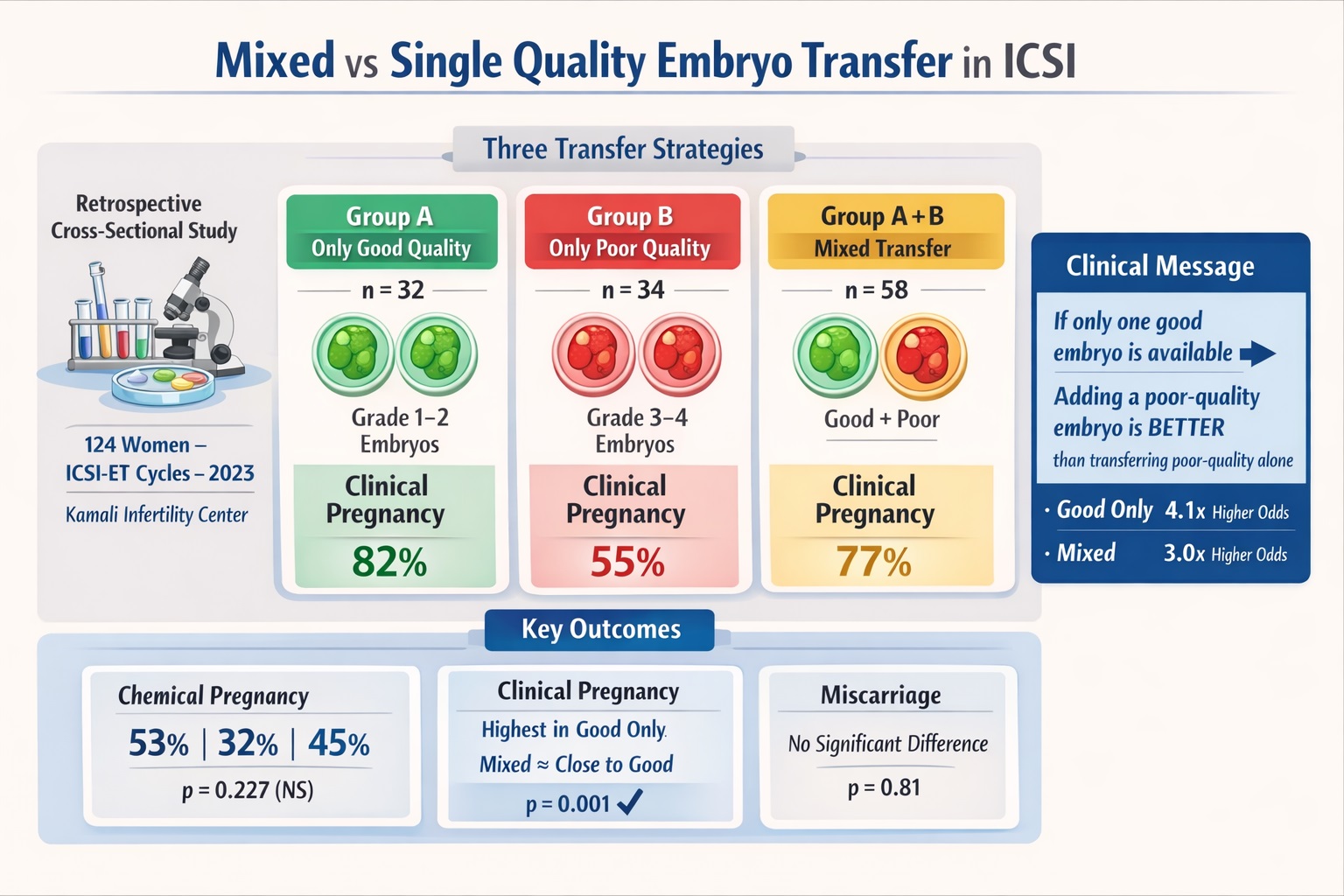
Materials and Methods: In this cross-sectional study, data of 124 women who underwent intracytoplasmic sperm injection and embryo transfer from January to December 2023 at Kamali hospital, Karaj, Iran were extracted from their medical records. Participants were classified into 3 groups: group 1 (n = 32) received only high-quality embryos (grades 1-2; A), group 2 (n = 34) received only poor-quality embryos (grades 3-4; B), and group 3 (n = 58) received a combination of both (A+B). Chemical pregnancy, clinical pregnancy, and miscarriage rates were measured.
Results: Chemical pregnancy rates were 53.1%, 32.4%, and 44.8% in groups 1, 2, and 3, respectively (p = 0.227). Clinical pregnancy rates were significantly higher in group 1 (82.4%) compared with group 2 (54.5%) and group 3 (76.9%) (p = 0.001). Miscarriage rates were 17.6%, 27.3%, and 26.9%, respectively, with no significant difference (p = 0.81). Multivariate logistic regression adjusting for female age and body mass index confirmed that the embryo quality group was a significant independent predictor of clinical pregnancy. Compared to group 2 (only poor-quality embryos), the adjusted odds ratio for achieving a clinical pregnancy was 4.12 (95% confidence interval: 1.15-14.78, p = 0.030) for group 1 and 3.05 (95% confidence interval: 1.01-9.22, p = 0.048) for group 3.
Conclusion: Transfer of high-quality embryos (grade A) yielded the best pregnancy outcomes. However, when high-quality embryos are limited, transferring a combination of good- and poor-quality embryos may improve outcomes compared with transferring only poor-quality embryos.
Objective: This study aimed to evaluate the effect of transferring poor-quality embryos along with good-quality embryos on intracytoplasmic sperm injection outcomes.
Materials and Methods: In this cross-sectional study, data of 124 women who underwent intracytoplasmic sperm injection and embryo transfer from January to December 2023 at Kamali hospital, Karaj, Iran were extracted from their medical records. Participants were classified into 3 groups: group 1 (n = 32) received only high-quality embryos (grades 1-2; A), group 2 (n = 34) received only poor-quality embryos (grades 3-4; B), and group 3 (n = 58) received a combination of both (A+B). Chemical pregnancy, clinical pregnancy, and miscarriage rates were measured.
Results: Chemical pregnancy rates were 53.1%, 32.4%, and 44.8% in groups 1, 2, and 3, respectively (p = 0.227). Clinical pregnancy rates were significantly higher in group 1 (82.4%) compared with group 2 (54.5%) and group 3 (76.9%) (p = 0.001). Miscarriage rates were 17.6%, 27.3%, and 26.9%, respectively, with no significant difference (p = 0.81). Multivariate logistic regression adjusting for female age and body mass index confirmed that the embryo quality group was a significant independent predictor of clinical pregnancy. Compared to group 2 (only poor-quality embryos), the adjusted odds ratio for achieving a clinical pregnancy was 4.12 (95% confidence interval: 1.15-14.78, p = 0.030) for group 1 and 3.05 (95% confidence interval: 1.01-9.22, p = 0.048) for group 3.
Conclusion: Transfer of high-quality embryos (grade A) yielded the best pregnancy outcomes. However, when high-quality embryos are limited, transferring a combination of good- and poor-quality embryos may improve outcomes compared with transferring only poor-quality embryos.
Keywords: Infertility, Embryo quality, Intracytoplasmic sperm injection, Embryo transfer, Pregnancy outcome.
Type of Study: Original Article |
Subject:
Embryology
Send email to the article author
| Rights and permissions | |
 |
This work is licensed under a Creative Commons Attribution-NonCommercial 4.0 International License. |