
International Journal of
Reproductive Biomedicine




BibTeX | RIS | EndNote | Medlars | ProCite | Reference Manager | RefWorks
Send citation to:


URL: http://ijrm.ir/article-1-3825-en.html


 , Hassan Sharifiyazdi2 , Seyed Mehdi Kalantar3 , Nasrin Ghasemi3 , Mojgan Moshrefi4 , Mehran Ghaemi5 , Fateme Montazeri *6
2- Department of Clinical Sciences, School of Veterinary Medicine, Shiraz University, Shiraz, Iran.
3- Abortion Research Center, Yazd Reproductive Sciences Institute, Shahid Sadoghi University of Medical Sciences, Yazd, Iran.
4- Biotechnology Research Center, Yazd Reproductive Sciences Institute, Shahid Sadoughi University of Medical Sciences, Yazd, Iran.
5- Department of Pathobiology, Faculty of Veterinary Medicine, Ferdowsi University of Mashhad, Mashhad, Iran.
6- Abortion Research Center, Yazd Reproductive Sciences Institute, Shahid Sadoghi University of Medical Sciences, Yazd, Iran. ,
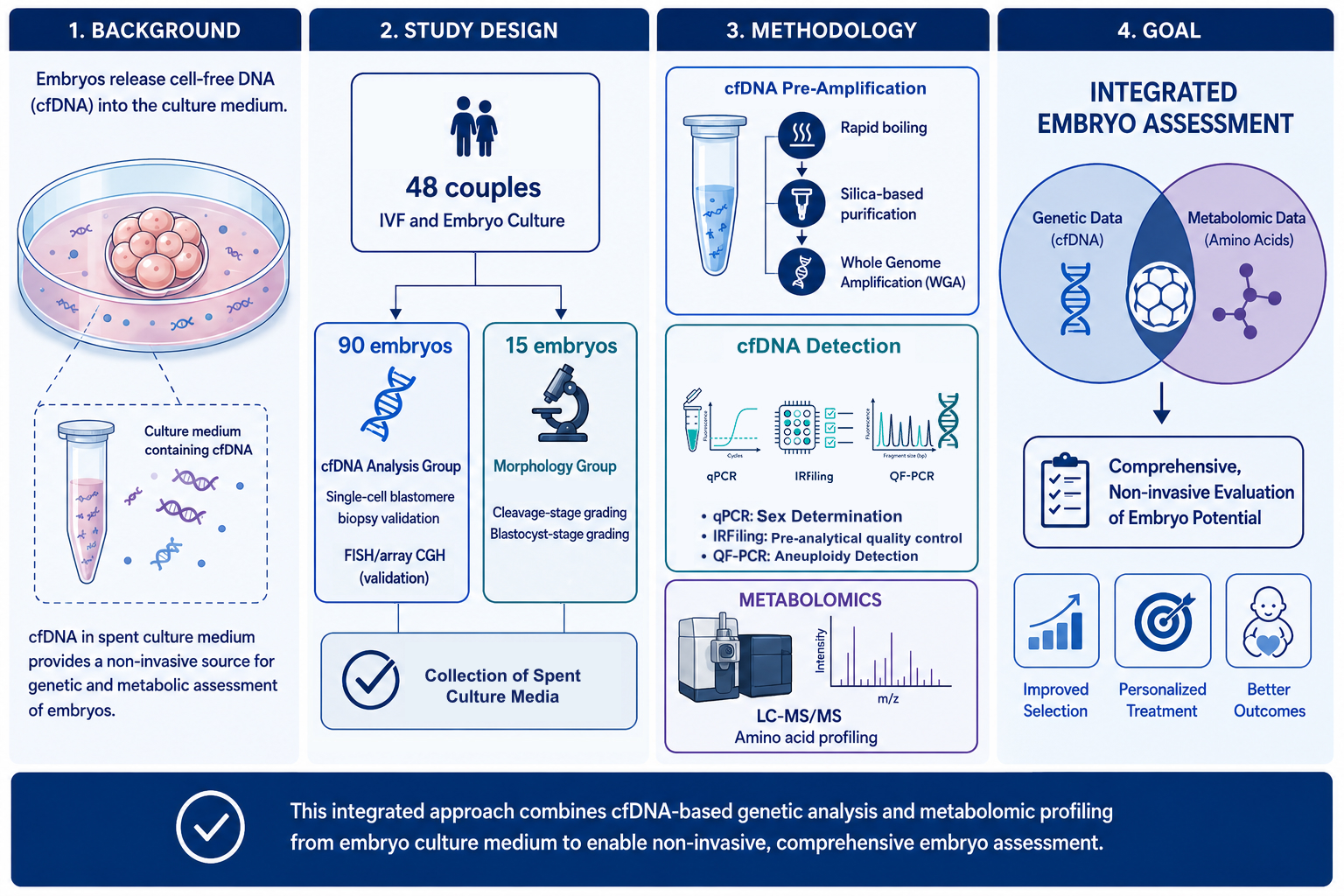
Background: Cell-free DNA (cfDNA) in spent culture medium (SCM) offers a non-invasive option for preimplantation genetic testing, but its low concentration and fragmentation reduce clinical reliability. Combining genetic assessment with metabolomic profiling may provide complementary information about embryo competence.
Objective: This study assessed pre-analytical cfDNA processing workflows and examined whether SCM amino acid metabolic patterns could act as practical markers of embryo quality.
Materials and Methods: In this case-control study (2021-2023), 90 embryos were evaluated using fluorescence in situ hybridization or array comparative genomic hybridization. SCM samples underwent rapid boiling, silica-based purification, or whole-genome amplification (WGA). Sex determination was performed using quantitative polymerase chain reaction (qPCR). For cfDNA quality control and aneuploidy screening, the multiplex IRFiling kit and quantitative fluorescent polymerase chain reaction (QF-PCR) were used. Amino acid profiles across embryonic developmental stages and quality grades were quantified via liquid chromatography-tandem mass spectrometry.
Results: Rapid boiling resulted in complete failure of DNA amplification. Conversely, silica-based purification yielded 70.0% concordance for qPCR-based sexing and 56.7% for QF-PCR. WGA achieved the highest efficacy (73.3% qPCR and 56.7% QF-PCR concordance), although quality control checks flagged occasional misclassifications. LC-MS/MS profiling revealed significantly elevated alanine and arginine levels in tripronuclear embryos. Furthermore, high-quality blastocysts exhibited elevated glutamic acid levels alongside a pronounced overall depletion of extracellular amino acids compared to low-quality counterparts and controls.
Conclusion: WGA improves cfDNA detectability and qPCR accuracy compared with boiling or purification, but remains inadequate as a standalone screening approach. SCM amino acid profiling provides informative, complementary metabolic signatures of developmental competence, supporting a multimodal strategy for non-invasive embryo assessment.
| Rights and permissions | |
 |
This work is licensed under a Creative Commons Attribution-NonCommercial 4.0 International License. |