
International Journal of
Reproductive Biomedicine
Thu, Oct 22, 2026
[Archive]
Volume 24, Issue 7 (July 2026)
IJRM 2026, 24(7): 627-636 |
Back to browse issues page



Ethics code: IR.SSU.RSI.REC.1399.049


Download citation:
BibTeX | RIS | EndNote | Medlars | ProCite | Reference Manager | RefWorks
Send citation to:


BibTeX | RIS | EndNote | Medlars | ProCite | Reference Manager | RefWorks
Send citation to:
Dashti S, Davar R, Emami F, Shamsi F, Mangoli E. Stop gonadotropin-releasing hormone-agonist protocol not superior to antagonist protocol on the outcomes of assisted reproductive techniques in poor responders: A randomized clinical trial. IJRM 2026; 24 (7) :627-636
URL: http://ijrm.ir/article-1-3854-en.html
URL: http://ijrm.ir/article-1-3854-en.html


1- Research and Clinical Center for Infertility, Yazd Reproductive Sciences Institute, Shahid Sadoughi University of Medical Sciences, Yazd, Iran.
2- Department of Biostatistics and Epidemiology, Center for Health Data Modeling, School of Public Health, Shahid Sadoughi University of Medical Sciences, Yazd, Iran.
3- Research and Clinical Center for Infertility, Yazd Reproductive Sciences Institute, Shahid Sadoughi University of Medical Sciences, Yazd, Iran. ,es.mangoli@gmail.com; e.mangoli@ssu.ac.ir
2- Department of Biostatistics and Epidemiology, Center for Health Data Modeling, School of Public Health, Shahid Sadoughi University of Medical Sciences, Yazd, Iran.
3- Research and Clinical Center for Infertility, Yazd Reproductive Sciences Institute, Shahid Sadoughi University of Medical Sciences, Yazd, Iran. ,
Abstract: (380 Views)
Background: Poor ovarian response remains one of the most challenging problems in assisted reproductive technology. Various stimulation protocols have been proposed to improve outcomes, including combined gonadotropin-releasing hormone (GnRH) agonist and antagonist strategies.
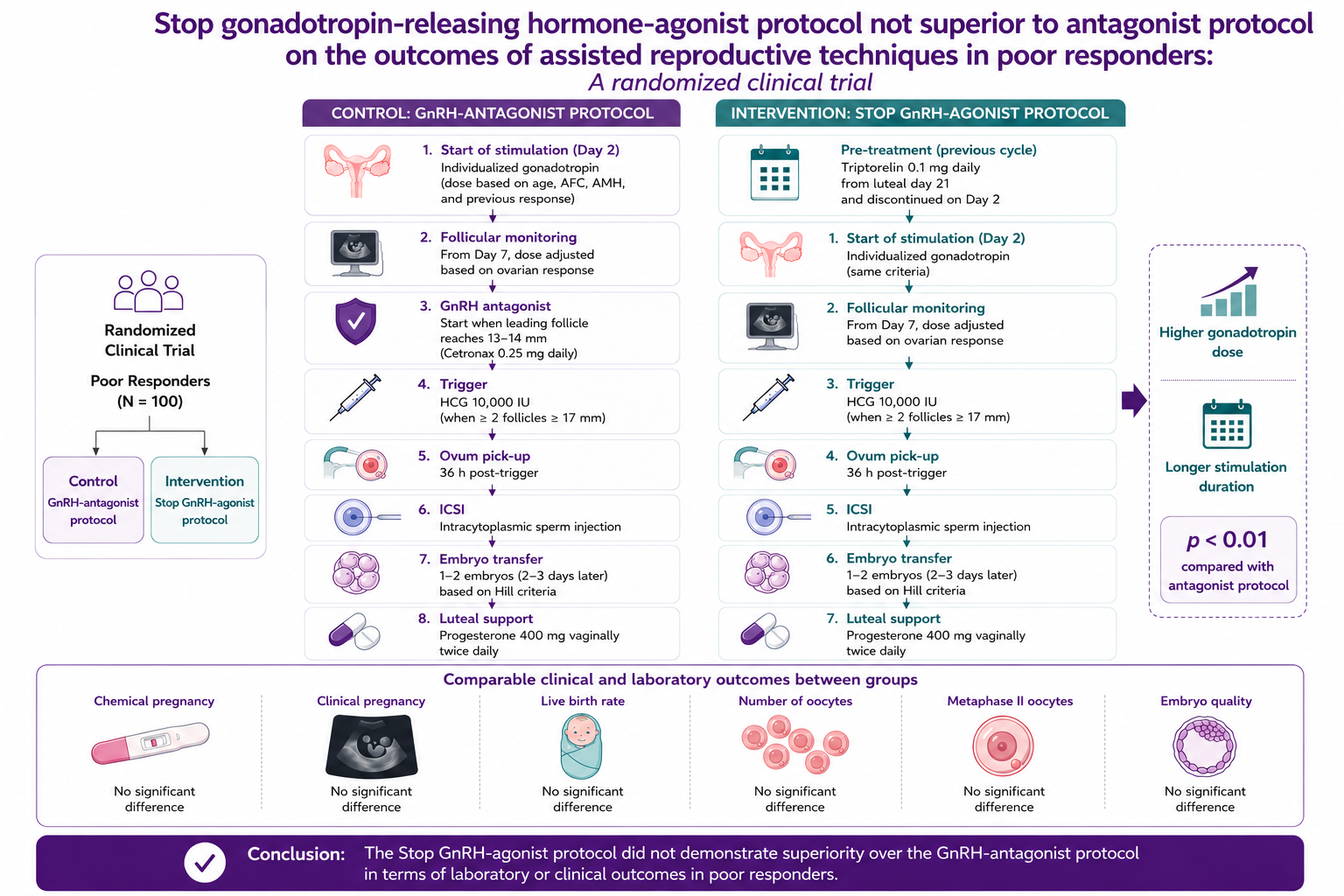
Objective: To compare the effectiveness of a stop GnRH-agonist protocol combined with a GnRH-antagonist protocol vs. a standard GnRH-antagonist protocol in poor ovarian responder (POR) cases.
Materials and Methods: This randomized clinical trial was conducted on 100 women aged 18-44 yr diagnosed as POR according to the Bologna criteria. Participants were randomly allocated to either a GnRH-antagonist protocol (control group) or a combined Stop GnRH-agonist/GnRH-antagonist protocol (intervention group). The primary outcome was the clinical pregnancy rate. Secondary outcomes included the number of retrieved oocytes, embryo quality, chemical pregnancy, and live birth rate.
Results: No statistically significant differences were observed between the 2 groups regarding chemical pregnancy, clinical pregnancy, or live birth rates. Laboratory outcomes, including the number of retrieved oocytes, metaphase II oocytes, and embryo quality, were also comparable. The intervention group required a significantly higher gonadotropin dose and had a longer stimulation duration (p < 0.01).
Conclusion: The stop GnRH-agonist protocol did not demonstrate superiority over the GnRH-antagonist protocol in terms of laboratory or clinical outcomes in POR cases.
Objective: To compare the effectiveness of a stop GnRH-agonist protocol combined with a GnRH-antagonist protocol vs. a standard GnRH-antagonist protocol in poor ovarian responder (POR) cases.
Materials and Methods: This randomized clinical trial was conducted on 100 women aged 18-44 yr diagnosed as POR according to the Bologna criteria. Participants were randomly allocated to either a GnRH-antagonist protocol (control group) or a combined Stop GnRH-agonist/GnRH-antagonist protocol (intervention group). The primary outcome was the clinical pregnancy rate. Secondary outcomes included the number of retrieved oocytes, embryo quality, chemical pregnancy, and live birth rate.
Results: No statistically significant differences were observed between the 2 groups regarding chemical pregnancy, clinical pregnancy, or live birth rates. Laboratory outcomes, including the number of retrieved oocytes, metaphase II oocytes, and embryo quality, were also comparable. The intervention group required a significantly higher gonadotropin dose and had a longer stimulation duration (p < 0.01).
Conclusion: The stop GnRH-agonist protocol did not demonstrate superiority over the GnRH-antagonist protocol in terms of laboratory or clinical outcomes in POR cases.
Keywords: Poor ovarian responders, Controlled ovarian hyperstimulation, Bologna criteria, Stop GnRH-agonist protocol, GnRH-antagonist.
Type of Study: Original Article |
Subject:
Assisted Reproductive Technologies
Send email to the article author
| Rights and permissions | |
 |
This work is licensed under a Creative Commons Attribution-NonCommercial 4.0 International License. |