International Journal of
Reproductive Biomedicine
Thu, Oct 22, 2026
[Archive]
Volume 24, Issue 7 (July 2026)
IJRM 2026, 24(7): 617-626 |
Back to browse issues page



Ethics code: IR.SSU.MEDICINE.REC.1402.124


Download citation:
BibTeX | RIS | EndNote | Medlars | ProCite | Reference Manager | RefWorks
Send citation to:


BibTeX | RIS | EndNote | Medlars | ProCite | Reference Manager | RefWorks
Send citation to:
Ebrahimi Askari R, Malcher A, Sadeghzadeh S, Ibrahim R, Pastuszak K, Srivastava A, et al . Whole-genome sequencing identifies a potentially causative homozygous splicing variant in RAD54 like in non-obstructive azoospermia. IJRM 2026; 24 (7) :617-626
URL: http://ijrm.ir/article-1-3856-en.html
URL: http://ijrm.ir/article-1-3856-en.html
Razieh Ebrahimi Askari1 

 , Agnieszka Malcher2 , Sara Sadeghzadeh3 , Rim Ibrahim2 , Krzysztof Pastuszak4 , Aashish Srivastava5 , Seyed Mehdi Kalantar6 , Serajoddin Vahidi7 , Nasrin Ghasemi8 , Maciej Kurpisz *9
, Agnieszka Malcher2 , Sara Sadeghzadeh3 , Rim Ibrahim2 , Krzysztof Pastuszak4 , Aashish Srivastava5 , Seyed Mehdi Kalantar6 , Serajoddin Vahidi7 , Nasrin Ghasemi8 , Maciej Kurpisz *9
1- Department of Medical Genetics, Faculty of Medicine, Shahid Sadoughi University of Medical Sciences, Yazd, Iran.
2- Institute of Human Genetics, Polish Academy of Sciences, Poznan, Poland.
3- Department of Molecular Medicine, Faculty of Medicine, Shahid Sadoughi University of Medical Sciences, Yazd, Iran.
4- Department of Algorithms and System Modelling, Gdansk University of Technology, Gdansk, Poland. & Department of Translational Oncology, Medical University of Gdansk, Gdansk, Poland. Centre of Biostatistics and Bioinformatics, Medical University of Gdansk, Gdansk, Poland.
5- Genome Core Facility, Clinical Laboratory, Haukeland University Hospital, Bergen, Norway.
6- Department of Medical Genetics, Faculty of Medicine, Shahid Sadoughi University of Medical Sciences, Yazd, Iran. & Abortion Research Center, Yazd Reproductive Sciences Institute, Shahid Sadoughi University of Medical Sciences, Yazd, Iran.
7- Andrology Research Center, Yazd Reproductive Sciences Institute, Shahid Sadoughi University of Medical Sciences, Yazd, Iran.
8- Abortion Research Center, Yazd Reproductive Sciences Institute, Shahid Sadoughi University of Medical Sciences, Yazd, Iran.
9- Institute of Human Genetics, Polish Academy of Sciences, Poznan, Poland. ,maciej.kurpisz@igcz.poznan.pl
2- Institute of Human Genetics, Polish Academy of Sciences, Poznan, Poland.
3- Department of Molecular Medicine, Faculty of Medicine, Shahid Sadoughi University of Medical Sciences, Yazd, Iran.
4- Department of Algorithms and System Modelling, Gdansk University of Technology, Gdansk, Poland. & Department of Translational Oncology, Medical University of Gdansk, Gdansk, Poland. Centre of Biostatistics and Bioinformatics, Medical University of Gdansk, Gdansk, Poland.
5- Genome Core Facility, Clinical Laboratory, Haukeland University Hospital, Bergen, Norway.
6- Department of Medical Genetics, Faculty of Medicine, Shahid Sadoughi University of Medical Sciences, Yazd, Iran. & Abortion Research Center, Yazd Reproductive Sciences Institute, Shahid Sadoughi University of Medical Sciences, Yazd, Iran.
7- Andrology Research Center, Yazd Reproductive Sciences Institute, Shahid Sadoughi University of Medical Sciences, Yazd, Iran.
8- Abortion Research Center, Yazd Reproductive Sciences Institute, Shahid Sadoughi University of Medical Sciences, Yazd, Iran.
9- Institute of Human Genetics, Polish Academy of Sciences, Poznan, Poland. ,
Abstract: (419 Views)
Background: Non-obstructive azoospermia (NOA) is a severe form of male infertility characterized by impaired spermatogenesis. Although chromosomal abnormalities and Y-chromosome microdeletions are known causes, many cases remain idiopathic, suggesting that other genetic factors may be involved. RAD54 like (RAD54L) is a key component of the homologous recombination pathway required for DNA double-strand break repair and meiotic progression.
Objective: To identify the potential genetic cause of NOA using whole-genome sequencing (WGS) in affected individuals from consanguineous families.
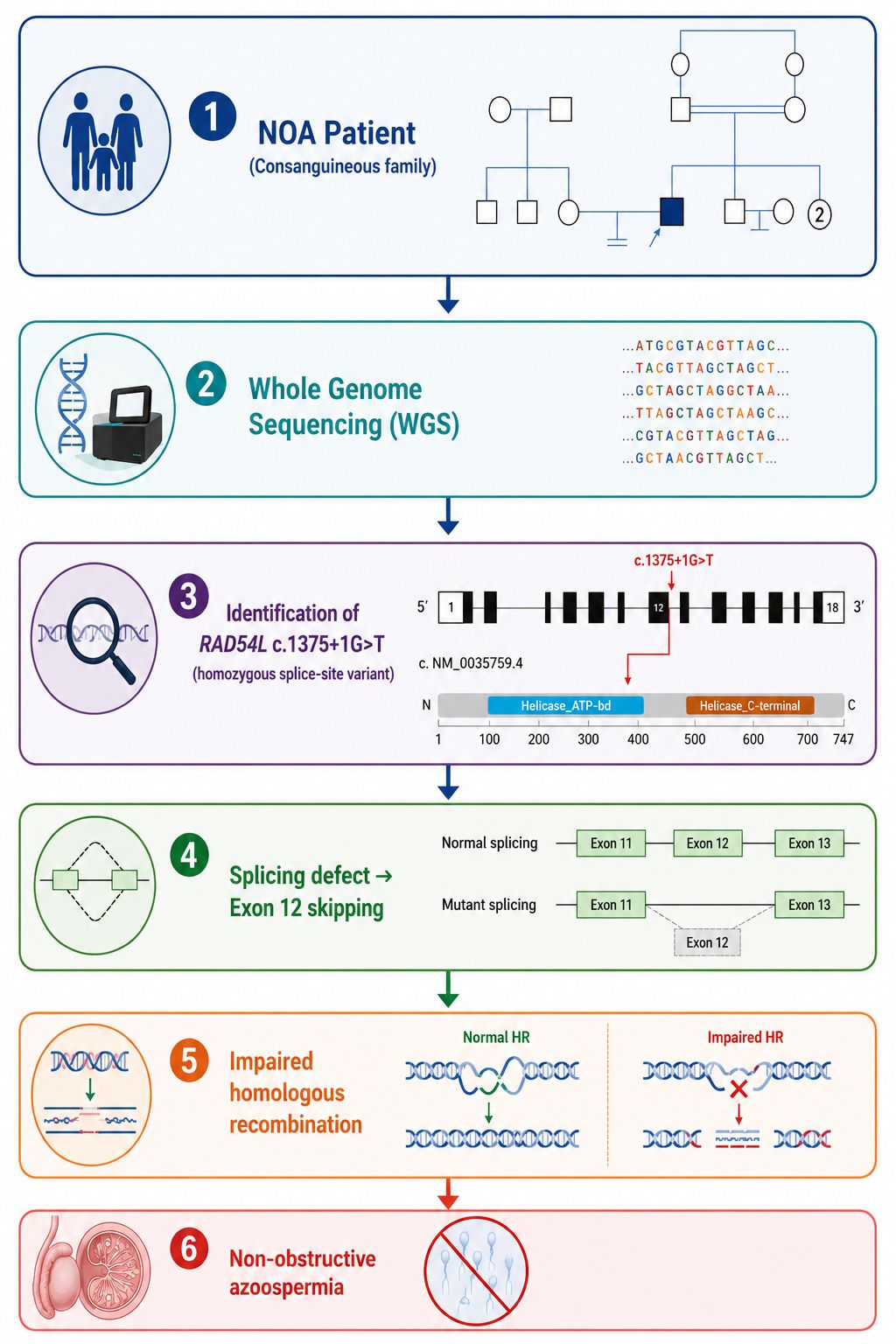
Materials and Methods: For performing this experimental study, 10 NOA men who were referred to Infertility Center of the Yazd Reproductive Sciences Institute, Yazd, Iran underwent clinical, hormonal, and genetic evaluations. Genomic DNA was extracted from peripheral blood and was subjected to WGS. Variants were filtered and prioritized based on allele frequency, predicted pathogenicity, inheritance pattern, and gene expression data. In silico splicing analyses were performed using SpliceAI and Human Splicing Finder.
Results: WGS identified an ultrarare homozygous splice-site variant, c.1375+1G>T, in the RAD54L gene. The variant affects a canonical donor splice site and is predicted to cause loss of normal splicing, likely resulting in exon 12 skipping, frameshift, and premature termination codon formation. RAD54L shows the highest expression in testicular tissue and plays a critical role in homologous recombination and meiotic DNA repair. The patient exhibited hormonal findings consistent with primary testicular failure.
Conclusion: This study proposes RAD54L as a potential novel candidate gene linked to NOA and underscores the efficacy of WGS in identifying rare genetic etiologies of idiopathic male infertility. Further functional and clinical studies are needed to validate this association.
Objective: To identify the potential genetic cause of NOA using whole-genome sequencing (WGS) in affected individuals from consanguineous families.
Materials and Methods: For performing this experimental study, 10 NOA men who were referred to Infertility Center of the Yazd Reproductive Sciences Institute, Yazd, Iran underwent clinical, hormonal, and genetic evaluations. Genomic DNA was extracted from peripheral blood and was subjected to WGS. Variants were filtered and prioritized based on allele frequency, predicted pathogenicity, inheritance pattern, and gene expression data. In silico splicing analyses were performed using SpliceAI and Human Splicing Finder.
Results: WGS identified an ultrarare homozygous splice-site variant, c.1375+1G>T, in the RAD54L gene. The variant affects a canonical donor splice site and is predicted to cause loss of normal splicing, likely resulting in exon 12 skipping, frameshift, and premature termination codon formation. RAD54L shows the highest expression in testicular tissue and plays a critical role in homologous recombination and meiotic DNA repair. The patient exhibited hormonal findings consistent with primary testicular failure.
Conclusion: This study proposes RAD54L as a potential novel candidate gene linked to NOA and underscores the efficacy of WGS in identifying rare genetic etiologies of idiopathic male infertility. Further functional and clinical studies are needed to validate this association.
Keywords: Infertility, Azoospermia, RAD54L, Spermatogenesis, Whole genome sequencing, Splice-site variant.
Type of Study: Original Article |
Subject:
Reproductive Genetics
Send email to the article author
| Rights and permissions | |
 |
This work is licensed under a Creative Commons Attribution-NonCommercial 4.0 International License. |