International Journal of
Reproductive Biomedicine
Sun, Nov 29, 2026
[Archive]
Volume 24, Issue 9 (September 2026)
Int J Reprod BioMed. 2026, 24(9): 843-858 |
Back to browse issues page



Ethics code: IR.MUMS.IRH.REC.1404.027


Download citation:
BibTeX | RIS | EndNote | Medlars | ProCite | Reference Manager | RefWorks
Send citation to:


BibTeX | RIS | EndNote | Medlars | ProCite | Reference Manager | RefWorks
Send citation to:
Rostami M, Khadem Ghaebi N, Ziaee A, Ardalan Khales S, Afiat M, Amirian M, et al . Age modifies the association between endometrial thickness and live birth after frozen embryo transfer: A retrospective cohort study. , Int J Reprod BioMed.. 2026; 24 (9) :843-858
URL: http://ijrm.ir/article-1-3872-en.html
URL: http://ijrm.ir/article-1-3872-en.html
Mahboobeh Rostami1  , Nayereh Khadem Ghaebi2 , Arash Ziaee3 , Sahar Ardalan Khales2 , Malihe Afiat2 , Malihe Amirian2 , Sajede Armaghan Rad4 , Malihe Mahmoudinia *5
1- Department of Obstetrics and Gynecology, Faculty of Medicine, Islamic Azad University, Mashhad, Iran.
2- Fertility, Sterility and Reproductive Biology Research Center, Mashhad University of Medical Sciences, Mashhad, Iran.
3- Infectious Diseases Research Center, Birjand University of Medical Sciences, Birjand, Iran. & Farabi Eye Research Center, Farabi Eye Hospital, Tehran University of Medical Sciences, Tehran, Iran.
4- Department of Midwifery, Faculty of Nursing and Midwifery, Mashhad University of Medical Sciences, Mashhad, Iran.
5- Fertility, Sterility and Reproductive Biology Research Center, Mashhad University of Medical Sciences, Mashhad, Iran. ,Mahmoudiniam@mums.ac.ir
2- Fertility, Sterility and Reproductive Biology Research Center, Mashhad University of Medical Sciences, Mashhad, Iran.
3- Infectious Diseases Research Center, Birjand University of Medical Sciences, Birjand, Iran. & Farabi Eye Research Center, Farabi Eye Hospital, Tehran University of Medical Sciences, Tehran, Iran.
4- Department of Midwifery, Faculty of Nursing and Midwifery, Mashhad University of Medical Sciences, Mashhad, Iran.
5- Fertility, Sterility and Reproductive Biology Research Center, Mashhad University of Medical Sciences, Mashhad, Iran. ,
Abstract: (327 Views)
Background: The impact of endometrial thickness (EMT) on reproductive outcomes remains a critical consideration in assisted reproductive technology, yet its age-specific influence requires further clarification.
Objective: To assess the association between EMT and live birth rate (LBR) in frozen embryo transfer (FET) cycles.
Materials and Methods: This retrospective cohort study included 557 FET cycles performed at Milad Infertility Center, Mashhad, Iran, from March 2020 to February 2025. Live birth was analyzed by multivariable logistic regression and clinical pregnancy by modified Poisson regression. EMT was modeled continuously and categorically. Spline models assessed non-linearity, inverse probability weighting assessed sensitivity to missing covariate data, and an EMT-by-age-group interaction was tested.
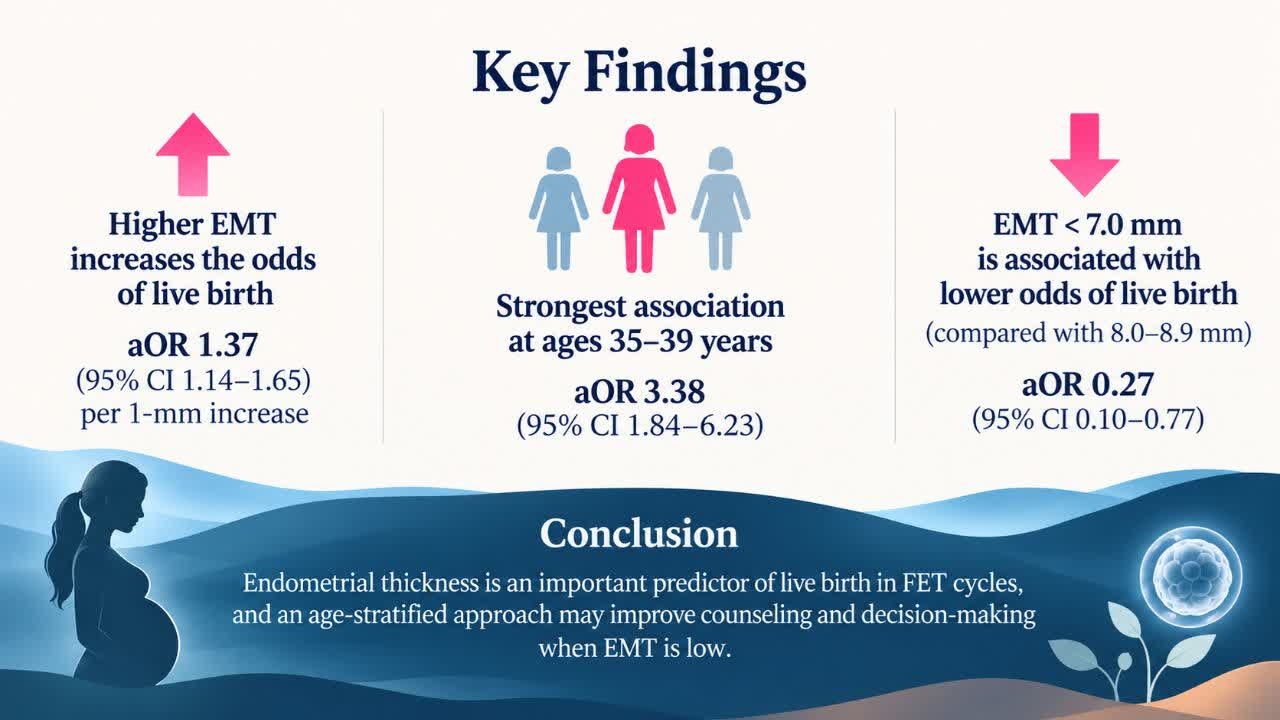
Results: In complete-case adjusted analyses (n = 366), each 1-mm increase in EMT was associated with higher odds of LBR (adjusted odds ratio [aOR]: 1.37, 95% confidence interval [CI]: 1.14-1.65; p < 0.001); inverse probability weighted sensitivity analysis was similar (aOR: 1.38, 95% CI: 1.15-1.67; p < 0.001). A statistically significant interaction between EMT and maternal age was identified (P-interaction < 0.001). In age-stratified analyses, this positive association was most pronounced in women aged 35-39 yr (aOR: 3.38, 95% CI: 1.84-6.23), but was attenuated and non-significant in women < 35 yr and those ≥ 40 yr. Compared with EMT 8.0-8.9 mm, EMT < 7.0 mm was associated with lower odds of LBR (aOR: 0.27, 95% CI: 0.10-0.77; p = 0.014).
Conclusion: EMT is a crucial predictor of live birth in FET cycles, but its clinical significance is strongly dependent on maternal age. These findings support an age-stratified approach to counseling and decision-making when EMT is low in FET cycles.
Type of Study: Original Article |
Subject:
Fertility & Infertility
Send email to the article author
| Rights and permissions | |
 |
This work is licensed under a Creative Commons Attribution-NonCommercial 4.0 International License. |