International Journal of
Reproductive Biomedicine
Mon, Oct 19, 2026
[Archive]
Volume 24, Issue 8 (August 2026)
IJRM 2026, 24(8): 687-696 |
Back to browse issues page



Ethics code: IR.TUMU.SHARIATI.REC.1404.051


Download citation:
BibTeX | RIS | EndNote | Medlars | ProCite | Reference Manager | RefWorks
Send citation to:


BibTeX | RIS | EndNote | Medlars | ProCite | Reference Manager | RefWorks
Send citation to:
Mokhtari S, Eslamian L, Marsoosi V, Golbabaei A, Saedi N, Boustani P. Comparison of indomethacin and nifedipine regarding ductus arteriosus Doppler findings after laser therapy for monochorionic diamniotic twin-to-twin transfusion syndrome: A retrospective cohort study. IJRM 2026; 24 (8) :687-696
URL: http://ijrm.ir/article-1-3882-en.html
URL: http://ijrm.ir/article-1-3882-en.html
Sareh Mokhtari1 

 , Laleh Eslamian *2 , Vajiheh Marsoosi1 , Alireza Golbabaei3 , Nafiseh Saedi4 , Paria Boustani5
, Laleh Eslamian *2 , Vajiheh Marsoosi1 , Alireza Golbabaei3 , Nafiseh Saedi4 , Paria Boustani5
1- Department of Obstetrics and Gynecology, Tehran University of Medical Sciences, Tehran, Iran.
2- Department of Obstetrics and Gynecology, Tehran University of Medical Sciences, Tehran, Iran. ,leslamian@tums.ac.ir
3- Department of Perinatology and Fetal Cardiology, Shariati Hospital, Tehran University of Medical Sciences, Tehran, Iran.
4- Department of Obstetrics and Gynecology, Yas Hospital, Tehran University of Medical Sciences, Tehran, Iran.
5- Digestive Disease Research Institute, Tehran University of Medical Sciences, Tehran, Iran.
2- Department of Obstetrics and Gynecology, Tehran University of Medical Sciences, Tehran, Iran. ,
3- Department of Perinatology and Fetal Cardiology, Shariati Hospital, Tehran University of Medical Sciences, Tehran, Iran.
4- Department of Obstetrics and Gynecology, Yas Hospital, Tehran University of Medical Sciences, Tehran, Iran.
5- Digestive Disease Research Institute, Tehran University of Medical Sciences, Tehran, Iran.
Abstract: (273 Views)
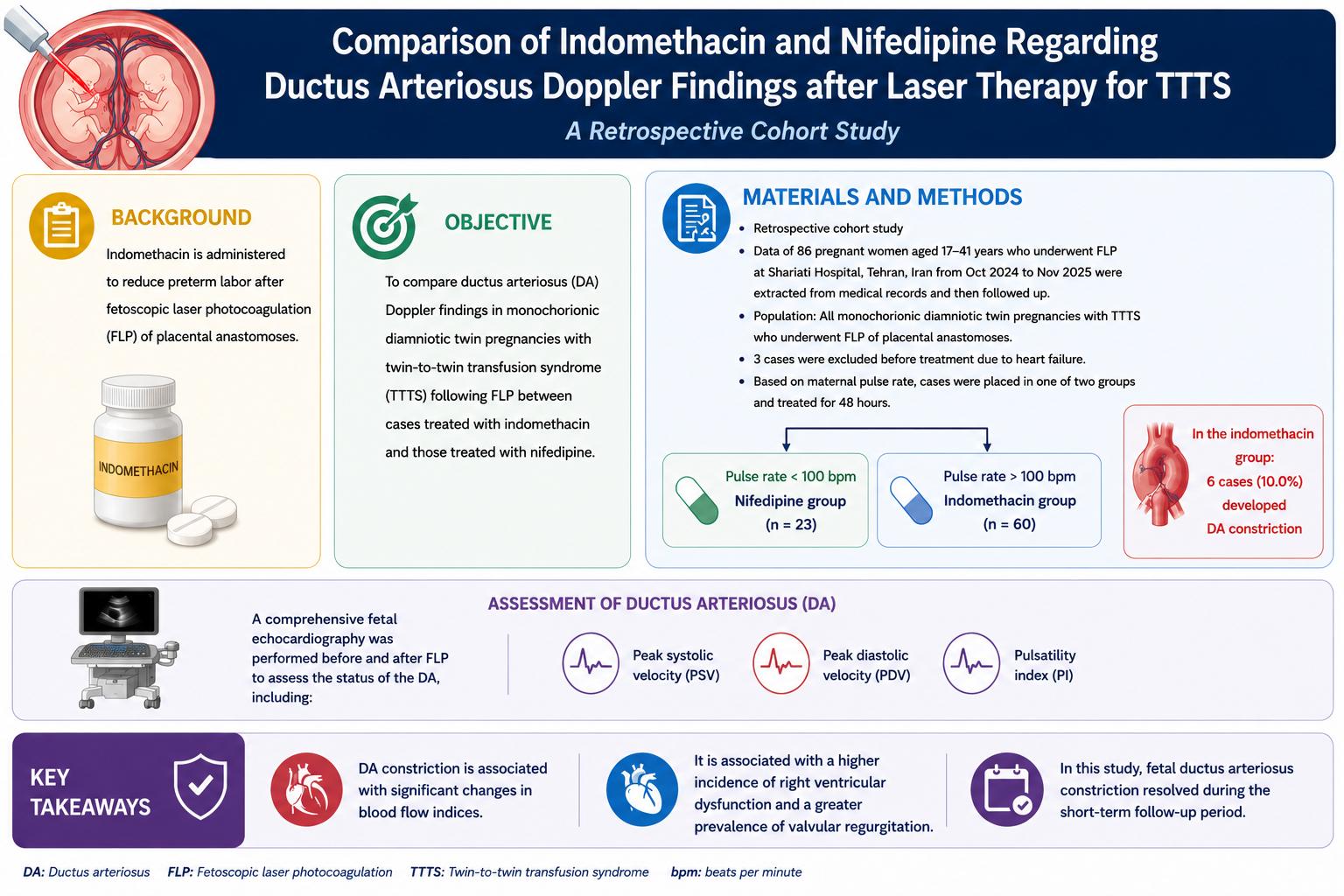
Background: Indomethacin is administered to reduce preterm labor after fetoscopic laser photocoagulation (FLP) of placental anastomoses.
Objective: To compare ductus arteriosus (DA) Doppler findings in monochorionic diamniotic twin pregnancies complicated by twin-to-twin transfusion syndrome following FLP between cases treated with indomethacin and those treated with nifedipine.
Materials and Methods: In this retrospective cohort study, data of 86 pregnant women aged 17-41 yr who underwent FLP in Shariati hospital, Tehran, Iran from October 2024-November 2025 were extracted from medical records and then followed up. In the study, based on pulse rate, the cases were placed in one of 2 groups: nifedipine (pulse rate < 100) and indomethacin (pulse rate > 100) for 48 hr. In cases receiving indomethacin, 6 cases developed DA constriction. A comprehensive fetal echocardiography was performed to assess the status of the DA before and after FLP.
Results: Peak systolic velocity was higher in both donor (145.7 ± 32.2, p = 0.012) and recipient twins (147.2 ± 23.6, p = 0.010) in the constricted group compared with the non-constricted groups. In recipient twins, end-diastolic velocity mean was also significantly increased (32.0 in the constricted, 19.9 in the indomethacin, and 18.7 in the nifedipine group, p = 0.012), while pulsatility index mean was significantly lower in the constricted group (1.8, 2.6, 2.5, respectively, p = 0.010).
Conclusion: DA constriction is associated with significant changes in blood flow indices, a higher incidence of right ventricular dysfunction, and a greater prevalence of valvular regurgitation. In this study, fetal DA constriction resolved during the short-term follow-up period.
Objective: To compare ductus arteriosus (DA) Doppler findings in monochorionic diamniotic twin pregnancies complicated by twin-to-twin transfusion syndrome following FLP between cases treated with indomethacin and those treated with nifedipine.
Materials and Methods: In this retrospective cohort study, data of 86 pregnant women aged 17-41 yr who underwent FLP in Shariati hospital, Tehran, Iran from October 2024-November 2025 were extracted from medical records and then followed up. In the study, based on pulse rate, the cases were placed in one of 2 groups: nifedipine (pulse rate < 100) and indomethacin (pulse rate > 100) for 48 hr. In cases receiving indomethacin, 6 cases developed DA constriction. A comprehensive fetal echocardiography was performed to assess the status of the DA before and after FLP.
Results: Peak systolic velocity was higher in both donor (145.7 ± 32.2, p = 0.012) and recipient twins (147.2 ± 23.6, p = 0.010) in the constricted group compared with the non-constricted groups. In recipient twins, end-diastolic velocity mean was also significantly increased (32.0 in the constricted, 19.9 in the indomethacin, and 18.7 in the nifedipine group, p = 0.012), while pulsatility index mean was significantly lower in the constricted group (1.8, 2.6, 2.5, respectively, p = 0.010).
Conclusion: DA constriction is associated with significant changes in blood flow indices, a higher incidence of right ventricular dysfunction, and a greater prevalence of valvular regurgitation. In this study, fetal DA constriction resolved during the short-term follow-up period.
Type of Study: Original Article |
Subject:
Perinatology
Send email to the article author
| Rights and permissions | |
 |
This work is licensed under a Creative Commons Attribution-NonCommercial 4.0 International License. |