
International Journal of
Reproductive Biomedicine
Mon, Sep 28, 2026
[Archive]
Volume 24, Issue 3 (March 2026)
IJRM 2026, 24(3): 257-264 |
Back to browse issues page



Ethics code: IR.SSU.MEDICINE.REC.1402.097


Download citation:
BibTeX | RIS | EndNote | Medlars | ProCite | Reference Manager | RefWorks
Send citation to:


BibTeX | RIS | EndNote | Medlars | ProCite | Reference Manager | RefWorks
Send citation to:
Nematollahi R, Samadi M, Montazeri F, Kalantar S M, Shams A. Endometrial expression of T-cell immunoreceptor with Ig and ITIM domains and cluster of differentiation 155: A case-control study of a novel immunomodulatory axis in endometriosis. IJRM 2026; 24 (3) :257-264
URL: http://ijrm.ir/article-1-3598-en.html
URL: http://ijrm.ir/article-1-3598-en.html


1- Department of Immunology, Faculty of Medicine, Shahid Sadoughi University of Medical Sciences, Yazd, Iran. & Abortion Research Center, Yazd Reproductive Sciences Institute, Shahid Sadoughi University of Medical Sciences, Yazd, Iran.
2- Department of Immunology, School of Medicine, Isfahan University of Medical Sciences, Isfahan, Iran.
3- Abortion Research Center, Yazd Reproductive Sciences Institute, Shahid Sadoughi University of Medical Sciences, Yazd, Iran.
4- Department of Immunology, Faculty of Medicine, Shahid Sadoughi University of Medical Sciences, Yazd, Iran. ,alis743@yahoo.com; Alishams@ssu.ac.ir
2- Department of Immunology, School of Medicine, Isfahan University of Medical Sciences, Isfahan, Iran.
3- Abortion Research Center, Yazd Reproductive Sciences Institute, Shahid Sadoughi University of Medical Sciences, Yazd, Iran.
4- Department of Immunology, Faculty of Medicine, Shahid Sadoughi University of Medical Sciences, Yazd, Iran. ,
Abstract: (488 Views)
Background: Endometriosis is a chronic inflammatory disorder affecting about 10% of females in their reproductive years, characterized by endometrial tissue growing outside the uterus. Immune checkpoints play a crucial role in regulating the immune system and preserving homeostasis. T-cell immunoreceptor with immunoglobulin and immunoreceptor tyrosine-based inhibitory motif domains (TIGIT), a newly discovered immune checkpoint, interacts with its ligand, cluster of differentiation 155 (CD155), to exert inhibitory effects on immune responses.
Objective: Though numerous studies have explored the immunological profile in endometriosis cases, limited information exists about the potential role of TIGIT/CD155 interaction.
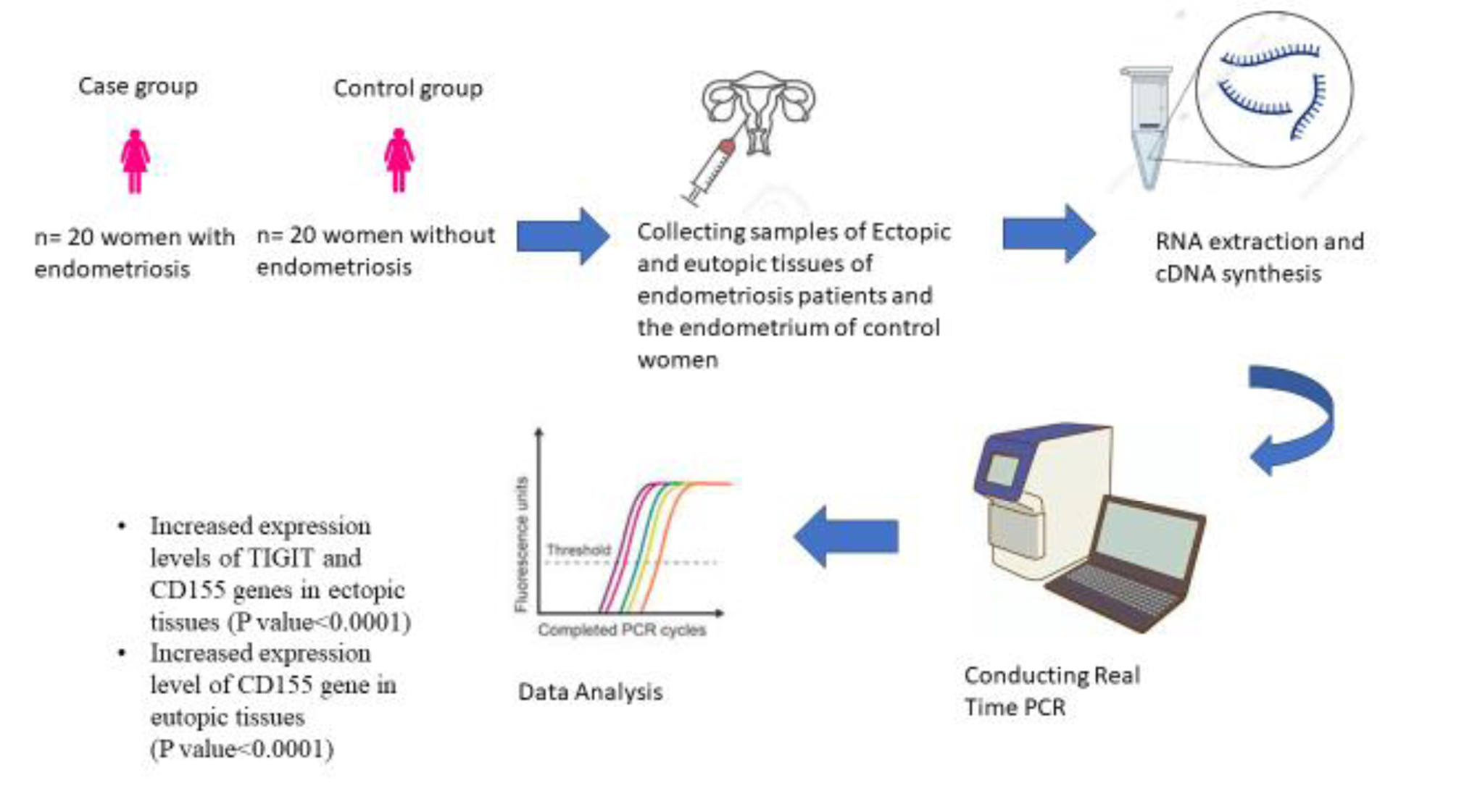
Materials and Methods: This case-control study aimed to investigate the expression levels of TIGIT and CD155 genes in ectopic and eutopic tissues of 20 women diagnosed with endometriosis by a gynecologist with laparoscopy compared to the endometrium of 20 women without endometriosis, using real-time polymerase chain reaction.
Results: Results showed that both TIGIT and CD155 gene expressions were significantly higher in ectopic endometrial tissues (p < 0.0001). CD155 is also upregulated in the eutopic endometrium of cases (p < 0.0001). However, no significant difference in TIGIT expression was observed between eutopic endometrium of cases and controls (p = 0.49).
Conclusion: These findings suggest an upregulation of the TIGIT/CD155 pathway in endometriosis, indicating its potential role in the disease's pathogenesis. Further research is necessary to fully understand this signaling pathway and explore its viability as a biomarker for diagnosis and immunotherapy.
Objective: Though numerous studies have explored the immunological profile in endometriosis cases, limited information exists about the potential role of TIGIT/CD155 interaction.
Materials and Methods: This case-control study aimed to investigate the expression levels of TIGIT and CD155 genes in ectopic and eutopic tissues of 20 women diagnosed with endometriosis by a gynecologist with laparoscopy compared to the endometrium of 20 women without endometriosis, using real-time polymerase chain reaction.
Results: Results showed that both TIGIT and CD155 gene expressions were significantly higher in ectopic endometrial tissues (p < 0.0001). CD155 is also upregulated in the eutopic endometrium of cases (p < 0.0001). However, no significant difference in TIGIT expression was observed between eutopic endometrium of cases and controls (p = 0.49).
Conclusion: These findings suggest an upregulation of the TIGIT/CD155 pathway in endometriosis, indicating its potential role in the disease's pathogenesis. Further research is necessary to fully understand this signaling pathway and explore its viability as a biomarker for diagnosis and immunotherapy.
Type of Study: Original Article |
Subject:
Reproductive Genetics
Send email to the article author
| Rights and permissions | |
 |
This work is licensed under a Creative Commons Attribution-NonCommercial 4.0 International License. |