
International Journal of
Reproductive Biomedicine
Tue, Sep 29, 2026
[Archive]
Volume 24, Issue 5 (May 2026)
IJRM 2026, 24(5): 403-412 |
Back to browse issues page



Ethics code: IR.ABZUMS.REC.1403.133


Download citation:
BibTeX | RIS | EndNote | Medlars | ProCite | Reference Manager | RefWorks
Send citation to:


BibTeX | RIS | EndNote | Medlars | ProCite | Reference Manager | RefWorks
Send citation to:
Baradaran Bagheri R, Hosseini S S, Hosseingholipour S, Mohammadian S. Does the transfer of a poor-quality embryo along with a good-quality embryo influence the intracytoplasmic sperm injectionembryo transfer outcomes? A cross-sectional study. IJRM 2026; 24 (5) :403-412
URL: http://ijrm.ir/article-1-3764-en.html
URL: http://ijrm.ir/article-1-3764-en.html


1- Department of Obstetrics and Gynecology, Alzahra Hospital, Tabriz University of Medical Sciences, Tabriz, Iran.
2- Department of Obstetrics and Gynecology, Faculty of Medicine, Kamali Infertility Center, Alborz University of Medical Sciences, Karaj, Iran.
3- Department of Obstetrics and Gynecology, Faculty of Medicine, Alborz University of Medical Sciences, Karaj, Iran. ,sabagpour@gmail.com; sabagpour@abzums.ac.ir
2- Department of Obstetrics and Gynecology, Faculty of Medicine, Kamali Infertility Center, Alborz University of Medical Sciences, Karaj, Iran.
3- Department of Obstetrics and Gynecology, Faculty of Medicine, Alborz University of Medical Sciences, Karaj, Iran. ,
Keywords: Infertility, Embryo quality, Intracytoplasmic sperm injection, Embryo transfer, Pregnancy outcome.
Full-Text [PDF 396 kb]
(412 Downloads)
| Abstract (HTML) (455 Views)
Full-Text: (52 Views)
1. Introduction
Infertility is one of the most controversial health issues for both men and women (1, 2). It is estimated that approximately 18% of couples experience some form of infertility (3, 4). It may affect many couples worldwide and lead them to use assisted reproductive technologies (5-7). In recent years, various methods have been developed to optimize fertility outcomes, including assisted reproductive technologies such as intracytoplasmic sperm injection (ICSI) (8-10). These advancements are designed not only to improve fertilization rates but also to boost the chances of successful implantation and a healthy pregnancy.
Various herbal supplements and lifestyle interventions have been investigated as complementary approaches to enhance fertility outcomes (11, 12). Measures such as weight management (13, 14), smoking cessation (15), and psychological stress management (16, 17) have been investigated. However, one of the key factors in in vitro fertilization is embryo selection, which determines the success of the methods used (18). In clinical practice, selecting the optimal embryo for transfer is straightforward when multiple high-quality embryos are available. However, the decision becomes challenging when the available cohort includes a mix of qualities, particularly when only one high-quality embryo exists alongside poorer-quality ones. This common scenario raises the question of whether transferring an additional poor-quality embryo is beneficial or detrimental. While some studies suggest that transferring additional, lower-quality embryos may not affect pregnancy success rates, others suggest that, under certain conditions, such transfers may help increase cumulative live birth rates (19-21).
This study aimed to evaluate the clinical outcomes of transferring low-quality and good-quality embryos during ICSI-embryo transfer (ET) cycles at Kamali hospital, Alborz University of Medical Sciences, Karaj, Iran in 2023. The innovation lies in directly comparing 3 distinct transfer strategies within the same clinical setting to provide evidence for a frequent, yet debated, clinical dilemma.
2. Materials and Methods
2.1. Study design and setting
In this cross-sectional study, data of 124 women undergoing ICSI-ET at Kamali hospital, Karaj, Iran from January to December 2023 were extracted from their medical records.
To compare pregnancy outcomes, participants were classified into 3 groups based on the quality of transferred embryos:
Infertility is one of the most controversial health issues for both men and women (1, 2). It is estimated that approximately 18% of couples experience some form of infertility (3, 4). It may affect many couples worldwide and lead them to use assisted reproductive technologies (5-7). In recent years, various methods have been developed to optimize fertility outcomes, including assisted reproductive technologies such as intracytoplasmic sperm injection (ICSI) (8-10). These advancements are designed not only to improve fertilization rates but also to boost the chances of successful implantation and a healthy pregnancy.
Various herbal supplements and lifestyle interventions have been investigated as complementary approaches to enhance fertility outcomes (11, 12). Measures such as weight management (13, 14), smoking cessation (15), and psychological stress management (16, 17) have been investigated. However, one of the key factors in in vitro fertilization is embryo selection, which determines the success of the methods used (18). In clinical practice, selecting the optimal embryo for transfer is straightforward when multiple high-quality embryos are available. However, the decision becomes challenging when the available cohort includes a mix of qualities, particularly when only one high-quality embryo exists alongside poorer-quality ones. This common scenario raises the question of whether transferring an additional poor-quality embryo is beneficial or detrimental. While some studies suggest that transferring additional, lower-quality embryos may not affect pregnancy success rates, others suggest that, under certain conditions, such transfers may help increase cumulative live birth rates (19-21).
This study aimed to evaluate the clinical outcomes of transferring low-quality and good-quality embryos during ICSI-embryo transfer (ET) cycles at Kamali hospital, Alborz University of Medical Sciences, Karaj, Iran in 2023. The innovation lies in directly comparing 3 distinct transfer strategies within the same clinical setting to provide evidence for a frequent, yet debated, clinical dilemma.
2. Materials and Methods
2.1. Study design and setting
In this cross-sectional study, data of 124 women undergoing ICSI-ET at Kamali hospital, Karaj, Iran from January to December 2023 were extracted from their medical records.
To compare pregnancy outcomes, participants were classified into 3 groups based on the quality of transferred embryos:
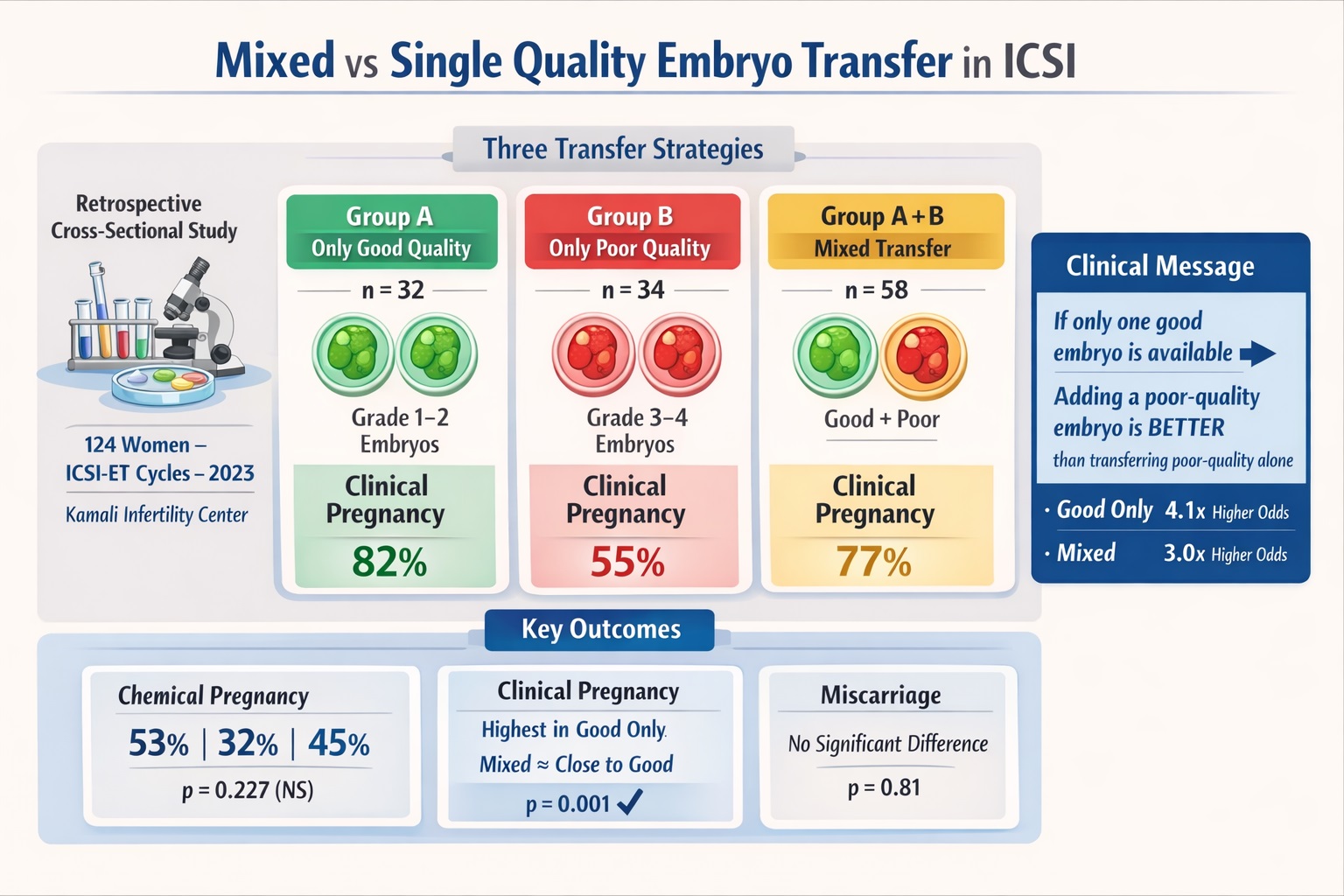
- Group 1 (A): received only high-quality embryos (grades 1 and 2) (n = 32).
- Group 2 (B): received only lower-quality embryos (grades 3 and 4) (n = 34).
- Group 3 (A + B): received a combination of high- and lower-quality embryos (n = 58).
This naturalistic grouping reflects real-world clinical decisions based on embryo availability.
2.2. Sample size
Sample size was determined using the statistical formula for comparing proportions in cohort studies. This calculation was performed according to the results of previous study, and using the Open Epi software (22).

n = required sample size in each group
Zα/2 = standard normal deviation corresponding to the 2-sided significance level (for α = 0.05, Zα/2 = 1.96)
Zβ = standard normal deviation corresponding to study power (for 80% power, Zβ = 0.84)
p1 = expected proportion of outcome in the exposed group
p2 = expected proportion of outcome in the unexposed group
The necessary parameters included the 2-sided significance level (95%), the power of the test (80%), the percentage of positive results in the unexposed group (6.3%) and the exposed group (34%), a 1:1 ratio between the sample sizes of the study groups, and the risk difference.
Accordingly, the required sample size was calculated to be 31 per group. The final group sizes were unequal due to the retrospective, non-randomized nature of the study and the distribution of available embryos in the clinic during the study period.
Participants were selected and assigned to different groups using a non-probability, accessible method.
The sample size was calculated a priori for a theoretical design with equal group sizes. However, in this retrospective study, the final group sizes were determined by the actual distribution of embryo quality among eligible women during the study period, resulting in unequal numbers.
2.3. Participants
Enrolled participants were studied in 3 groups based on the existence of transferable embryos during the ICSI treatment periods and according to clinical criteria and standard embryo grading.
In all groups, the embryos were examined for developmental stage and appearance, fragmentation percentage, multinucleation, and blastomeres size and symmetry, and embryos of the same type and quality were transferred on the third day. Embryos that were morphologically grades 1 and 2 were consistent with the day of development and were considered as favorable embryos or (A). Embryos of grades 3 and 4 or embryos with a delay in relation to the day of development were considered as weak embryos or (B). Informed consent was obtained from all participants. Group 1 included 32 participants with grade A embryos (grades 1 and 2 in accordance with the developmental day), group 2 included 34 female with grade B embryos (grades 3 and 4 or embryos that were not in accordance with the developmental day), and group 3 included 58 participants with a combination of grade A and B embryos (grades 1 and 2 with grades 3 and 4 embryos).
2.4. Eligibility criteria
Inclusion criteria included women aged ≤ 40 yr, body mass index 19-25, anti-Müllerian hormone > 1, and antral follicle count > 7. Exclusion criteria included uterine pathology, severe male problems (semen analysis, fever, sperm count < 5 million with < 10% motility or morphology < 4% Sperm DNA fragmentation assay, > 30 sperm from testicular tissue), having an underlying disease, taking medication, and women with fibroids, endometrial polyps, or hydrosalpinx. Untreated large ovarian cysts, difficult or tenaculum ET, transfer under anesthesia, not taking medication correctly, participants’ lack of cooperation in post-ET check-ups, lack of good quality embryos, and incomplete file information regarding ICSI results were considered.
2.5. Data collection
In this study, information about the ICSI process and clinical outcomes, including chemical pregnancy, clinical pregnancy, and miscarriage, was extracted from the participants’ medical records. Demographic information was also obtained from the participants' biographical notes.
2.6. Ethical Considerations
This study was conducted in accordance with the ethical principles outlined in the Declaration of Helsinki and was approved by the ethics committee of Alborz University of Medical Sciences, Karaj, Iran (Code: IR.ABZUMS.REC.1403.133). Confidentiality of participants’ data was maintained throughout the research process, and all data were anonymized to protect participants privacy.
2.7. Statistical Analysis
Statistical analyses were performed using SPSS software (Inc., Chicago, Illinois, USA), version 26. Variables were examined using both observational (histograms, probability plots) and analytical (Kolmogorov-Smirnov and Shapiro-Wilk tests) methods to determine whether they were normally distributed. Depending on the data distribution, continuous data were analyzed using Student's t test. The relationship between 2 categorical variables was analyzed using the Chi-square test. P < 0.05 was considered significant.
Given the observational design, multivariate binary logistic regression was also performed for key outcomes (clinical pregnancy and miscarriage) to adjust for potential confounders, including female age and body mass index. Results are presented as adjusted odds ratios (AOR) with 95% confidence intervals (CI).
3. Results
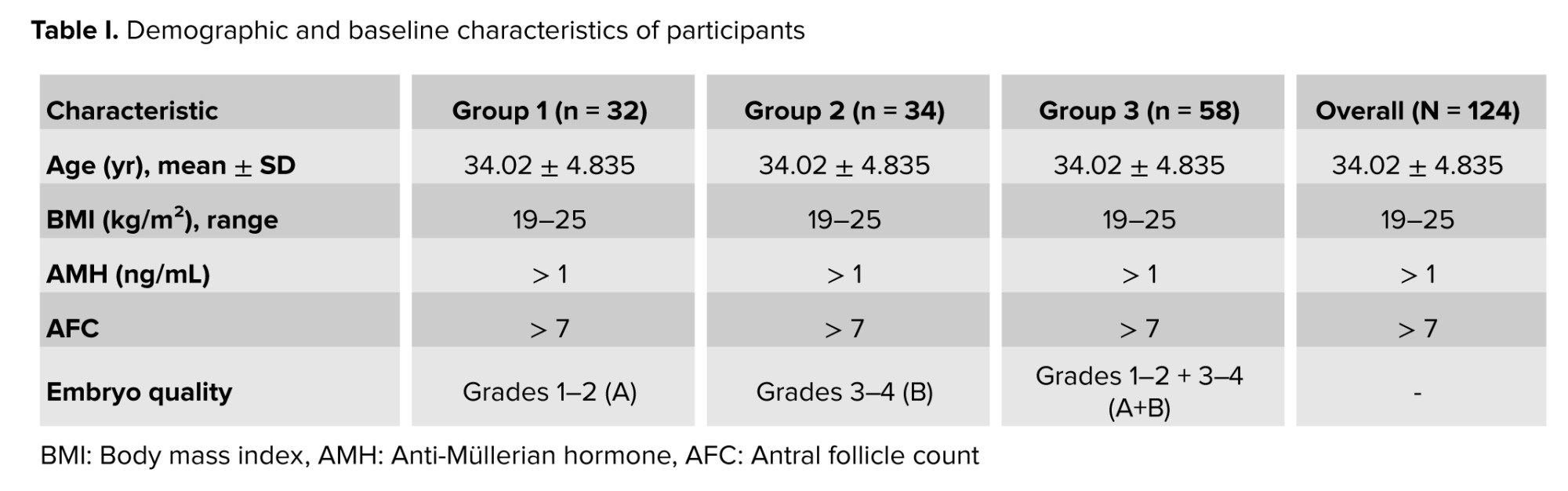
This study included 124 women undergoing ICSI-ET with a mean age of 34.02 ± 4.835 yr (range: 20-40). The demographic and clinical characteristics of the participants were comparable across the 3 study groups (Table I).
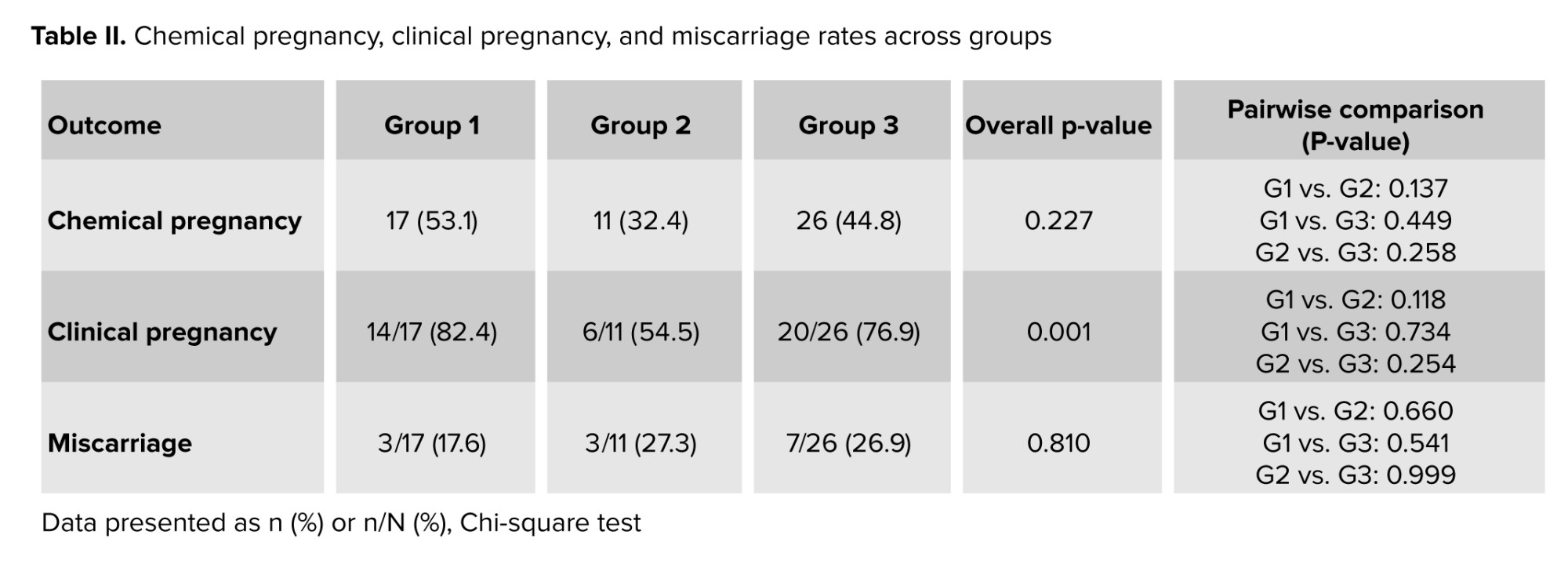
The chemical pregnancy rates (beta-human chorionic gonadotropin [β-hCG] positive) did not differ significantly between the groups (p = 0.227).
Among women with a positive β-hCG test, the clinical pregnancy rate was significantly different between groups (p = 0.001), with the highest rate observed in group 1 (only high-quality embryos).
The miscarriage rates among β-hCG-positive women showed no statistically significant difference between the 3 embryo quality groups (p = 0.81) (Table II).
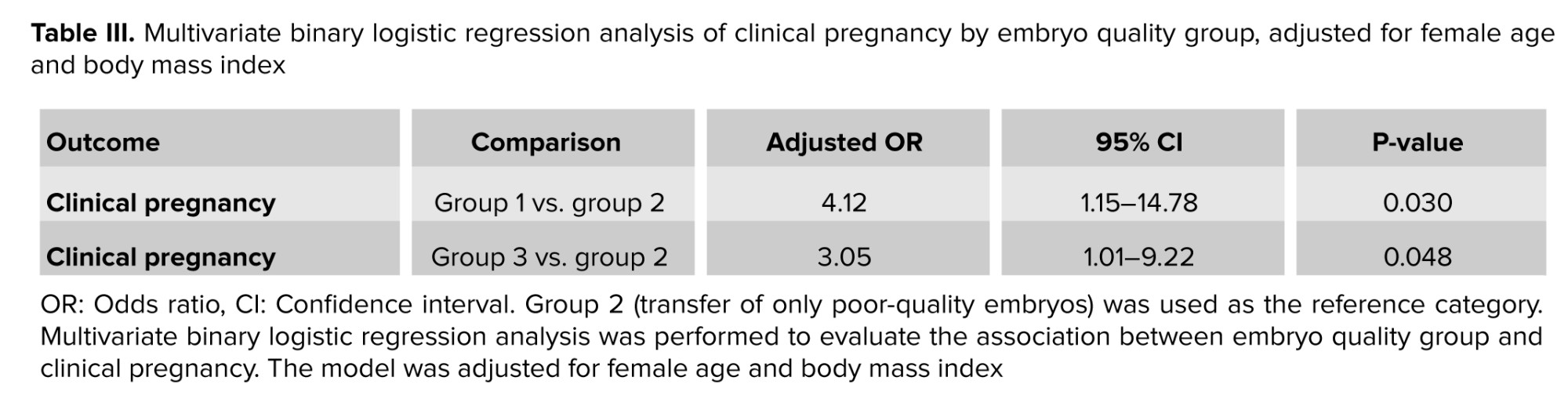
In an exploratory post-hoc analysis, multivariate logistic regression adjusting for female age and body mass index was performed. Compared to group 2 (only poor-quality embryos), the adjusted odds of achieving a clinical pregnancy were significantly higher in both group 1 (AOR: 4.12, 95% CI: 1.15-14.78, p = 0.030) and group 3 (AOR: 3.05, 95% CI: 1.01-9.22, p = 0.048) table III.
4. Discussion
The present study aimed to investigate the effect of transferring grade A and B embryos along with good-quality embryos on ICSI-ET outcomes at Kamali hospital, Alborz University of Medical Sciences, Karaj, Iran in 2023. This design addresses a common clinical question regarding optimal embryo selection when high-quality embryos are limited. In order to determine the effect of embryo quality on pregnancy, the study of chemical pregnancy rates by measuring β-hCG positivity in different groups showed that 53.1% of participants in group 1 (only grade A embryos) had chemical pregnancy and β-hCG positive, while this figure reached 32.4% in group 2, which included grade B embryos, and 44.8% in group 3 (combination of grade A and B embryos).
This difference observed was not significant at the p = 0.001 level. Also, in order to investigate the effect of embryo combination on clinical pregnancy rates as one of the key parameters in evaluating the success of assisted reproductive technology treatments, the study in different groups showed that in group 1, 82.4% of participants had clinical pregnancies, while in group 2, only 54.5%, and in group 3, 76.92% of participants had clinical pregnancies. P = 0.001 indicates that this difference is significant. Based on the findings, it appears that combining embryos of different qualities can significantly increase successfully in terms of clinical pregnancy compared to transferring a single low-quality embryo when access to high-quality embryos is limited. In this study, the highest miscarriage rate was observed in group 2 (grade B embryos only), and the lowest miscarriage rate in group 1 (grade A embryos only). Combining grade A and B embryos resulted in a miscarriage rate (26.9%) that was intermediate between the 2 groups. This difference between groups was not statistically significant (p = 0.81), meaning we cannot conclude that the mixed transfer strategy alters miscarriage risk. This finding could indicate a lower genetic or metabolic potential in low-grade embryos, which are more likely to be lost even if they implant successfully. Therefore, it can be concluded that the mere occurrence of an initial pregnancy does not guarantee its successful continuation and that the basic quality of the embryo, even after the onset of pregnancy, plays a decisive role in its stability.
The non-significant result for miscarriage (p = 0.81) should be interpreted with caution due to potential insufficient statistical power stemming from the modest and unequal sample sizes when analyzing this subgroup (β-hCG-positive women).
On comparing the results of different studies with ours, there are several patterns and differences that could be due to differences in methods, samples, and demographic characteristics. These findings are consistent with some previous investigations. One study similarly reported that transferring a poor-quality embryo alongside a good-quality one could increase clinical pregnancy and live birth rates in certain women populations (23). Also, in another study, the effect of transferring embryos of different quality (one good and one low-quality) on pregnancy outcomes was investigated. The results showed that, in blastocyst transfer subgroups, the groups that received 2 high-quality embryos had higher pregnancy and live birth rates (20). Comparison with our study shows that similar results can be observed in terms of the fact that embryo quality has a direct impact on pregnancy and live birth rates. However, the difference in the type of study (medical and demographic) and its timing could explain the differences in the results in our study. Also, the results of a study showed that adding a low-quality embryo to a good-quality blastocyst did not have a negative effect on the birth rate, and even increased the live birth rate in some groups (21). It is important to distinguish between statistical significance and clinical relevance. While the mixed-transfer strategy did not yield a statistically superior clinical pregnancy rate to the high-quality-only transfer, its rate (76.9%) was notably higher than that of the poor-quality-only group (54.5%) and approached that of the ideal group. This suggests a potential clinical benefit for women with limited high-quality embryos, although it is not a substitute for having 2 high-quality embryos.
4.1. Strengths and Limitations
One of the main limitations of this study is the limited sample size. Given that the number of participants in the study was relatively small, the statistical power to detect all significant differences between groups may not have been sufficient. The retrospective calculation of clinical pregnancy and miscarriage rates only from the β-hCG-positive subgroup, rather than from all transfer cycles, may introduce selection bias and limit the generalizability of these rates. Also, this study only evaluated the results of ET using ICSI and did not allow for comparison with other treatment methods. This may prevent a more complete understanding of the effects of embryo quality on different treatment methods and limit comparisons between methods. Another limitation of this study is its limited time period. This may not reflect the effects of seasonal or temporal factors on the results and may not reflect the long-term effects of combined transfers of embryos of different quality. Finally, the failure to control for some factors affecting pregnancy success, including the female's general health status, lifestyle, history of underlying diseases, and environmental factors, is another limitation of this study. Although we performed multivariate adjustments for age and body mass index, residual confounding from unmeasured variables is possible.
These variables can independently or interactively affect pregnancy outcomes, and their lack of careful monitoring may lead to confounding in data interpretation. Given the limitations of this study, it is suggested that future studies be conducted with a larger sample size and more careful control over these factors. Also, comparing the results of different treatment methods, such as in vitro fertilization and ICSI, can provide a better understanding of the impact of embryo quality on pregnancy outcomes.
Third, the sample sizes of the compared groups were unequal (32, 34, 58). This is an inherent feature of our retrospective, observational design, where participants were categorized based on the embryo types they actually received rather than being randomly allocated. The larger size of the mixed-transfer group (group 3) likely reflects its higher frequency in real-world clinical practice compared to the scenario of having only poor-quality embryos. While this limits the statistical power for direct comparisons, particularly involving the smaller group 2, it accurately represents the clinical distribution of cases.
5. Conclusion
This study suggests that embryo quality plays an important role in clinical pregnancy outcomes following ET. Transfers involving only high‑quality embryos were associated with higher clinical pregnancy rates compared with transfers involving only poor‑quality embryos. Moreover, the presence of at least one high‑quality embryo in combined transfers also appeared to improve the likelihood of achieving clinical pregnancy. These findings indicate that embryo morphological quality remains an important factor in predicting reproductive success. Although transfers including poor‑quality embryos may still result in pregnancy, the probability appears to be lower compared with cycles involving high‑quality embryos. Therefore, prioritizing the transfer of high‑quality embryos may enhance clinical pregnancy outcomes. However, given the exploratory nature of the adjusted analysis and the relatively limited sample size, further studies with larger populations are warranted to confirm these findings and better clarify the contribution of embryo quality to pregnancy success in assisted reproductive technologies.
Data Availability
Data supporting the findings of this study are available upon reasonable request from the corresponding author.
Author Contributions
R. Baradaran Bagheri: Writing, reviewing and editing of original draft, visualization, validation, investigation, data curation, conceptualization. S.S Hosseini: Visualization, validation, supervision, software, resources. S. Hosseingholipour: Writing, reviewing, and editing, of original draft, visualization, methodology. Sh. Mohammadian: Visualization, validation, resources, investigation. All authors critically revised the manuscript for important intellectual content, approved the final version, and accepted responsibility for the integrity of the work.
Acknowledgments
The authors of this manuscript express their sincere appreciation to the Deputy of Research and Technology of Alborz University of Medical Sciences, Karaj, Iran, and the Clinical Research Development Unit of Tabriz Valiasr hospital, Tabriz, Iran, for their continuous support and valuable assistance throughout this study. The authors also gratefully acknowledge the developers of the DeepSeek AI tool for their contribution to improving the quality of this manuscript.
Conflict of Interest
The authors declare that there is no conflict of interest.
2.2. Sample size
Sample size was determined using the statistical formula for comparing proportions in cohort studies. This calculation was performed according to the results of previous study, and using the Open Epi software (22).
n = required sample size in each group
Zα/2 = standard normal deviation corresponding to the 2-sided significance level (for α = 0.05, Zα/2 = 1.96)
Zβ = standard normal deviation corresponding to study power (for 80% power, Zβ = 0.84)
p1 = expected proportion of outcome in the exposed group
p2 = expected proportion of outcome in the unexposed group
The necessary parameters included the 2-sided significance level (95%), the power of the test (80%), the percentage of positive results in the unexposed group (6.3%) and the exposed group (34%), a 1:1 ratio between the sample sizes of the study groups, and the risk difference.
Accordingly, the required sample size was calculated to be 31 per group. The final group sizes were unequal due to the retrospective, non-randomized nature of the study and the distribution of available embryos in the clinic during the study period.
Participants were selected and assigned to different groups using a non-probability, accessible method.
The sample size was calculated a priori for a theoretical design with equal group sizes. However, in this retrospective study, the final group sizes were determined by the actual distribution of embryo quality among eligible women during the study period, resulting in unequal numbers.
2.3. Participants
Enrolled participants were studied in 3 groups based on the existence of transferable embryos during the ICSI treatment periods and according to clinical criteria and standard embryo grading.
In all groups, the embryos were examined for developmental stage and appearance, fragmentation percentage, multinucleation, and blastomeres size and symmetry, and embryos of the same type and quality were transferred on the third day. Embryos that were morphologically grades 1 and 2 were consistent with the day of development and were considered as favorable embryos or (A). Embryos of grades 3 and 4 or embryos with a delay in relation to the day of development were considered as weak embryos or (B). Informed consent was obtained from all participants. Group 1 included 32 participants with grade A embryos (grades 1 and 2 in accordance with the developmental day), group 2 included 34 female with grade B embryos (grades 3 and 4 or embryos that were not in accordance with the developmental day), and group 3 included 58 participants with a combination of grade A and B embryos (grades 1 and 2 with grades 3 and 4 embryos).
2.4. Eligibility criteria
Inclusion criteria included women aged ≤ 40 yr, body mass index 19-25, anti-Müllerian hormone > 1, and antral follicle count > 7. Exclusion criteria included uterine pathology, severe male problems (semen analysis, fever, sperm count < 5 million with < 10% motility or morphology < 4% Sperm DNA fragmentation assay, > 30 sperm from testicular tissue), having an underlying disease, taking medication, and women with fibroids, endometrial polyps, or hydrosalpinx. Untreated large ovarian cysts, difficult or tenaculum ET, transfer under anesthesia, not taking medication correctly, participants’ lack of cooperation in post-ET check-ups, lack of good quality embryos, and incomplete file information regarding ICSI results were considered.
2.5. Data collection
In this study, information about the ICSI process and clinical outcomes, including chemical pregnancy, clinical pregnancy, and miscarriage, was extracted from the participants’ medical records. Demographic information was also obtained from the participants' biographical notes.
2.6. Ethical Considerations
This study was conducted in accordance with the ethical principles outlined in the Declaration of Helsinki and was approved by the ethics committee of Alborz University of Medical Sciences, Karaj, Iran (Code: IR.ABZUMS.REC.1403.133). Confidentiality of participants’ data was maintained throughout the research process, and all data were anonymized to protect participants privacy.
2.7. Statistical Analysis
Statistical analyses were performed using SPSS software (Inc., Chicago, Illinois, USA), version 26. Variables were examined using both observational (histograms, probability plots) and analytical (Kolmogorov-Smirnov and Shapiro-Wilk tests) methods to determine whether they were normally distributed. Depending on the data distribution, continuous data were analyzed using Student's t test. The relationship between 2 categorical variables was analyzed using the Chi-square test. P < 0.05 was considered significant.
Given the observational design, multivariate binary logistic regression was also performed for key outcomes (clinical pregnancy and miscarriage) to adjust for potential confounders, including female age and body mass index. Results are presented as adjusted odds ratios (AOR) with 95% confidence intervals (CI).
3. Results
This study included 124 women undergoing ICSI-ET with a mean age of 34.02 ± 4.835 yr (range: 20-40). The demographic and clinical characteristics of the participants were comparable across the 3 study groups (Table I).
The chemical pregnancy rates (beta-human chorionic gonadotropin [β-hCG] positive) did not differ significantly between the groups (p = 0.227).
Among women with a positive β-hCG test, the clinical pregnancy rate was significantly different between groups (p = 0.001), with the highest rate observed in group 1 (only high-quality embryos).
The miscarriage rates among β-hCG-positive women showed no statistically significant difference between the 3 embryo quality groups (p = 0.81) (Table II).
In an exploratory post-hoc analysis, multivariate logistic regression adjusting for female age and body mass index was performed. Compared to group 2 (only poor-quality embryos), the adjusted odds of achieving a clinical pregnancy were significantly higher in both group 1 (AOR: 4.12, 95% CI: 1.15-14.78, p = 0.030) and group 3 (AOR: 3.05, 95% CI: 1.01-9.22, p = 0.048) table III.
4. Discussion
The present study aimed to investigate the effect of transferring grade A and B embryos along with good-quality embryos on ICSI-ET outcomes at Kamali hospital, Alborz University of Medical Sciences, Karaj, Iran in 2023. This design addresses a common clinical question regarding optimal embryo selection when high-quality embryos are limited. In order to determine the effect of embryo quality on pregnancy, the study of chemical pregnancy rates by measuring β-hCG positivity in different groups showed that 53.1% of participants in group 1 (only grade A embryos) had chemical pregnancy and β-hCG positive, while this figure reached 32.4% in group 2, which included grade B embryos, and 44.8% in group 3 (combination of grade A and B embryos).
This difference observed was not significant at the p = 0.001 level. Also, in order to investigate the effect of embryo combination on clinical pregnancy rates as one of the key parameters in evaluating the success of assisted reproductive technology treatments, the study in different groups showed that in group 1, 82.4% of participants had clinical pregnancies, while in group 2, only 54.5%, and in group 3, 76.92% of participants had clinical pregnancies. P = 0.001 indicates that this difference is significant. Based on the findings, it appears that combining embryos of different qualities can significantly increase successfully in terms of clinical pregnancy compared to transferring a single low-quality embryo when access to high-quality embryos is limited. In this study, the highest miscarriage rate was observed in group 2 (grade B embryos only), and the lowest miscarriage rate in group 1 (grade A embryos only). Combining grade A and B embryos resulted in a miscarriage rate (26.9%) that was intermediate between the 2 groups. This difference between groups was not statistically significant (p = 0.81), meaning we cannot conclude that the mixed transfer strategy alters miscarriage risk. This finding could indicate a lower genetic or metabolic potential in low-grade embryos, which are more likely to be lost even if they implant successfully. Therefore, it can be concluded that the mere occurrence of an initial pregnancy does not guarantee its successful continuation and that the basic quality of the embryo, even after the onset of pregnancy, plays a decisive role in its stability.
The non-significant result for miscarriage (p = 0.81) should be interpreted with caution due to potential insufficient statistical power stemming from the modest and unequal sample sizes when analyzing this subgroup (β-hCG-positive women).
On comparing the results of different studies with ours, there are several patterns and differences that could be due to differences in methods, samples, and demographic characteristics. These findings are consistent with some previous investigations. One study similarly reported that transferring a poor-quality embryo alongside a good-quality one could increase clinical pregnancy and live birth rates in certain women populations (23). Also, in another study, the effect of transferring embryos of different quality (one good and one low-quality) on pregnancy outcomes was investigated. The results showed that, in blastocyst transfer subgroups, the groups that received 2 high-quality embryos had higher pregnancy and live birth rates (20). Comparison with our study shows that similar results can be observed in terms of the fact that embryo quality has a direct impact on pregnancy and live birth rates. However, the difference in the type of study (medical and demographic) and its timing could explain the differences in the results in our study. Also, the results of a study showed that adding a low-quality embryo to a good-quality blastocyst did not have a negative effect on the birth rate, and even increased the live birth rate in some groups (21). It is important to distinguish between statistical significance and clinical relevance. While the mixed-transfer strategy did not yield a statistically superior clinical pregnancy rate to the high-quality-only transfer, its rate (76.9%) was notably higher than that of the poor-quality-only group (54.5%) and approached that of the ideal group. This suggests a potential clinical benefit for women with limited high-quality embryos, although it is not a substitute for having 2 high-quality embryos.
4.1. Strengths and Limitations
One of the main limitations of this study is the limited sample size. Given that the number of participants in the study was relatively small, the statistical power to detect all significant differences between groups may not have been sufficient. The retrospective calculation of clinical pregnancy and miscarriage rates only from the β-hCG-positive subgroup, rather than from all transfer cycles, may introduce selection bias and limit the generalizability of these rates. Also, this study only evaluated the results of ET using ICSI and did not allow for comparison with other treatment methods. This may prevent a more complete understanding of the effects of embryo quality on different treatment methods and limit comparisons between methods. Another limitation of this study is its limited time period. This may not reflect the effects of seasonal or temporal factors on the results and may not reflect the long-term effects of combined transfers of embryos of different quality. Finally, the failure to control for some factors affecting pregnancy success, including the female's general health status, lifestyle, history of underlying diseases, and environmental factors, is another limitation of this study. Although we performed multivariate adjustments for age and body mass index, residual confounding from unmeasured variables is possible.
These variables can independently or interactively affect pregnancy outcomes, and their lack of careful monitoring may lead to confounding in data interpretation. Given the limitations of this study, it is suggested that future studies be conducted with a larger sample size and more careful control over these factors. Also, comparing the results of different treatment methods, such as in vitro fertilization and ICSI, can provide a better understanding of the impact of embryo quality on pregnancy outcomes.
Third, the sample sizes of the compared groups were unequal (32, 34, 58). This is an inherent feature of our retrospective, observational design, where participants were categorized based on the embryo types they actually received rather than being randomly allocated. The larger size of the mixed-transfer group (group 3) likely reflects its higher frequency in real-world clinical practice compared to the scenario of having only poor-quality embryos. While this limits the statistical power for direct comparisons, particularly involving the smaller group 2, it accurately represents the clinical distribution of cases.
5. Conclusion
This study suggests that embryo quality plays an important role in clinical pregnancy outcomes following ET. Transfers involving only high‑quality embryos were associated with higher clinical pregnancy rates compared with transfers involving only poor‑quality embryos. Moreover, the presence of at least one high‑quality embryo in combined transfers also appeared to improve the likelihood of achieving clinical pregnancy. These findings indicate that embryo morphological quality remains an important factor in predicting reproductive success. Although transfers including poor‑quality embryos may still result in pregnancy, the probability appears to be lower compared with cycles involving high‑quality embryos. Therefore, prioritizing the transfer of high‑quality embryos may enhance clinical pregnancy outcomes. However, given the exploratory nature of the adjusted analysis and the relatively limited sample size, further studies with larger populations are warranted to confirm these findings and better clarify the contribution of embryo quality to pregnancy success in assisted reproductive technologies.
Data Availability
Data supporting the findings of this study are available upon reasonable request from the corresponding author.
Author Contributions
R. Baradaran Bagheri: Writing, reviewing and editing of original draft, visualization, validation, investigation, data curation, conceptualization. S.S Hosseini: Visualization, validation, supervision, software, resources. S. Hosseingholipour: Writing, reviewing, and editing, of original draft, visualization, methodology. Sh. Mohammadian: Visualization, validation, resources, investigation. All authors critically revised the manuscript for important intellectual content, approved the final version, and accepted responsibility for the integrity of the work.
Acknowledgments
The authors of this manuscript express their sincere appreciation to the Deputy of Research and Technology of Alborz University of Medical Sciences, Karaj, Iran, and the Clinical Research Development Unit of Tabriz Valiasr hospital, Tabriz, Iran, for their continuous support and valuable assistance throughout this study. The authors also gratefully acknowledge the developers of the DeepSeek AI tool for their contribution to improving the quality of this manuscript.
Conflict of Interest
The authors declare that there is no conflict of interest.
Type of Study: Original Article |
Subject:
Embryology
Send email to the article author
| Rights and permissions | |
 |
This work is licensed under a Creative Commons Attribution-NonCommercial 4.0 International License. |