International Journal of
Reproductive Biomedicine
Sat, Oct 24, 2026
[Archive]
Volume 24, Issue 4 (April 2026)
Int J Reprod BioMed. 2026, 24(4): 325-336 |
Back to browse issues page



Ethics code: IR.MODAREs.REC.1401.227


Download citation:
BibTeX | RIS | EndNote | Medlars | ProCite | Reference Manager | RefWorks
Send citation to:


BibTeX | RIS | EndNote | Medlars | ProCite | Reference Manager | RefWorks
Send citation to:
Shafieizade R, Hezavehei M, Shahverdi A, Halvaei I. Hydroxytyrosol protects sperm viability and DNA integrity in human asthenoteratozoospermia during incubation: An experimental study. Int J Reprod BioMed. 2026; 24 (4) :325-336
URL: http://ijrm.ir/article-1-3765-en.html
URL: http://ijrm.ir/article-1-3765-en.html

1- Department of Anatomical Sciences, Faculty of Medical Sciences, Tarbiat Modares University, Tehran, Iran.
2- Department of Embryology, Reproductive Biomedicine Research Center, Royan Institute for Reproductive Biomedicine, ACECR, Tehran, Iran.
3- Department of Embryology, Reproductive Biomedicine Research Center, Royan Institute for Reproductive Biomedicine, ACECR, Tehran, Iran., Royan Institute, No. 12, Royan Alley., Hafez St., Banihashem St., Shahid Soleimani Expwy. (Resalat Ave.), Tehran, Iran.
4- Department of Anatomical Sciences, Faculty of Medical Sciences, Tarbiat Modares University, Tehran, Iran. ,ihalvaei@modares.ac.ir
2- Department of Embryology, Reproductive Biomedicine Research Center, Royan Institute for Reproductive Biomedicine, ACECR, Tehran, Iran.
3- Department of Embryology, Reproductive Biomedicine Research Center, Royan Institute for Reproductive Biomedicine, ACECR, Tehran, Iran., Royan Institute, No. 12, Royan Alley., Hafez St., Banihashem St., Shahid Soleimani Expwy. (Resalat Ave.), Tehran, Iran.
4- Department of Anatomical Sciences, Faculty of Medical Sciences, Tarbiat Modares University, Tehran, Iran. ,
Abstract: (737 Views)
Background: Asthenoteratozoospermia (AT), marked by poor sperm motility and abnormal morphology, is a major cause of male infertility. During semen handling, AT samples generate high reactive oxygen species (ROS) levels, increasing oxidative stress and sperm damage.
Objective: This study investigated the effects of hydroxytyrosol (HT), a natural antioxidant, on sperm quality and ROS levels in AT samples during incubation.
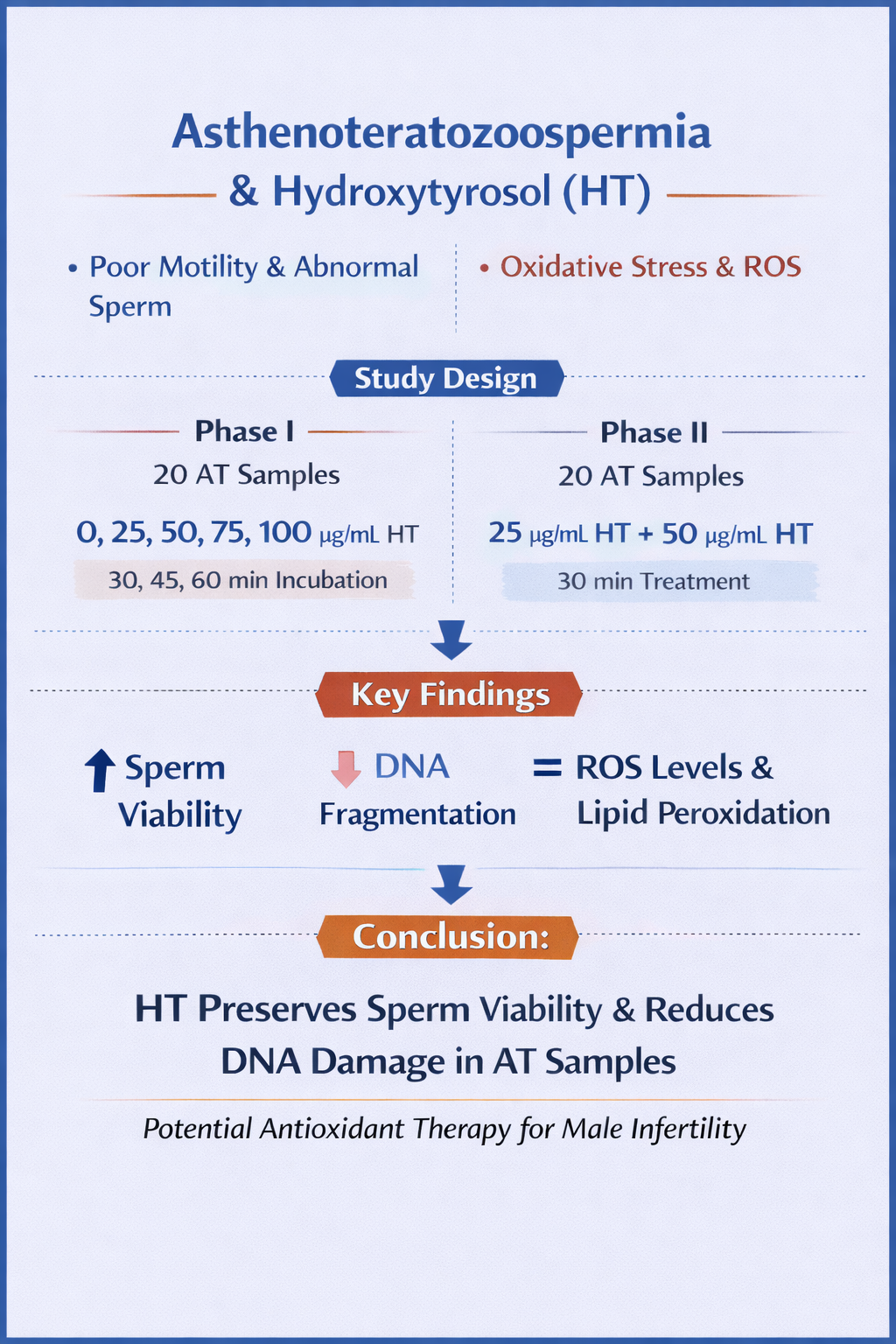
Materials and Methods: This experimental study was conducted in 2 phases. In phase I, 20 AT samples were divided into 5 groups (0, 25, 50, 75, and 100 μg/mL HT) and incubated for 30, 45, and 60 min to determine optimal conditions based on sperm motility and viability. In phase II, another 20 AT samples were treated with 25 and 50 μg/mL HT for 30 min. Sperm mitochondrial membrane potential, intracellular ROS, DNA fragmentation, and lipid peroxidation were evaluated.
Results: Sperm motility decreased after incubation; however, treatment with HT maintained motility, although the difference was not statistically significant. Similarly, sperm viability declined following incubation compared to the baseline. 25 μg/mL HT significantly preserves sperm viability after 30 min compared to 0 μg/mL HT (p = 0.02). Incubation significantly increased DNA fragmentation; however, at both 25 and 50 μg/mL HT, DNA fragmentation remained comparable to pre-incubation levels. No significant effects were observed on lipid peroxidation, ROS levels, or mitochondrial membrane potential.
Conclusion: Incubation of AT sperm with HT for 30 min preserved sperm viability and reduced DNA damage, suggesting that HT may serve as a beneficial antioxidant in assisted reproductive technologies for men with AT by minimizing oxidative stress-related sperm damage.
Objective: This study investigated the effects of hydroxytyrosol (HT), a natural antioxidant, on sperm quality and ROS levels in AT samples during incubation.
Materials and Methods: This experimental study was conducted in 2 phases. In phase I, 20 AT samples were divided into 5 groups (0, 25, 50, 75, and 100 μg/mL HT) and incubated for 30, 45, and 60 min to determine optimal conditions based on sperm motility and viability. In phase II, another 20 AT samples were treated with 25 and 50 μg/mL HT for 30 min. Sperm mitochondrial membrane potential, intracellular ROS, DNA fragmentation, and lipid peroxidation were evaluated.
Results: Sperm motility decreased after incubation; however, treatment with HT maintained motility, although the difference was not statistically significant. Similarly, sperm viability declined following incubation compared to the baseline. 25 μg/mL HT significantly preserves sperm viability after 30 min compared to 0 μg/mL HT (p = 0.02). Incubation significantly increased DNA fragmentation; however, at both 25 and 50 μg/mL HT, DNA fragmentation remained comparable to pre-incubation levels. No significant effects were observed on lipid peroxidation, ROS levels, or mitochondrial membrane potential.
Conclusion: Incubation of AT sperm with HT for 30 min preserved sperm viability and reduced DNA damage, suggesting that HT may serve as a beneficial antioxidant in assisted reproductive technologies for men with AT by minimizing oxidative stress-related sperm damage.
Keywords: Abnormal semen, Antioxidant, Incubation time, Oxidative stress, DNA integrity, Asthenoteratozoospermia.
Type of Study: Original Article |
Subject:
Assisted Reproductive Technologies
Send email to the article author
| Rights and permissions | |
 |
This work is licensed under a Creative Commons Attribution-NonCommercial 4.0 International License. |